




I Predicted Roku's Bounceback in 2025. Here's My Prediction for 2026.
Key Points
Entering 2025, Roku's valuation was reasonable relative to its growth and profitability.
The company's pricing in advertising needs to improve for the stock to perform better over the long term.
- 10 stocks we like better than Roku ›
Shares of connected-TV (CTV) platform company Roku (NASDAQ: ROKU) dropped a discouraging 19% in 2024, drastically underperforming the 23% gain for the S&P 500. But I was hopeful about the company's prospects for 2025. On Dec. 22, 2024, I wrote an article saying that Roku stock could bounce back.
Bounce back it did. Roku stock raced to a 46% gain in 2025, easily outpacing the market's gains. Granted, it's still down 78% from its all-time high all the way back in 2021. But it was a solid one-year performance to be sure.
Where to invest $1,000 right now? Our analyst team just revealed what they believe are the 10 best stocks to buy right now, when you join Stock Advisor. See the stocks »

Image source: Roku.
However, I'm a little less optimistic about Roku heading into 2026, and I believe it could underperform the S&P 500. So here's what went right in 2025 and what to watch in the coming year.
Why Roku stock bounced back
I thought Roku stock could bounce back because it had a favorable setup going into 2025: Growth was picking up, cash flow was gaining steam, and the valuation was reasonable.
Roku delivered strong growth in 2025 as hoped. The company has two revenue streams: platform and device. Device revenue has a negative gross margin, making platform revenue the more attractive stream of the two. Platform revenue was up 17%, 18%, and 17% in the first, second, and third quarters, respectively. Fourth-quarter results still haven't been reported.
Roku's cash flow steadily improved as well. To management's credit, operating expenses held steady in 2025, enabling higher profits as revenue climbed. In Q3, the company reported trailing 12-month free cash flow of $443 million, its highest in years.
Finally, Roku's price-to-sales (P/S) ratio had dropped below 3 at the start of 2025, which isn't a bad valuation for a business growing at a double-digit rate. With cash flow climbing and growth continuing, Roku's cheap valuation set it up nicely for its market-beating gains this past year, which is what happened.
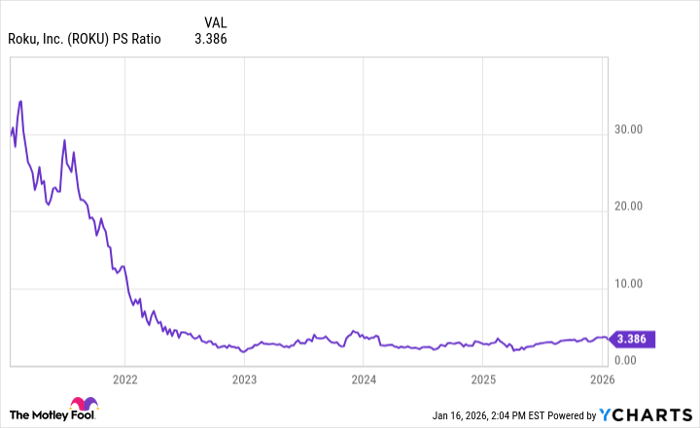
Data by YCharts.
Why I'm worried about Roku now
Personally, I moved on from Roku stock in 2025 after holding for years. The main concern I have about the business is monetization. In short, key growth metrics are great. But advertising isn't providing as big a lift as I believe it should.
To be clear, advertising is a large component of Roku's platform revenue. And the company has plenty of opportunities to advertise to viewers. Roku is reportedly approaching users in 100 million households. And active accounts streamed 36.5 billion hours of content in Q3.
According to Nielsen data, this is enough to have pushed viewing time on Roku above broadcast TV in July. That's incredible and certainly makes Roku hard to dismiss. But viewership is increasing faster than advertising revenue, suggesting that pricing is a problem.
Charlie Collier, President of Roku Media, recently said, "We don't have a supply issue" with regard to its advertising pricing. Well, the only other side of that equation is demand. In other words, there must be a demand issue: Advertisers don't seem to be clamoring for Roku's ad spots.
With Amazon making strides in advertising and with Walmart recently acquiring Vizio for its own CTV platform, I got tired of waiting for demand for Roku's ad slots to pick up.
Why I could be wrong about Roku
There may be some strategy behind Roku's current advertising pricing. Collier went on to point out that volume is important and that Roku "can price up and down the demand curve and use that to our advantage." So perhaps the current goal is to onboard advertisers at low prices to prove its value proposition.
Roku is indeed making big strides with onboarding. In recent months, the company has partnered with and deepened partnerships with many leading demand-side advertising platforms (DSPs), including Amazon and The Trade Desk. So perhaps it's still an issue of ramping advertising demand for long-term growth.
Roku is also enjoying growth in international markets. And those naturally have lower monetization rates and could overshadow the good progress the company is otherwise making.
I will say that if I'm wrong and advertising pricing improves in 2026 and beyond, then Roku stock has much more upside today. Big TV screens are attractive for advertisers, and Roku clearly has the viewership. If it proves its value proposition and drives a sudden surge in advertising demand, I believe Roku stock could reach new all-time highs in relatively short order.
Should you buy stock in Roku right now?
Before you buy stock in Roku, consider this:
The Motley Fool Stock Advisor analyst team just identified what they believe are the 10 best stocks for investors to buy now… and Roku wasn’t one of them. The 10 stocks that made the cut could produce monster returns in the coming years.
Consider when Netflix made this list on December 17, 2004... if you invested $1,000 at the time of our recommendation, you’d have $474,578!* Or when Nvidia made this list on April 15, 2005... if you invested $1,000 at the time of our recommendation, you’d have $1,141,628!*
Now, it’s worth noting Stock Advisor’s total average return is 955% — a market-crushing outperformance compared to 196% for the S&P 500. Don't miss the latest top 10 list, available with Stock Advisor, and join an investing community built by individual investors for individual investors.
See the 10 stocks »
*Stock Advisor returns as of January 20, 2026.
Jon Quast has no position in any of the stocks mentioned. The Motley Fool has positions in and recommends Amazon, Roku, and Walmart. The Motley Fool has a disclosure policy.
Recommended Articles


