


Canadian Dollar extends gains, Greenback falls on Greenland threats
- The Canadian Dollar drifted higher against the US Dollar amid rising geopolitical tensions.
- Broad-market weakness in the Greenback has pushed to the Loonie to two-week highs.
- Declining odds of BoC rate cuts is further supporting the CAD, while Crude Oil markets are dragging down bullish momentum.
The Canadian Dollar (CAD) caught a second straight leg higher against the US Dollar (USD) on Tuesday as markets extend their USD-negative flows following renewed threats from US President Donald Trump to force a sale of Greenland to the US. The Trump administration is vowing to impose further tariffs on key European Union members by February 1 if the EU doesn’t cut Greenland off from the Kingdom of Denmark, prompting threats of targeted counter-tariffs from the EU.
A repeat of last April’s geopolitical haze at the hands of Trump’s confusing, whiplash international policy goals has sparked a matching tumble in market confidence. Investor sentiment has crumbled in the US market segment, driving the US Dollar and American equities lower, while Gold prices and Treasury yields have jumped higher.
Daily digest market movers: Canadian Dollar gains ground on Greenland fears
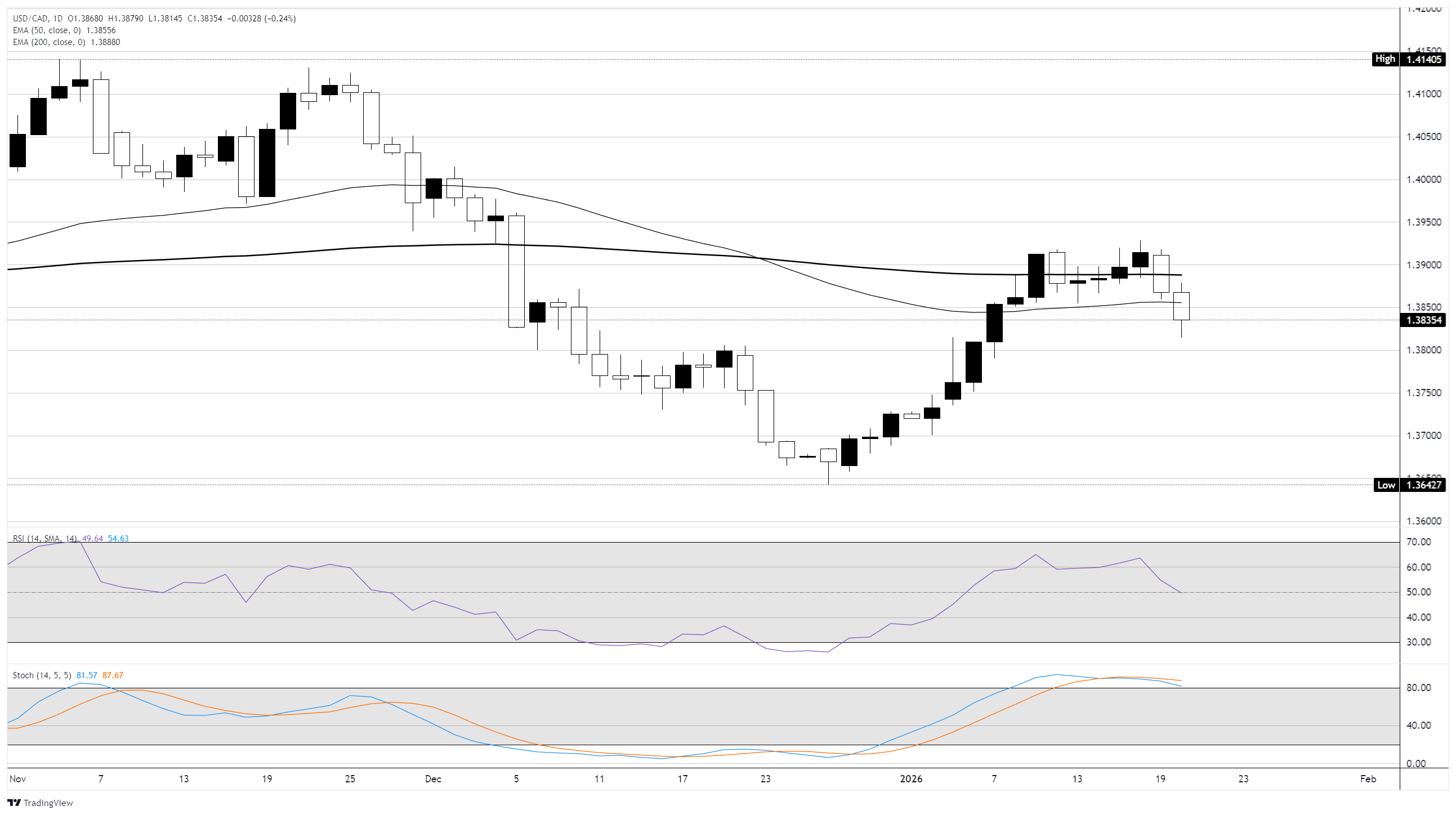
- Despite it only being Tuesday, the US Dollar is on pace for its worst weekly performance since June of last year. Down 0.76% in just two days, Greenback weakness has bolstered the Canadian Dollar to its highest bids against the USD in nearly two weeks, setting the stage for a medium-term reversal in the USD/CAD chart.
- Crude Oil prices remain subdued, limiting the Canadian Dollar’s bullish potential. However, following recent events in Venezuela, the potential for price shocks at the hands of continued Trump administration interference can’t be ruled out and could boost the Loonie even further.
- Geopolitical headlines remain the key driver for CAD markets as trade war fears on multiple fronts, including between the US and Canada directly, continue to simmer.
- Canadian Consumer Price Index (CPI) inflation data jumped on an annualized basis earlier this week, crimping expectations for near-term Bank of Canada (BoC) interest rate cuts, further supporting the CAD.
- Despite a broad-market shift away from the US Dollar on targeted single-market risk aversion, geopolitical dynamics could shift quickly if the Trump administration settles down, and could snap current momentum.
Canadian Dollar price forecast
The Canadian Dollar’s near-term bounce at the hands of a market-wide retreat from the US Dollar has punched a sharp rejection from the 200-day Exponential Moving Average (EMA) on the USD/CAD chart. Price action is barreling toward a retest of the 1.3800 handle, and a steeply overbought Stochastic Oscillator on daily chandlesticks is teasing heightened potential for further room to run as long as current market positioning holds.
USD/CAD daily chart
Canadian Dollar FAQs
The key factors driving the Canadian Dollar (CAD) are the level of interest rates set by the Bank of Canada (BoC), the price of Oil, Canada’s largest export, the health of its economy, inflation and the Trade Balance, which is the difference between the value of Canada’s exports versus its imports. Other factors include market sentiment – whether investors are taking on more risky assets (risk-on) or seeking safe-havens (risk-off) – with risk-on being CAD-positive. As its largest trading partner, the health of the US economy is also a key factor influencing the Canadian Dollar.
The Bank of Canada (BoC) has a significant influence on the Canadian Dollar by setting the level of interest rates that banks can lend to one another. This influences the level of interest rates for everyone. The main goal of the BoC is to maintain inflation at 1-3% by adjusting interest rates up or down. Relatively higher interest rates tend to be positive for the CAD. The Bank of Canada can also use quantitative easing and tightening to influence credit conditions, with the former CAD-negative and the latter CAD-positive.
The price of Oil is a key factor impacting the value of the Canadian Dollar. Petroleum is Canada’s biggest export, so Oil price tends to have an immediate impact on the CAD value. Generally, if Oil price rises CAD also goes up, as aggregate demand for the currency increases. The opposite is the case if the price of Oil falls. Higher Oil prices also tend to result in a greater likelihood of a positive Trade Balance, which is also supportive of the CAD.
While inflation had always traditionally been thought of as a negative factor for a currency since it lowers the value of money, the opposite has actually been the case in modern times with the relaxation of cross-border capital controls. Higher inflation tends to lead central banks to put up interest rates which attracts more capital inflows from global investors seeking a lucrative place to keep their money. This increases demand for the local currency, which in Canada’s case is the Canadian Dollar.
Macroeconomic data releases gauge the health of the economy and can have an impact on the Canadian Dollar. Indicators such as GDP, Manufacturing and Services PMIs, employment, and consumer sentiment surveys can all influence the direction of the CAD. A strong economy is good for the Canadian Dollar. Not only does it attract more foreign investment but it may encourage the Bank of Canada to put up interest rates, leading to a stronger currency. If economic data is weak, however, the CAD is likely to fall.
Recommended Articles


