


TradingKey 2025 Markets Recap & Outlook | Wall Street Bullish on 2026: S&P 500 Forecast at 8,000 with AI Gains and Cyclical Stocks Soaring

 Trending Articles
- Today’s Market Recap: US and Iran Signal Willingness to End Conflict, Three Major US Stock Indexes Surge, Dollar Ends Five-Day Winning Streak
- US-Iran Rift Persists, Will Gold Rise or Fall Next?
- Trump Withdrawal Intent Reshapes Liquidity, Bitcoin Breaks $68,000 Mark
- Gold rallies on hopes for US-Iran talks and falling US Treasury yields
- Gold Price Forecast: XAU/USD opens lower around $4,450 on fears of widening Iran conflicts
- USD/JPY Hits 160.00 Mark, Will Japanese Government Intervene? Will the Currency’s Rally Be Contained?

TradingKey - As 2025 draws to a close, the U.S. stock market has delivered a series of exciting and astonishing moments.
In early April, following President Trump's sudden announcement of tariff policies, the U.S. stock market's value evaporated by a staggering $6.6 trillion, with the S&P 500 index plummeting over 10% in two days and the VIX "fear index" surging above 50 for the first time since the pandemic. However, after Trump postponed the tariff implementation, driven by both the artificial intelligence (AI) boom and the Federal Reserve's initiation of an easing cycle, the total market capitalization of U.S. stocks continued to climb, now approaching the $70 trillion mark .
Throughout the year, the market grappled with concerns over a potential AI bubble while simultaneously witnessing the fervent rally in AI stocks. According to a JPMorgan Chase research report, the technology sector's return during the same period was nearly double that of the S&P 500 index. Despite ongoing macroeconomic uncertainties threatening market confidence, robust corporate earnings and AI-driven capital expenditures have continued to underpin the U.S. stock rally.
As 2026 approaches, major Wall Street banks remain confident about the outlook for U.S. equities, with an average forecast for the S&P 500 index reaching 7,500 points. Overall, Wall Street believes AI will remain the central theme for U.S. stock growth in the coming year, but it will be accompanied by high volatility. Furthermore, a subtle rotation of capital is occurring within U.S. equities, and cyclical stocks warrant continued attention.
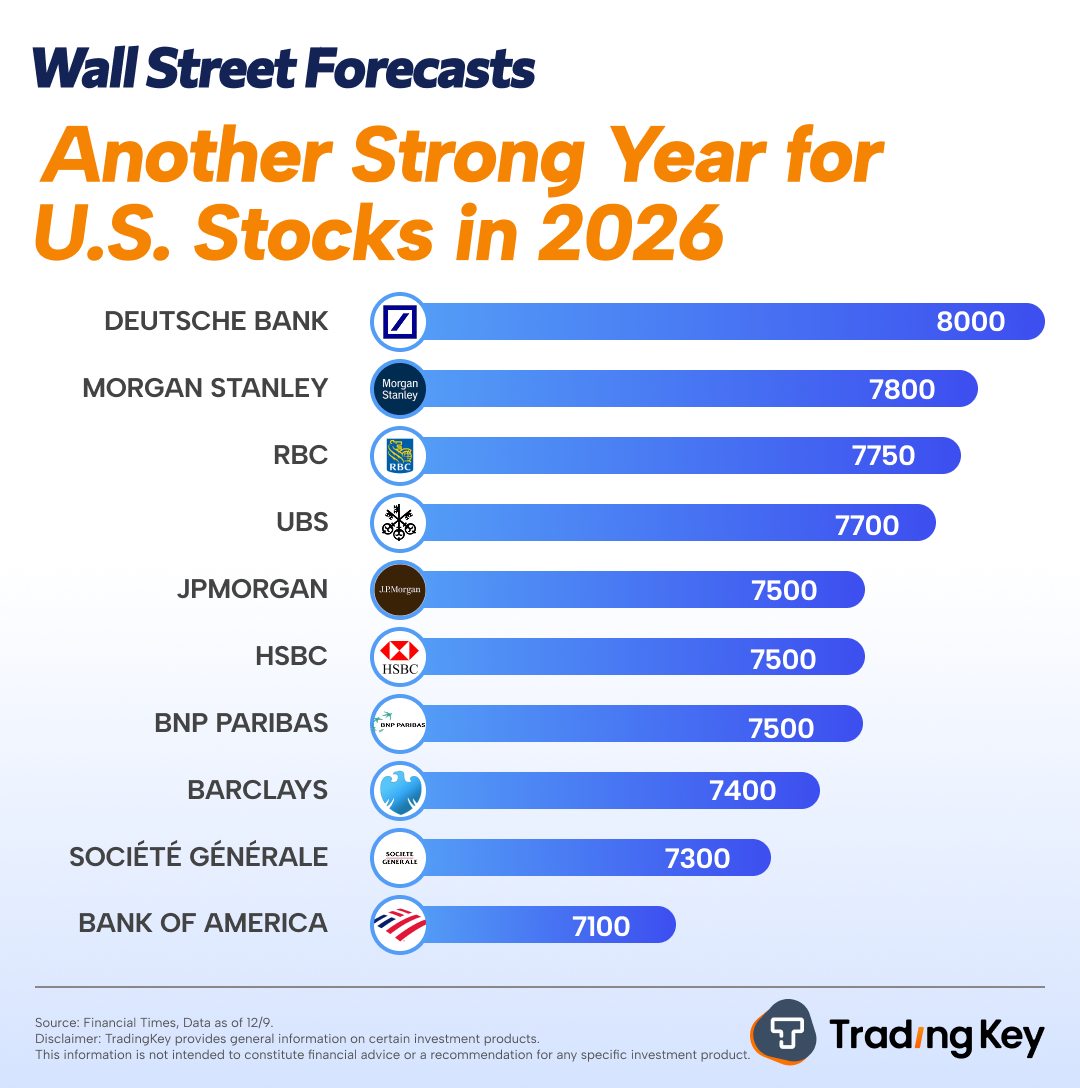
S&P 500 Targets 8000 Points: Is Wall Street Collective Bullish Sentiment Too Crazy?
According to a survey by the Financial Times, the average forecast from nine major investment banks for the S&P 500 index by the end of 2026 reached 7,500 points, as of the close on December 20, the index stood at 6,909.79 points, implying an upside potential of approximately 10% .
Among these, Deutsche Bank and Capital Economics, the most optimistic on U.S. stock growth, both provided a forecast of 8,000 points, while the most pessimistic, Bank of America, also projected 7,100 points, which is above current levels. Wall Street has reached a consensus regarding the upward trend of U.S. equities in 2026: improving trade relations, an unfinished easing cycle, ample market liquidity, sustained expansion in corporate earnings and business activity, and continuous growth in AI capital expenditures. Furthermore, Trump's "Beautiful Big Bill" is expected to deliver $129 billion in corporate tax cuts. These factors are poised to support continued gains in U.S. stocks; however, negative factors also exist, such as market concerns about an AI bubble and valuations. Nevertheless, Wall Street's optimistic forecasts suggest that fears of an AI bubble will not prevail for now.
S&P 500 Index Forecasts from Major Investment Banks
Investment Bank | S&P 500 Forecast |
Bank of America | 7,100 points |
Societe Generale | 7,300 points |
Barclays | 7,400 points |
CFRA | 7,400 points |
UBS | 7,500 points |
HSBC | 7,500 points |
JPMorgan Chase | 7,500 points |
Yardeni | 7,700 points |
Royal Bank of Canada (RBC) | 7,750 points |
Morgan Stanley | 7,800 points |
Wells Fargo | 7,800 points |
Deutsche Bank | 8,000 points |
Capital Economics | 8,000 points |
However, Wall Street's current optimism for U.S. stocks in 2026 has also sparked concerns among some market participants. According to Bloomberg data, the S&P 500 index forecasts from major institutions are currently within their tightest range in nearly a decade. In response, some analysts suggest that such "clustering" of forecasts indicates that market expectations are already fully priced in, making these predictions fragile and the market more sensitive to negative news.
It is worth noting, however, that investment banks' optimistic forecasts for U.S. stocks are, in fact, a customary practice on Wall Street. Based on an average forecast of 7,500 points, the projected 10% gain is not only lower than the 16% gain observed year-to-date in 2025, but also below the average gain of the past decade (using 2026 as the benchmark). Between 2016 and 2025, the S&P 500 only experienced declines in 2018 and 2022, with gains in all other years exceeding 11%, and four of those years seeing increases greater than 20%. Compared to the stock market volatility of the past decade, Wall Street's forecast of a 10% gain for the S&P 500 index in 2026 is not aggressive.
S&P 500 Forecast Set to 8,000 Points: Is Wall Street's Bullish Consensus Too Optimistic?
AI is the core engine for growth in the US stock market in 2025. At the individual stock level, Nvidia became the first company to break through a $5 trillion market capitalization; other companies in the AI industry chain, such as Micron Technology, Broadcom, and Palantir, also broadly benefited. Oracle, which transitioned from a database company to an AI infrastructure provider, saw its shares surge 40% in a single day, adding $270 billion to its market cap, due to a massive AI contract with OpenAI, briefly making founder Larry Ellison the world's richest person.
'The ultimate frontier of AI is energy,' and as tech giants race to build AI data centers, the energy sector has also experienced explosive growth. Nuclear power newcomer Oklo has surged over 280% this year, while Bloom Energy's shares have risen by nearly 300%.
From a broader macroeconomic perspective, AI giants have become the most crucial support for the US stock market. According to Bloomberg data, approximately 40% of the S&P 500's total return was solely due to Nvidia, Broadcom, Google, Microsoft, and Palantir. Their significant contribution.
Despite the overall market rally, this year's US stock market has experienced high volatility, which cannot be overlooked. In October, the Nasdaq Composite and S&P 500 reached new all-time highs, and Nvidia also hit a record, surpassing a $5 trillion market cap. However, a sharp correction followed in November. During that month, the Nasdaq's maximum decline reached 8.8%, Nvidia fell 12.6% for the entire month, and data center provider CoreWeave's stock dropped over 60%. Concerns about an AI bubble were cited as the reason for this temporary market pullback.
However, a Bank of America survey indicated that while fund managers view the AI bubble as the top risk, the fear of missing out (FOMO) on the bull market is equally strong. This dynamic likely explains the high volatility observed in the US stock market this year. Wall Street strategists believe that this high volatility, characterized by the coexistence of significant sell-offs and rapid reversals, is highly likely to persist into 2026.
While sustained high volatility is expected, major Wall Street institutions generally still believe that the logic of an AI-driven bull market will also hold true in 2026.
JPMorgan stated that the Fear of Becoming Obsolete (FOBO) is replacing FOMO, driving the next wave of AI capital expenditures. This sentiment implies that even amid macroeconomic headwinds, tightening credit conditions, and market concerns over elevated valuations, companies cannot afford to slow down their AI investments. Influenced by shortages in computing power, energy infrastructure, and data center capacity, coupled with more aggressive investment commitments from businesses, JPMorgan forecasts that corporate AI spending in 2026 will once again surpass market expectations.
Despite ongoing market concerns about a bubble and high current valuations, JPMorgan believes that these valuations are reasonable, reflecting better-than-expected corporate earnings growth, the AI capital expenditure boom, enhanced shareholder returns, and more accommodative fiscal and monetary policies. Furthermore, the profit increases from deregulation and AI-driven productivity improvements remain underestimated by the market .
Goldman Sachs also emphasized the unlikelihood of an AI bubble burst, asserting that the current tech stock frenzy is not a pre-burst bubble. Compared to the Dot-com bubble of 2000, current tech giants boast stronger balance sheets and cash flows.
AI Intensifies K-shaped Differentiation: The Strong Get Stronger, Winner Takes All
While predicting that AI stocks will remain strong, Goldman Sachs also stated that the benefits of AI will extend beyond tech giants to a wider range of industries, particularly those capable of leveraging AI to boost profit margins and productivity. However, this does not mean that the benefits of AI will be broadly distributed. JPMorgan noted that as the AI theme continues to grow, the decoupling of the S&P 500 from the so-called "old economy" will become more pronounced, with AI acting as a catalyst for K-shaped growth.
K-shaped growth refers to different sectors exhibiting diverging, opposite trends, much like the two arms of the letter "K." The sectors distinguished by AI are, therefore, stocks benefiting from AI and "old economy" sectors being phased out by the AI era.
This divergence is evident, in part, in market capitalization. A research report published by JPMorgan shows: The "AI 30" stocks currently account for 44% of the S&P 500's market capitalization (with the MAG7 and Broadcom collectively accounting for 39%), significantly higher than 26% when ChatGPT was launched in late 2022. This concentration has also reached an all-time high, surpassing the historical peak during the "Nifty 50" era in the early 1970s.
In response to this, market voices questioning excessive concentration suggest that concerns about an AI bubble could indiscriminately impact related stocks. However, JPMorgan stated that this concentration is different from previous periods, primarily focused on high-quality growth stocks. These companies typically possess strong profit margins, and their cash flows and balance sheets demonstrate resilience even when facing shocks. Furthermore, when new opportunities arise, these stocks are often able to deploy capital on a large scale, thereby perpetuating a "winner-take-all" dynamic.
Within the AI sector itself, K-shaped divergence is also occurring. Goldman Sachs noted that the stock correlation among the five major AI hyperscalers (Microsoft, Google, Amazon, Meta, and Oracle) has plummeted from 80% to 20%. In short, the stocks of these companies no longer rise and fall in tandem. Previously, during the AI frenzy, capital indiscriminately flowed into these AI giants. However, the market is now beginning to differentiate based on individual stock characteristics, opting to "vote with their feet."
This series of divergences will mean that by 2026, AI will not only serve as the core engine for U.S. equity growth but also reshape the market landscape. While the market grows overall, capital will flow towards the true beneficiaries of the AI market. Based on this forecast, Goldman Sachs recommends diversifying allocations within the technology sector to achieve superior risk-adjusted returns.
U.S. Stock Rotation Underway: Are Cyclical and Small-Cap Stocks Ready to Take Off?
According to Wall Street forecasts, it is almost a foregone conclusion that AI will continue to dominate the U.S. stock market in 2026. However, at the same time, strategists from several major Wall Street banks have also put forward completely contrary advice: that investment portfolios in 2026 should focus more on traditional sectors such as healthcare, industrials, and energy.
In early December, reports from publications such as Barron's and The Wall Street Journal all mentioned a phenomenon: since the sharp correction in U.S. stocks on November 20th, the rally in small-cap stocks has significantly outpaced the MAG7, indicating that investors are shifting from tech giants to cyclical stocks, small-cap stocks, and other sectors.
Another strong piece of evidence is that since November 20th, the S&P 500 Equal Weight Index, which better reflects market breadth, has also outperformed its market-cap-weighted counterpart. In the Equal Weight Index, all 500 constituent stocks have a 0.2% weighting, preventing larger market-cap stocks from having a disproportionately higher impact. This suggests that capital is beginning to flow from the MAG7 to the remaining stocks, a phenomenon dubbed “The Great Rotation.”
The rotation is occurring, on the one hand, due to concerns about the high valuations of AI giants. However, this does not imply that investment banks are bearish on the AI sector. Goldman Sachs states that the market is only just nearing "the end of the prologue" for AI investments. As K-shaped divergence begins to filter the AI sector, the era of blindly picking AI stocks and expecting easy returns is over. The future AI sector will be dominated by a select few winners who can truly convert AI hype into tangible profits. In other words, current AI investments demand stronger active management and stock-picking capabilities from investors.
Another reason for the rotation is that capital is seeking sectors with more reasonable valuations and a greater ability to benefit from macroeconomic improvements. sectors.
Goldman Sachs forecasts that, driven by easing financial conditions and fiscal policies from the 'Beautiful Big Bill', U.S. GDP growth in 2026 will exceed market expectations, reaching 2.5%. The prospect of accelerating economic growth typically favors cyclical stocks, which are stocks sensitive to the economic cycle. Despite the strong recent performance of cyclical stocks, the growth expectations reflected in market pricing remain low, indicating significant upside potential for this type of equity.
Bank of America, meanwhile, expects 2026 to be a pivotal year for U.S. equities, marking a shift from the 'virtual economy' back to the 'real economy'. In contrast to asset-light, high-margin tech giants, capital-intensive industrials and manufacturing sectors, which bear high compliance costs, will benefit more from policy dividends such as corporate tax reductions and regulatory easing. Compared to tech giants heavily reliant on global markets, industrials and manufacturing also stand to gain more from "America First" trade policies due to more stable policy expectations. Therefore, Bank of America anticipates greater tailwinds for the domestic real economy in 2026, leading to a market shift from tech giants to industrial and commodities giants.
Citi, for its part, is bullish on financials and healthcare stocks, as both sectors have relatively lagged in 2025, offering valuation advantages. The current easing cycle is conducive to healthy profit margins for the banking sector, while the healthcare sector will benefit from diminishing policy uncertainties.
Read more
* The content presented above, whether from a third party or not, is considered as general advice only. This article should not be construed as containing investment advice, investment recommendations, an offer of or solicitation for any transactions in financial instruments.


