




1 Dirt Cheap Artificial Intelligence (AI) Semiconductor Stock to Buy Hand Over Fist Before It Joins the $2 Trillion Club in 2026
Key Points
Taiwan Semi plays an enormous role behind the scenes in the world of artificial intelligence (AI) development.
Hyperscalers are planning to increase AI infrastructure spending in 2026, which bodes well for the chip industry.
Taiwan Semi's valuation looks compelling for growth investors seeking a good deal in an otherwise frothy market.
- 10 stocks we like better than Taiwan Semiconductor Manufacturing ›
When it comes to leading semiconductor stocks, most investors probably don't bother looking past Nvidia, Advanced Micro Devices, and Broadcom. These three powerhouses dominate the market for AI accelerators -- graphics processing units (GPU) and custom application-specific integrated circuits (ASICs) used to develop generative AI.
While investing in chip designers has been a good proxy for the overall health of the AI landscape, a more lucrative opportunity might be hiding in plain sight. As the world's largest chip manufacturer by revenue, Taiwan Semiconductor Manufacturing (NYSE: TSM) plays an enormous role in ensuring AI chips make into data centers on time.
Where to invest $1,000 right now? Our analyst team just revealed what they believe are the 10 best stocks to buy right now, when you join Stock Advisor. See the stocks »
One of my predictions for 2026 is that Taiwan Semi will be the next member of the trillion-dollar club to reach a $2 trillion valuation. Let's unpack how TSMC can reach this milestone and assess why the stock looks like a no-brainer buy right now.

Image source: Taiwan Semiconductor Manufacturing.
What would it take for Taiwan Semi to reach a $2 trillion valuation?
Currently, Taiwan Semi has a market cap of $1.7 trillion -- making it one of the most valuable companies in the world. In order to reach a $2 trillion valuation, shares of TSMC would need to rise by another 18% this year -- or about $380 per share. Considering the stock has rallied 62% over the last 12 months, joining Amazon in the $2 trillion club looks attainable. Let's take a look at some of the company's tailwinds that support further valuation expansion.
How TSMC can dominate in 2026 and beyond
Throughout the AI revolution, hyperscalers including Alphabet, Microsoft, Meta Platforms, and Amazon have each accelerated their investments in AI capital expenditures (capex).

GOOGL Capital Expenditures (Quarterly) data by YCharts
According to consensus estimates from FactSet Research, Wall Street is expecting the hyperscalers to spend $527 billion on AI infrastructure in 2026 -- up 13% from previously issued forecasts at the beginning of the third quarter.
Taking this a step further, McKinsey & Company estimates that $5 trillion will be spent on supporting AI workloads by 2030. Translation: Appetite for training and inference (i.e., more chips) is expected to grow and accelerate among AI's largest developers for the next several years.
The obvious winners of the AI infrastructure era are companies like Nvidia, AMD, Broadcom, and Micron Technology. But behind the scenes, many of these companies are relying on Taiwan Semi to manufacture their chips in order to fulfill expanding backlog orders.
TSMC is already getting ahead of the curve as it relates to ratcheting up its foundry capabilities. The company is expanding its geographic footprint beyond Taiwan -- in particular, setting up facilities in Japan and Germany. Perhaps more importantly, however, TSMC is also considering a $300 billion expansion to its existing $165 billion infrastructure project in Arizona.
By diversifying its manufacturing expertise and doubling down on its relationship with the U.S., I think Taiwan Semi is positioning itself for even stronger relationships with its major customers. As such, I think the company is poised to continue commanding a high degree of pricing power over the competition -- fueling even further acceleration across the top line complemented by expanding profit margins.
Should you buy Taiwan Semi stock right now?
Taiwan Semi's forward price-to-earnings (P/E) multiple of 24 may not appear "cheap" upon first glance.
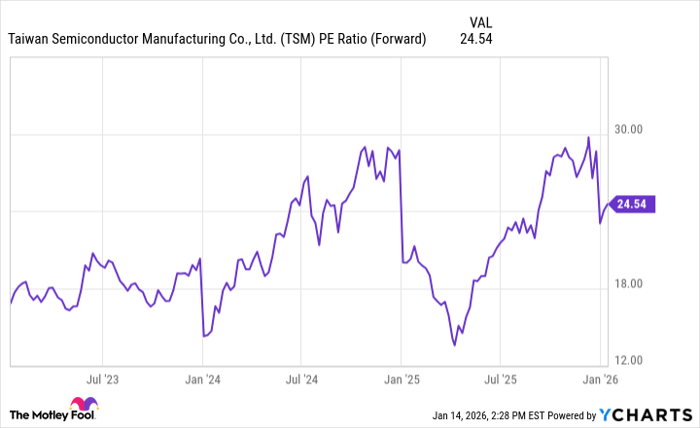
TSM PE Ratio (Forward) data by YCharts
The subtle nuance from the chart above is that the company is trading about 22% below its peak forward earnings levels. According to consensus estimates, sell-side analysts are anticipating TSMC to generate $13.26 in earnings per share (EPS) in 2026.
At its peak forward P/E of 30, TSMC could reach $390 per share assuming it meets analysts' earnings expectations. I think this is more than reasonable, as should the company reach or surpass these estimates, I would not be surprised to see the stock experience a meaningful rebound and propel well past a $2 trillion valuation.
To me, Taiwan Semi is one of the best examples of a pick-and-shovel opportunity tailor-made for the AI infrastructure chapter. With this in mind, I view TSMC as one of the most reasonably priced and safest AI chip stocks on the market right now relative to its growth prospects for this year and beyond.
Should you buy stock in Taiwan Semiconductor Manufacturing right now?
Before you buy stock in Taiwan Semiconductor Manufacturing, consider this:
The Motley Fool Stock Advisor analyst team just identified what they believe are the 10 best stocks for investors to buy now… and Taiwan Semiconductor Manufacturing wasn’t one of them. The 10 stocks that made the cut could produce monster returns in the coming years.
Consider when Netflix made this list on December 17, 2004... if you invested $1,000 at the time of our recommendation, you’d have $474,578!* Or when Nvidia made this list on April 15, 2005... if you invested $1,000 at the time of our recommendation, you’d have $1,141,628!*
Now, it’s worth noting Stock Advisor’s total average return is 955% — a market-crushing outperformance compared to 196% for the S&P 500. Don't miss the latest top 10 list, available with Stock Advisor, and join an investing community built by individual investors for individual investors.
See the 10 stocks »
*Stock Advisor returns as of January 18, 2026.
Adam Spatacco has positions in Alphabet, Amazon, Meta Platforms, Microsoft, and Nvidia. The Motley Fool has positions in and recommends Advanced Micro Devices, Alphabet, Amazon, FactSet Research Systems, Meta Platforms, Microsoft, Nvidia, and Taiwan Semiconductor Manufacturing. The Motley Fool recommends Broadcom and Micron Technology and recommends the following options: long January 2026 $395 calls on Microsoft and short January 2026 $405 calls on Microsoft. The Motley Fool has a disclosure policy.
Recommended Articles


