




1 Top Dividend Stock to Buy With Double-Digit Dividend Growth and an Aggressive Share Repurchase Program
Key Points
American Express (AMEX) has increased its dividend by 90% in the past five years.
AMEX's business model allows it to capture revenue from multiple sides of a transaction.
AMEX's fastest-growing demographics are millennials and Gen-Z customers.
- 10 stocks we like better than American Express ›
"Dividend stock" is probably not your first thought when you think of American Express (NYSE: AXP), but it is, indeed, a dividend stock. As of Jan. 15, its dividend yield is just around 0.9%, which is below the S&P 500 average.
That said, the company has been aggressive with annual dividend increases and share repurchases. Its dividend over the past four payouts was $0.82 quarterly, or $3.28 annually. That's 17% higher than the previous year's dividend and more than 90% higher than what it was five years ago.
Where to invest $1,000 right now? Our analyst team just revealed what they believe are the 10 best stocks to buy right now. Continue »
Dividend aside, AMEX has been aggressive with repurchasing shares. In the third quarter, it repurchased around $2.3 billion worth of shares (7.3 million bought). That makes well over $25 billion spent on repurchases in the past five years.
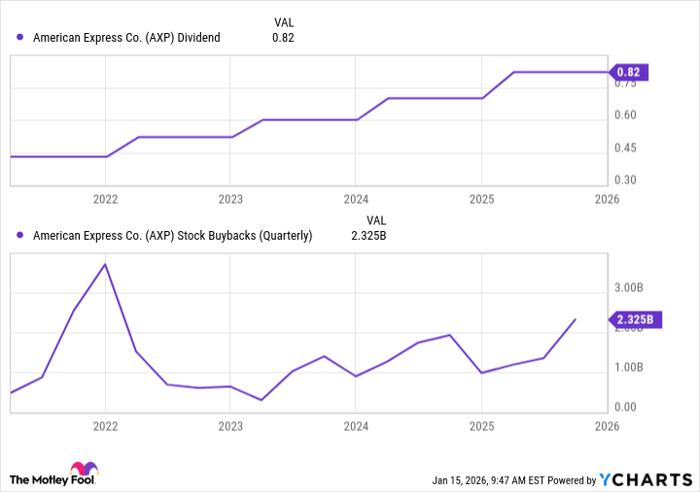
AXP Dividend data by YCharts
AMEX's business justifies these moves
One thing's for sure: Investors don't have to worry about the sustainability of AMEX's growing dividend and share repurchases. In the third quarter, its $0.82 dividend was only around 19% of its diluted earnings per share (EPS) for the quarter ($4.14).
AMEX says it expects full-year EPS to be between $15.20 and $15.50, more than enough to support the $3.28 it paid out. That leaves AMEX with plenty of money to continue investing in and expanding the business.
AMEX trails Visa and Mastercard in cards and acceptance worldwide, but that's by design. AMEX has positioned itself as the luxury credit card company, leaning on its perks to attract and retain customers. That premium branding has put AMEX in a unique -- and lucrative -- business position.
First, people are willing to pay extremely high annual fees to unlock the card's premium perks. This provides a guaranteed income that essentially works as a subscription.
It also helps that AMEX operates its own payment network and issues its own cards, allowing it to earn money from transactions, interest on balances, and merchant fees. Conversely, Visa and Mastercard operate the payment networks, but a separate bank issues the cards.
Why AMEX is a buy right now
AMEX has positioned itself well for long-term success, beginning with its diligence in attracting and retaining younger customers. Around 64% of new AMEX accounts globally were opened by millennials or Gen-Z customers. AMEX also noted that these customers have around 25% more transactions than other customers.
Between the shareholder-friendly dividend and share repurchases, premium brand, cash flow, and long-term prospects, AMEX is a great choice for someone looking to add a blue chip stock to their portfolio.
Should you buy stock in American Express right now?
Before you buy stock in American Express, consider this:
The Motley Fool Stock Advisor analyst team just identified what they believe are the 10 best stocks for investors to buy now… and American Express wasn’t one of them. The 10 stocks that made the cut could produce monster returns in the coming years.
Consider when Netflix made this list on December 17, 2004... if you invested $1,000 at the time of our recommendation, you’d have $474,578!* Or when Nvidia made this list on April 15, 2005... if you invested $1,000 at the time of our recommendation, you’d have $1,141,628!*
Now, it’s worth noting Stock Advisor’s total average return is 955% — a market-crushing outperformance compared to 196% for the S&P 500. Don't miss the latest top 10 list, available with Stock Advisor, and join an investing community built by individual investors for individual investors.
See the 10 stocks »
*Stock Advisor returns as of January 18, 2026.
American Express is an advertising partner of Motley Fool Money. Stefon Walters has no position in any of the stocks mentioned. The Motley Fool has no position in any of the stocks mentioned. The Motley Fool has a disclosure policy.
Recommended Articles


