


EUR/USD slips to 1.1600 as firm US data dampens Fed easing hopes
- EUR/USD weakens as solid US jobless claims and factory inflation lift Treasury yields.
- Markets scale back Fed easing bets amid political uncertainty over the next Fed Chair.
- German inflation hits ECB’s 2% target, offering limited support to the shared currency.
EUR/USD drops even though the Dollar pared some of its earlier gains on Friday sparked by solid US economic data releases in the week, which has improved the outlook for the labor market. This trimmed the chances for further easing by the Federal Reserve, a tailwind for the Greenback. The pair trades at 1.1599, down 0.08%.
Euro edges lower as strong US labor and production data underpin the Dollar despite fading momentum
The shared currency is poised to end the week negatively, following solid jobless claims revealed on Thursday. This, a spike on factory inflation and US President Trump reluctancy to nominate Kevin Hassett as Fed Chair, pushed US Treasury yields higher and expectations for further Fed easing lower.
Consequently, the Dollar recovered ground. US Treasury Secretary Scott Bessent said that the Fed Chair decision would be known before Davos and that Governor Stephen Miran can continue at the central bank past January 31st.
On Friday, several Federal Reserve officials crossed the wires, led by the Vice-Chair Philip Jefferson, Governor Michelle Bowman and Boston Fed Susan Collins. Except for Bowman supporting further rate cuts, Jefferson and Collins consider policy to be in a good place.
Data-wise, US Industrial Production rose 0.4% in December, exceeding estimates for a dip to 0.1%, revealed the Federal Reserve.
In Europe, the docket remained light with the release of German inflation, which hit the European Central Bank’s target of 2% YoY in December.
Euro Price This week
The table below shows the percentage change of Euro (EUR) against listed major currencies this week. Euro was the strongest against the Swiss Franc.
| USD | EUR | GBP | JPY | CAD | AUD | NZD | CHF | |
|---|---|---|---|---|---|---|---|---|
| USD | 0.29% | 0.13% | -0.03% | 0.00% | -0.05% | -0.40% | 0.29% | |
| EUR | -0.29% | -0.16% | -0.26% | -0.29% | -0.34% | -0.69% | -0.00% | |
| GBP | -0.13% | 0.16% | -0.13% | -0.13% | -0.18% | -0.53% | 0.15% | |
| JPY | 0.03% | 0.26% | 0.13% | 0.02% | -0.04% | -0.39% | 0.31% | |
| CAD | -0.00% | 0.29% | 0.13% | -0.02% | -0.08% | -0.41% | 0.29% | |
| AUD | 0.05% | 0.34% | 0.18% | 0.04% | 0.08% | -0.35% | 0.34% | |
| NZD | 0.40% | 0.69% | 0.53% | 0.39% | 0.41% | 0.35% | 0.69% | |
| CHF | -0.29% | 0.00% | -0.15% | -0.31% | -0.29% | -0.34% | -0.69% |
The heat map shows percentage changes of major currencies against each other. The base currency is picked from the left column, while the quote currency is picked from the top row. For example, if you pick the Euro from the left column and move along the horizontal line to the US Dollar, the percentage change displayed in the box will represent EUR (base)/USD (quote).
Daily digest market movers: Euro dives as inflation recedes
- The US Dollar Index (DXY) which tracks the American currency performance versus six peers, is up 0.03% at 99.38. US Treasury yields are soaring following the Hassett headline, with the 10-year T-note yield up nearly five basis points at 4.219%.
- US economic data showed a mixed inflation picture, with consumer prices stabilizing while inflation on the producer-side turned hot. On an annual basis, headline CPI held at 2.7%, virtually unchanged from November, whereas PPI accelerated to 3.0%, up from 2.8% the prior month, highlighting lingering cost pressures upstream.
- Also, the labor market signaled resilience. Last Friday’s Nonfarm Payrolls report was solid despite undershooting forecasts, while the Unemployment Rate edged down to 4.4%, below the Fed’s 4.5% projection. Reinforcing that strength, Initial Jobless Claims fell from 207K to 198K, pointing to fewer Americans filing for unemployment benefits.
- Vice-Chair Jefferson said officials do not want to prejudge January’s decision, added that current policy stance leaves US well positioned to determine how much and when to adjust rates. Governor Bowman argued that the Federal Reserve should not pause its easing cycle, saying that additional rate cuts are warranted in light of rising risks of the jobs market.
- Meanwhile, Boston Fed President Susan Collins underscored the importance of central bank independence, noting that an effective central bank must remain accountable yet free to make difficult and potentially unpopular decisions in pursuit of its mandate.
- This week US economic data revealed that inflation on the producer side jumped while the labor market although weakening, remains resilient after a solid Initial Jobless Claims report on Thursday. Consequently market participants reduced their bets on subsequent rate cuts by the Fed in 2026.
- The US Dollar Index (DXY) which tracks the American currency performance versus six peers, is up 0.03% at 99.38.
- Given the backdrop, traders trimmed the chances for further easing by the Federal Reserve. Prime Market Terminal data shows 43 basis points of easing expected towards the end of 2026.
- Germany’s final Harmonized Index of Consumer Prices (HICP) released on Friday confirmed a cooling in inflation. Prices rose 0.2% month-on-month in December, reversing November’s -0.5% drop, while annual inflation slowed to 2.0%, down from 2.6% previously. The data prompted a modest rebound in the Euro, which lifted off session lows following the release.
Technical outlook: EUR/USD slumps below 1.1600 as it turns bearish
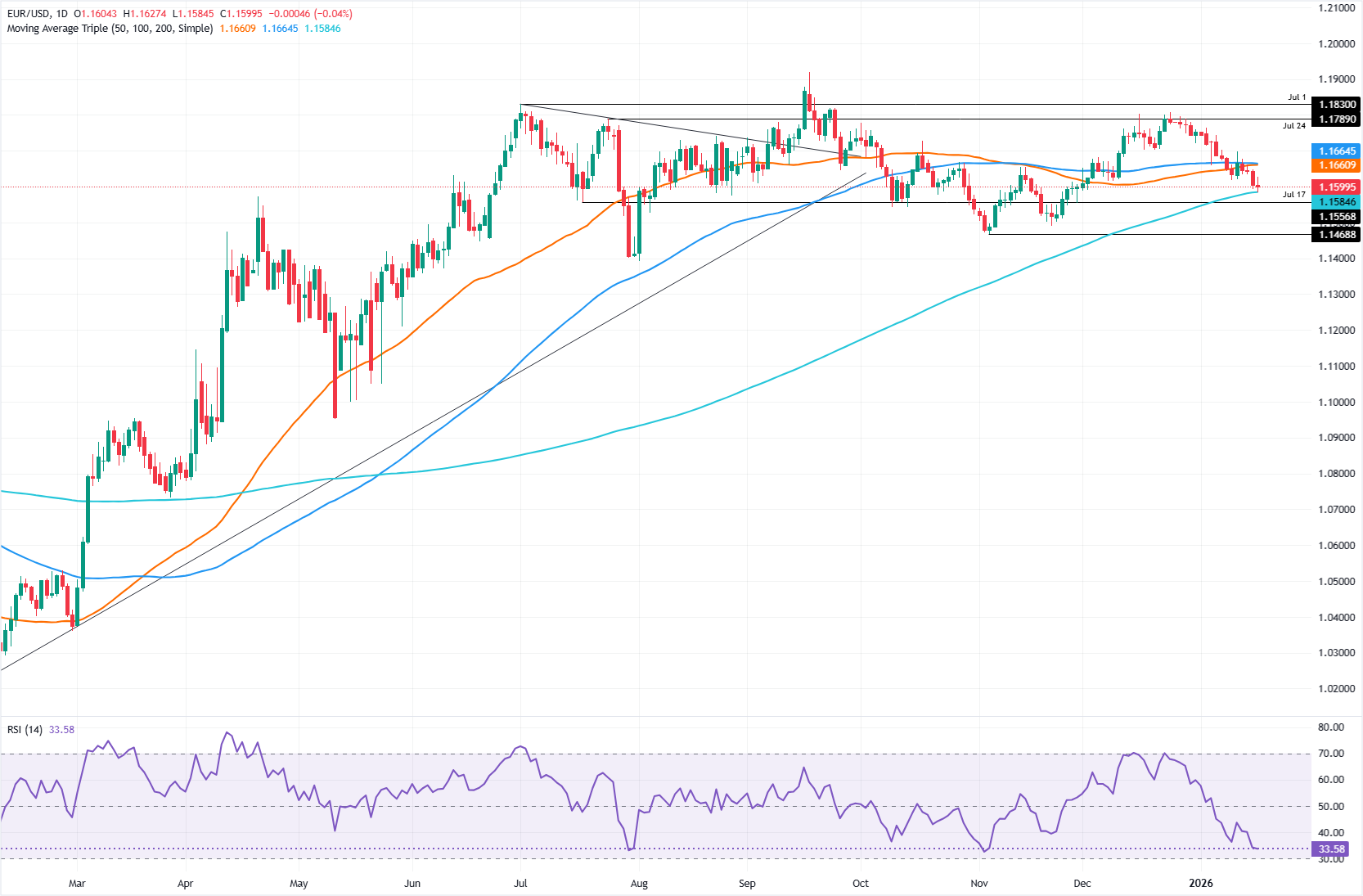
EUR/USD remains in a consolidation phase, though it briefly slipped below 1.1600 to post a year-to-date low at 1.1593 before rebounding back above the figure. Despite the recovery, downside momentum persists, with the Relative Strength Index (RSI) holding below the neutral 50 mark—an indication that sellers remain in control.
For the bearish scenario to extend, a renewed break below the 200-day Simple Moving Average (SMA) at 1.1582 on the radar. A decisive move beneath that level would be 1,1500, followed by a potentially deeper slide toward the August 1 low at 1.1391.
On the upside, buyers would need to reclaim 1.1600 to ease downside pressure. A sustained push above 1.1650 exposes 1.1700 and 1.1750.
Euro FAQs
The Euro is the currency for the 20 European Union countries that belong to the Eurozone. It is the second most heavily traded currency in the world behind the US Dollar. In 2022, it accounted for 31% of all foreign exchange transactions, with an average daily turnover of over $2.2 trillion a day. EUR/USD is the most heavily traded currency pair in the world, accounting for an estimated 30% off all transactions, followed by EUR/JPY (4%), EUR/GBP (3%) and EUR/AUD (2%).
The European Central Bank (ECB) in Frankfurt, Germany, is the reserve bank for the Eurozone. The ECB sets interest rates and manages monetary policy. The ECB’s primary mandate is to maintain price stability, which means either controlling inflation or stimulating growth. Its primary tool is the raising or lowering of interest rates. Relatively high interest rates – or the expectation of higher rates – will usually benefit the Euro and vice versa. The ECB Governing Council makes monetary policy decisions at meetings held eight times a year. Decisions are made by heads of the Eurozone national banks and six permanent members, including the President of the ECB, Christine Lagarde.
Eurozone inflation data, measured by the Harmonized Index of Consumer Prices (HICP), is an important econometric for the Euro. If inflation rises more than expected, especially if above the ECB’s 2% target, it obliges the ECB to raise interest rates to bring it back under control. Relatively high interest rates compared to its counterparts will usually benefit the Euro, as it makes the region more attractive as a place for global investors to park their money.
Data releases gauge the health of the economy and can impact on the Euro. Indicators such as GDP, Manufacturing and Services PMIs, employment, and consumer sentiment surveys can all influence the direction of the single currency. A strong economy is good for the Euro. Not only does it attract more foreign investment but it may encourage the ECB to put up interest rates, which will directly strengthen the Euro. Otherwise, if economic data is weak, the Euro is likely to fall. Economic data for the four largest economies in the euro area (Germany, France, Italy and Spain) are especially significant, as they account for 75% of the Eurozone’s economy.
Another significant data release for the Euro is the Trade Balance. This indicator measures the difference between what a country earns from its exports and what it spends on imports over a given period. If a country produces highly sought after exports then its currency will gain in value purely from the extra demand created from foreign buyers seeking to purchase these goods. Therefore, a positive net Trade Balance strengthens a currency and vice versa for a negative balance.
Recommended Articles


