




Prediction: This Growth ETF Will Crush the S&P 500 Over the Next 10 Years
Key Points
Growth ETFs are built for above-average returns, helping beat the market over time.
As tech stocks continue to surge, growth funds could be on the verge of lucrative returns.
Staying invested for the long term is key, especially if we face volatility in the coming years.
- 10 stocks we like better than Schwab Strategic Trust - Schwab U.s. Large-Cap Growth ETF ›
The right investment can build life-changing wealth, and exchange-traded funds (ETFs) are low-maintenance investments that can pack a punch.
Growth ETFs are designed to earn above-average returns, maximizing your earnings with minimal effort on your part. While nobody can say for certain what the market will do in the coming years, one powerhouse ETF could significantly outperform the S&P 500 (SNPINDEX: ^GSPC) over the next decade.
Where to invest $1,000 right now? Our analyst team just revealed what they believe are the 10 best stocks to buy right now. Continue »
Image source: Getty Images.
A growth ETF with a strong track record
The Schwab U.S. Large-Cap Growth ETF (NYSEMKT: SCHG) is a powerful growth fund with a slew of advantages. It contains nearly 200 large-cap stocks that exhibit growth characteristics, positioning them for above-average returns.
Large-cap stocks tend to be more stable than their smaller counterparts, and many of the companies in this ETF are industry-leading giants with a long history of not only surviving downturns, but thriving over time.
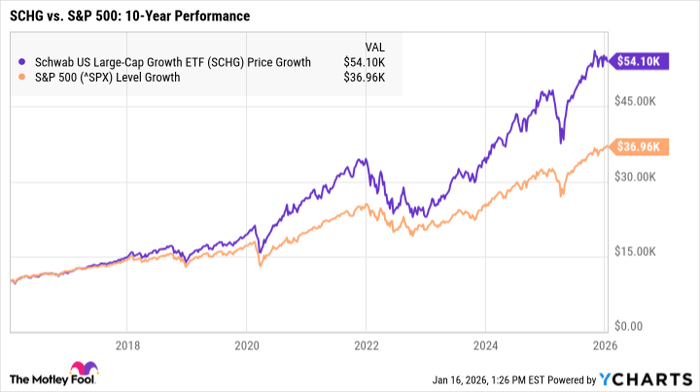
Over the last 10 years, the Schwab U.S. Large-Cap Growth ETF has earned total returns of around 441%, as of this writing, compared to around 270% for the S&P 500. In other words, if you'd invested $10,000 a decade ago, you'd have around $54,000 versus $37,000, respectively.
SCHG data by YCharts
Another advantage of this fund is its rock-bottom expense ratio of 0.04%, meaning you'll pay $4 per year in fees for every $10,000 invested. That's a fraction of the fee many other growth funds charge, which could potentially save you thousands of dollars over time.
Can this ETF beat the market in the next 10 years?
Past performance isn't necessarily indicative of future returns, so although this fund has significantly outperformed the market previously, that doesn't guarantee it will continue to do so.
That said, this ETF's heavy tilt toward the tech industry could help propel it forward in the years to come. Roughly half of the fund is allocated to tech stocks, and top holdings include major names such as Nvidia, Apple, and Microsoft.
Much of this fund's growth has come in the last five years or so, as tech stocks -- particularly those involved in the growth of artificial intelligence (AI) -- have surged. With experts predicting that AI is poised for long-term gains, this ETF could be on the verge of substantial growth.
The key to maximizing your earnings
Keeping a long-term outlook is critical when investing in a growth ETF, as this type of investment can be more volatile during periods of economic instability. If the market takes a turn for the worse in the coming years, this fund could be hit harder than an S&P 500-tracking fund.
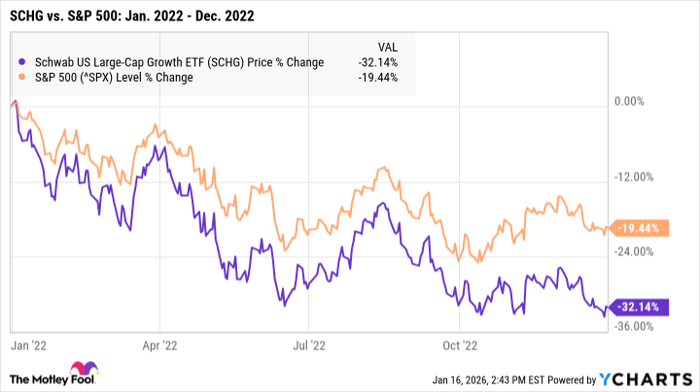
For example, throughout the bear market of 2022, the Schwab U.S. Large-Cap Growth ETF sank well below the S&P 500.
SCHG data by YCharts
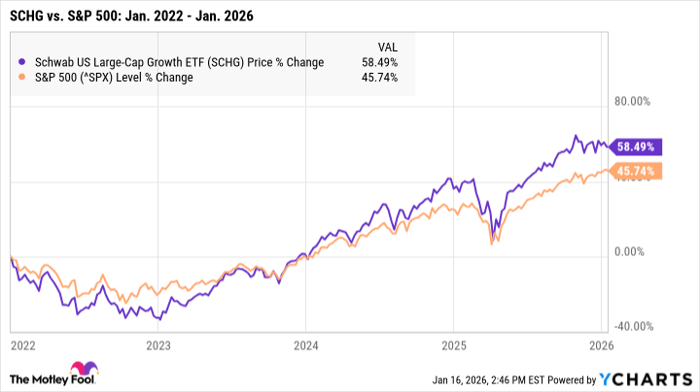
However, between January 2022 and today, the Schwab fund has earned total returns of more than 58% -- surging past the S&P 500 yet again.
SCHG data by YCharts
The short term can be rocky with growth funds, so be prepared for more significant price fluctuations. But strong investments are more likely to rebound from downturns, and staying invested for at least five to 10 years can help limit the impact of short-term volatility.
Growth ETFs can be fantastic investments for building wealth, but a long-term outlook is key. The Schwab U.S. Large-Cap Growth ETF has a powerful stock lineup and a history of beating the market, and with enough time, it has the potential to crush the S&P 500.
Should you buy stock in Schwab Strategic Trust - Schwab U.s. Large-Cap Growth ETF right now?
Before you buy stock in Schwab Strategic Trust - Schwab U.s. Large-Cap Growth ETF, consider this:
The Motley Fool Stock Advisor analyst team just identified what they believe are the 10 best stocks for investors to buy now… and Schwab Strategic Trust - Schwab U.s. Large-Cap Growth ETF wasn’t one of them. The 10 stocks that made the cut could produce monster returns in the coming years.
Consider when Netflix made this list on December 17, 2004... if you invested $1,000 at the time of our recommendation, you’d have $474,578!* Or when Nvidia made this list on April 15, 2005... if you invested $1,000 at the time of our recommendation, you’d have $1,141,628!*
Now, it’s worth noting Stock Advisor’s total average return is 955% — a market-crushing outperformance compared to 196% for the S&P 500. Don't miss the latest top 10 list, available with Stock Advisor, and join an investing community built by individual investors for individual investors.
See the 10 stocks »
*Stock Advisor returns as of January 18, 2026.
Katie Brockman has no position in any of the stocks mentioned. The Motley Fool has positions in and recommends Apple, Microsoft, and Nvidia. The Motley Fool recommends the following options: long January 2026 $395 calls on Microsoft and short January 2026 $405 calls on Microsoft. The Motley Fool has a disclosure policy.
Recommended Articles


