




Nvidia CEO Jensen Huang "Loves" This Artificial Intelligence (AI) Company. The Stock Could Soar 77% in 2026, According to 1 Wall Street Analyst
Key Points
At the CES last week, Nvidia CEO called out Serve Robotics, citing it as an example of the coming wave of physical AI.
The company has deployed more than 2,000 robots, marking the largest sidewalk delivery fleet in the United States.
While revenue is soaring, losses are mounting, so investors should tread carefully.
- 10 stocks we like better than Serve Robotics ›
Artificial intelligence (AI) has been all the rage over the past few years, as advances in the field of generative AI have taken the world by storm. Nvidia (NASDAQ: NVDA) has been among the biggest beneficiaries of these secular tailwinds, as the company's graphics processing units (GPUs) have become the gold standard chips that power these sophisticated algorithms.
Investors have already begun to look to potential advancements in agentic AI and physical AI as the next wave of this groundbreaking technology.
Where to invest $1,000 right now? Our analyst team just revealed what they believe are the 10 best stocks to buy right now. Continue »
One small AI company just got a big boost, courtesy of a shout-out from Nvidia CEO Jensen Huang.
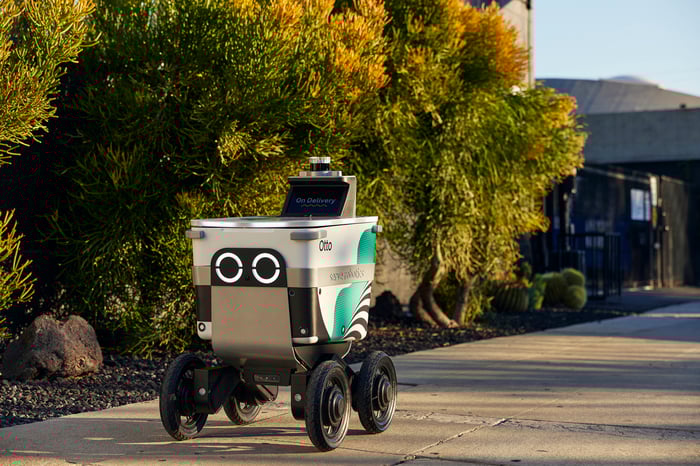
Image source: Serve Robotics.
Your Serve
Serve Robotics (NASDAQ: SERV) may not be a household name, but the maker of food delivery robots just got a significant boost in name recognition. The company was featured during Huang's keynote address at the CES this week. While discussing the future of physical AI, Huang pointed to a picture of Serve's sidewalk delivery robot and said, "I love these guys!" He went on to say, "The next generation of AI is physical AI."
That's where Serve Robotics comes in. The company is working to deploy drones and sidewalk-navigating robots to facilitate the $450 billion last-mile food delivery market. Its data suggests the median distance of food deliveries in the U.S. is 2.5 miles, and Serve Robotics believes it can cover that distance with its autonomous robots for roughly $1 per delivery.
It boasts the largest sidewalk delivery fleet in the U.S., with over 2,000 robots, and partners with prominent companies such as Uber, 7-Eleven, Shake Shack, Little Caesars, and Jersey Mike's Subs. The company has also recently entered into a multiyear strategic partnership with DoorDash to roll out deliveries nationwide.
Moreover, Nvidia is a strategic partner and former investor, which might explain Huang's love for the company.
Show me the money
Serve Robotics is growing like wildfire, but it's not without risk. In the third quarter, revenue grew 209% to $687,000, though its loss of $33 million surged nearly fourfold. However, management says it's on track to increase revenue tenfold in 2026, based on its preliminary projections -- which should help improve the company's financial picture.
The operational metrics are telling. Delivery volume increased 66% quarter over quarter and 300% year over year, thanks to its rapid geographical expansion. Serve Robotics currently has more than 1,000 food delivery robots, with plans to deploy more than 1 million. The company currently serves customers in Chicago, Dallas, Miami, and Los Angeles, with a current market of more than 3 million people and 1 million households.
Wall Street is totally on board
Wall Street is exceeding bullish regarding Serve Robotics. Of the seven analysts who offered an opinion in January, every single one rates the stock a buy. Furthermore, analysts' average price target on the stock is roughly $19, implying additional upside of 28%.
However, one analyst is much more bullish than his peers. Northland Capital Markets analyst Michael Latimore recently affirmed his Street-high price target of $26, which represents potential upside of 77% for investors over the coming year.
Latimore named the stock a top pick for 2026, suggesting there's a bright future ahead for Serve Robotics: Via physical AI, their virtual driver steers delivery robots through public spaces and produces a huge return on investment (ROI). [Serve Robotics] is one of the best investments in physical AI, we believe, and has myriad 2026 catalysts.
While Wall Street is sold, investors should tread carefully. As mentioned, Serve Robotics is far from profitable. Furthermore, its valuation leaves much to be desired, trading for more than 400 times sales as of this writing.
That's not to say that Serve Robotics can't be wildly successful. It certainly has laid the groundwork for the future, so only time will tell.
For investors intrigued by its prospects and looking to get in on the ground floor, adding a small position as part of a well-balanced portfolio wouldn't go amiss. If Serve Robotics can increase revenue tenfold in 2026, as management expects, it might well be worth a small investment.
Should you buy stock in Serve Robotics right now?
Before you buy stock in Serve Robotics, consider this:
The Motley Fool Stock Advisor analyst team just identified what they believe are the 10 best stocks for investors to buy now… and Serve Robotics wasn’t one of them. The 10 stocks that made the cut could produce monster returns in the coming years.
Consider when Netflix made this list on December 17, 2004... if you invested $1,000 at the time of our recommendation, you’d have $482,451!* Or when Nvidia made this list on April 15, 2005... if you invested $1,000 at the time of our recommendation, you’d have $1,133,229!*
Now, it’s worth noting Stock Advisor’s total average return is 968% — a market-crushing outperformance compared to 197% for the S&P 500. Don't miss the latest top 10 list, available with Stock Advisor, and join an investing community built by individual investors for individual investors.
See the 10 stocks »
*Stock Advisor returns as of January 13, 2026.
Danny Vena, CPA has positions in Nvidia. The Motley Fool has positions in and recommends DoorDash, Nvidia, Serve Robotics, and Uber Technologies. The Motley Fool has a disclosure policy.
Recommended Articles


