




Is Netflix Stock a Buy Under $100?
Key Points
Netflix's rally came to a halt following the company's stock-split in late 2025.
While the company missed Wall Street's earnings estimates in the third quarter, Netflix still has a number of compelling long-run tailwinds.
Netflix stock is trading near its cheapest valuation in nearly three years.
- 10 stocks we like better than Netflix ›
For much of 2025, shares of streaming pioneer Netflix (NASDAQ: NFLX) were on a roll. Up until mid-November, the stock had gained roughly 25% -- beating both the S&P 500 and Nasdaq Composite through that period.
But on Nov. 17, Netflix completed a 10-for-1 stock split -- its first in nearly 10 years. Since the split went into effect, shares of the streaming giant have plummeted 19% (as of closing bell on Jan. 9).
Where to invest $1,000 right now? Our analyst team just revealed what they believe are the 10 best stocks to buy right now. Continue »
Let's dig into what is driving the selling pressure in Netflix stock right now. With shares trading below $100, is now an opportunity for smart investors to buy the dip? Read on to find out.
Image source: Netflix.
Why did Netflix stock plunge?
In my eyes, there are two primary reasons driving the sell-off in Netflix stock.
First, the company missed Wall Street's expectations in its third quarter earnings report. While revenue continues to accelerate thanks to robust subscriber acquisition and retention, Netflix's bottom line wasn't as strong as analysts anticipated.
The bigger drag on Netflix stock, however, is attributable to the company's pending acquisition bid for the film and television assets of Warner Bros. Discovery. Netflix is in a heated bidding process along with Paramount Skydance Corporation for the Warner Bros. deal.
Concerns around financing the acquisition as well as integrating Warner Bros.' content into Netflix's existing content library have ushered in a period of uncertainty about what's next for the streaming powerhouse.
Against this backdrop, it's not uncommon for investor sentiment to drop in fluid, unpredictable situations.
What catalysts could fuel a rally in Netflix stock?
Over the last few months, Netflix released a number of highly anticipated pieces of content including the final season of Stranger Things as well as a Guillermo del Toro's feature film adaptation of Frankenstein.
Piggybacking off this, the company also opened up the first two locations of Netflix House -- an immersive experience that allows fans to connect with their favorite shows on a more personal level. Netflix House features games and set recreations inspired by fan-favorite hits including Wednesday, Squid Game, and more.
I think both of these developments could lead to higher-than-anticipated subscriber growth both in the fourth quarter and going forward.
Another catalyst for Netflix stems from its fast-growing, high-margin advertising business. When this segment first launched a couple of years ago, the advertisements on Netflix were pretty generic -- essentially identical to what you'd see on network television.
However, the company is now employing a new strategy. First, ads on Netflix are increasingly becoming targeted. In other words, the ads viewers see vary depending on specific subscriber demographics.
A more lucrative opportunity for the company's advertisement ambitions revolves around the content in the ads themselves. Many of the companies running marketing campaigns on Netflix are actually collaborating with the streamer by featuring some of the actors, themes, and sets from Netflix's actual shows.
For example, Tide laundry detergent and Discover Financial both ran ads promoting their respective products but featuring several of the actors from Stranger Things.
This is pretty savvy, as Netflix is getting paid by major corporations to -- in some sense -- promote its own content in addition to other products. In a way, this helps Netflix boast its content catalogue without breaking the bank on its own marketing budget.
Should you buy Netflix stock for less than $100?
Given the decline in Netflix stock over the last couple of months, I'd say there is a good chance that investors have already priced in the worst-case scenario.
While the Warner Bros. Discovery deal remains fluid and could go on for some time, nothing about Netflix's underlying business fundamentals has changed to the downside in a material way. In other words, I think the current selling pressure reflects more of an emotional reaction to Netflix's current situation than a legitimate problem in the company's business model.
Ultimately, Netflix is steadily laying the foundation for long-term success against the competition. In addition to its rich content library, the company has now complemented its intellectual property (IP) with a highly profitable advertising business and a lower-cost alternative to Disney in the experiential entertainment vertical.
NFLX PE Ratio (Forward) data by YCharts
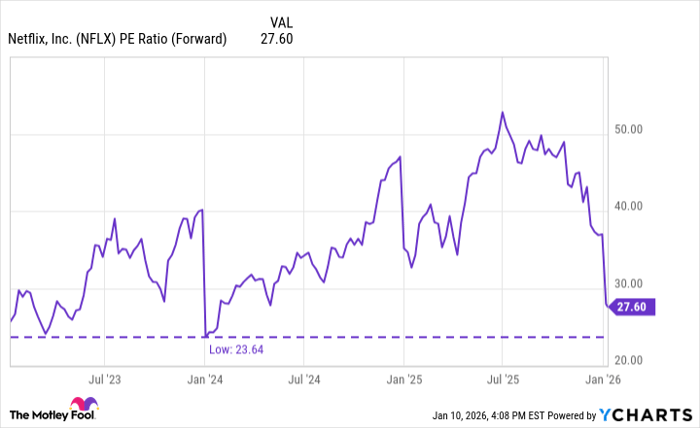
While Netflix's forward price-to-earnings (P/E) ratio of 28 isn't necessarily a bargain by traditional valuation standards, it is nearing the lowest levels Netflix has seen in three years. With that in mind, I think now is an interesting opportunity to take advantage of the depressed price action and prepare to hold for the long run as this current price dip won't last forever.
Should you buy stock in Netflix right now?
Before you buy stock in Netflix, consider this:
The Motley Fool Stock Advisor analyst team just identified what they believe are the 10 best stocks for investors to buy now… and Netflix wasn’t one of them. The 10 stocks that made the cut could produce monster returns in the coming years.
Consider when Netflix made this list on December 17, 2004... if you invested $1,000 at the time of our recommendation, you’d have $482,451!* Or when Nvidia made this list on April 15, 2005... if you invested $1,000 at the time of our recommendation, you’d have $1,133,229!*
Now, it’s worth noting Stock Advisor’s total average return is 968% — a market-crushing outperformance compared to 197% for the S&P 500. Don't miss the latest top 10 list, available with Stock Advisor, and join an investing community built by individual investors for individual investors.
See the 10 stocks »
*Stock Advisor returns as of January 13, 2026.
Adam Spatacco has no position in any of the stocks mentioned. The Motley Fool has positions in and recommends Netflix, Walt Disney, and Warner Bros. Discovery. The Motley Fool has a disclosure policy.
Recommended Articles


