


Dow Jones claws back 300 points ahead of US election results
- The Dow Jones pushed back into the high end of near-term consolidation on Tuesday.
- Equity markets are bracing for the results of the US election showdown that kicks off this week.
- Indexes have been rangebound heading into the election window.
The Dow Jones Industrial Average (DJIA) gained ground on Tuesday, climbing around 300 points to add three-quarters of one percent to its top-line. The major equity index is bumping into the ceiling of a near-term consolidation range as investors brace for the outcome of the US election as US voters head to the polls.
Another Federal Reserve (Fed) rate call looms ahead this week. Fed Chair Jerome Powell is widely expected to deliver another quarter-point cut to interest rates on Thursday, bringing the Fed Funds Rate down 25 bps to 4.75%. The Fed Funds Rate peaked at 5.5% in July of 2023, and investors have been clamoring for a return to a low interest rate environment that has become familiar territory since US interest rates clattered to an all-time low near 0% in early 2009.
US election odds have both candidates neck-and-neck in a dead-heat race for the Presidency, with former President Donald Trump and current Vice President Kamala Harris polling within 5% of each other, depending on which poll results you reference. Equity investors, tech sector addicts specifically, appear to broadly believe former President Trump to be the preferred stock-friendly candidate, an odd choice considering the Republican candidate has strongly voiced support of a return to the Smoot-Hawley tariff era of US history. Trump has regularly suggested stiff tariffs across the board on all imported goods into the US, an incredibly inflationary economic policy proposal.
The University of Michigan’s (UoM) Consumer Sentiment Index is waiting in the wings and slated for release on Friday. Investors expect November’s UoM sentiment indicator to climb to a six-month high of 71.0 from the previous month’s 70.5.
Dow Jones news
Most of the Dow Jones equity board is firmly in the green on Tuesday, with less than ten of the index’s listed securities down by half of a percent or more. Losses are being led by Boeing (BA), which backslid nine-tenths of a percent and falling below $154 per share. Boeing briefly rallied early Tuesday after announcing that the aerospace company finally negotiated an end to their workers’ strike, but markets remain concerned about the airplane manufacturers profitability looking forward and sent the ticker back into the low end.
Intel (INTC) rose over 4% on Tuesday, climbing into $23.50 per share despite an announcement that the Dow Jones Industrial Average would be dropping the chipmaker in favor of long-running AI rally darling Nvidia. Nvidia will be included in the Dow Jones equity roll beginning on Friday, November 8.
Dow Jones price forecast
The Dow Jones has seen some near-term chop as the major index grinds out chart paper around the 42,000 major handle. Price action has been pinned to the 50-day Exponential Moving Average (EMA) since dipping into its current range at the end of October.
Despite recent consolidation, the Dow Jones remains pinned deep into bull country. The index has outpaced its 200-day EMA for over a year straight and has closed higher for all but two of the last 11 straight calendar months.
Dow Jones daily chart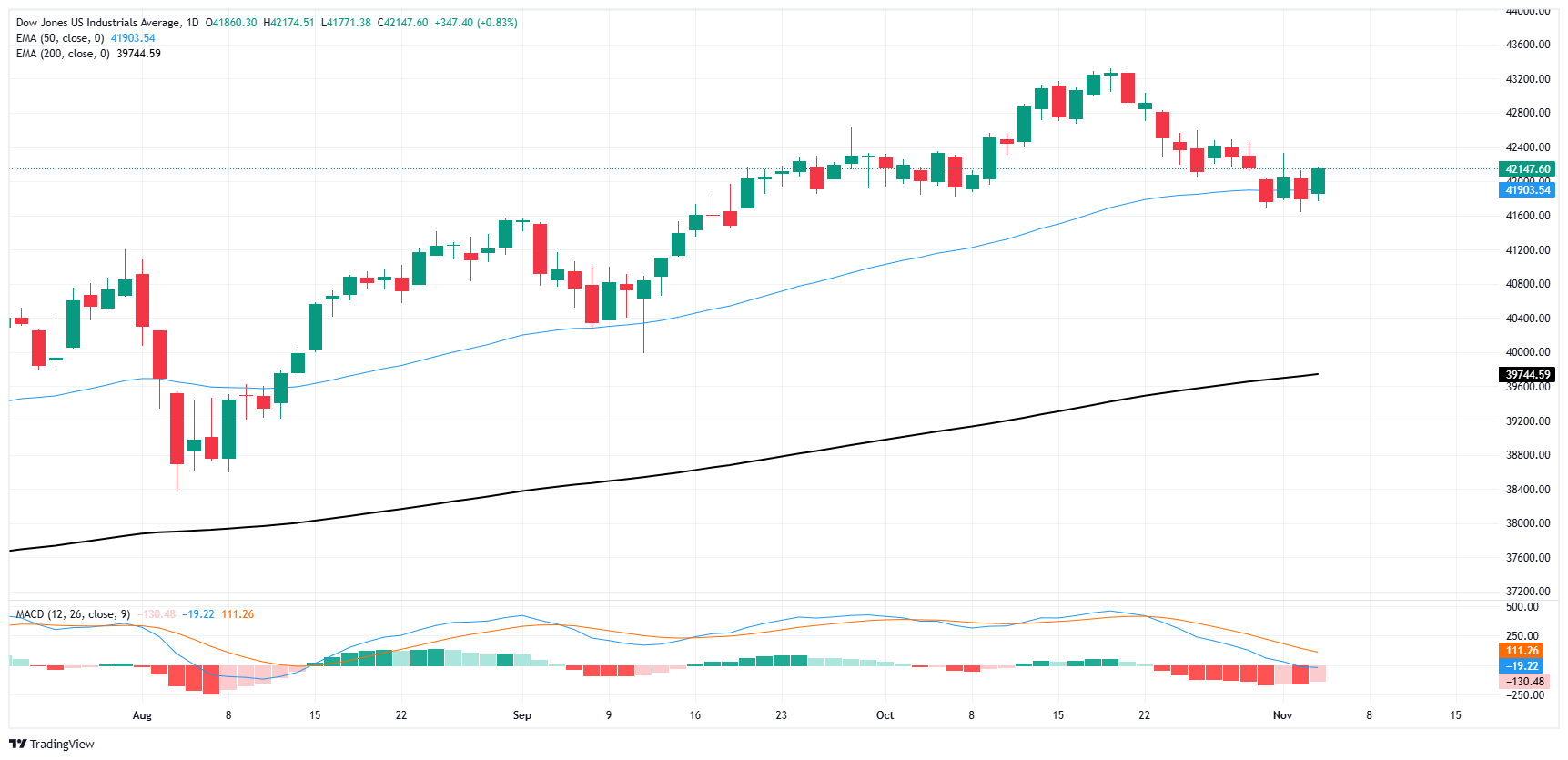
Dow Jones FAQs
The Dow Jones Industrial Average, one of the oldest stock market indices in the world, is compiled of the 30 most traded stocks in the US. The index is price-weighted rather than weighted by capitalization. It is calculated by summing the prices of the constituent stocks and dividing them by a factor, currently 0.152. The index was founded by Charles Dow, who also founded the Wall Street Journal. In later years it has been criticized for not being broadly representative enough because it only tracks 30 conglomerates, unlike broader indices such as the S&P 500.
Many different factors drive the Dow Jones Industrial Average (DJIA). The aggregate performance of the component companies revealed in quarterly company earnings reports is the main one. US and global macroeconomic data also contributes as it impacts on investor sentiment. The level of interest rates, set by the Federal Reserve (Fed), also influences the DJIA as it affects the cost of credit, on which many corporations are heavily reliant. Therefore, inflation can be a major driver as well as other metrics which impact the Fed decisions.
Dow Theory is a method for identifying the primary trend of the stock market developed by Charles Dow. A key step is to compare the direction of the Dow Jones Industrial Average (DJIA) and the Dow Jones Transportation Average (DJTA) and only follow trends where both are moving in the same direction. Volume is a confirmatory criteria. The theory uses elements of peak and trough analysis. Dow’s theory posits three trend phases: accumulation, when smart money starts buying or selling; public participation, when the wider public joins in; and distribution, when the smart money exits.
There are a number of ways to trade the DJIA. One is to use ETFs which allow investors to trade the DJIA as a single security, rather than having to buy shares in all 30 constituent companies. A leading example is the SPDR Dow Jones Industrial Average ETF (DIA). DJIA futures contracts enable traders to speculate on the future value of the index and Options provide the right, but not the obligation, to buy or sell the index at a predetermined price in the future. Mutual funds enable investors to buy a share of a diversified portfolio of DJIA stocks thus providing exposure to the overall index.
Recommended Articles


