

Injective Generated More Revenue Than BNB Chain, Avalanche In Q3 2024, Next $50?

Source Newsbtc

Injective Protocol, a DeFi-centric platform using Cosmos tech, is gaining traction, looking at the gas fee revenue distributed to its validators in Q3 2024.

While INJ, the native currency of the protocol, is under pressure, cooling off after rallying to as high as $52 early this year, the recent development is a huge confidence boost. Looking at trends may signal that more users are flowing to Injective, a net positive for INJ in the coming sessions.

Injective Generates More Revenue Than The BNB Chain, Avalanche

According to CryptoRank data, Injective Protocol generated $4 million in revenue derived from gas fees. Every transfer or smart contract deployment attracts a gas fee like every other public ledger like Bitcoin or Solana. This fee is distributed to the winning validator or miner as an incentive to operate a node.
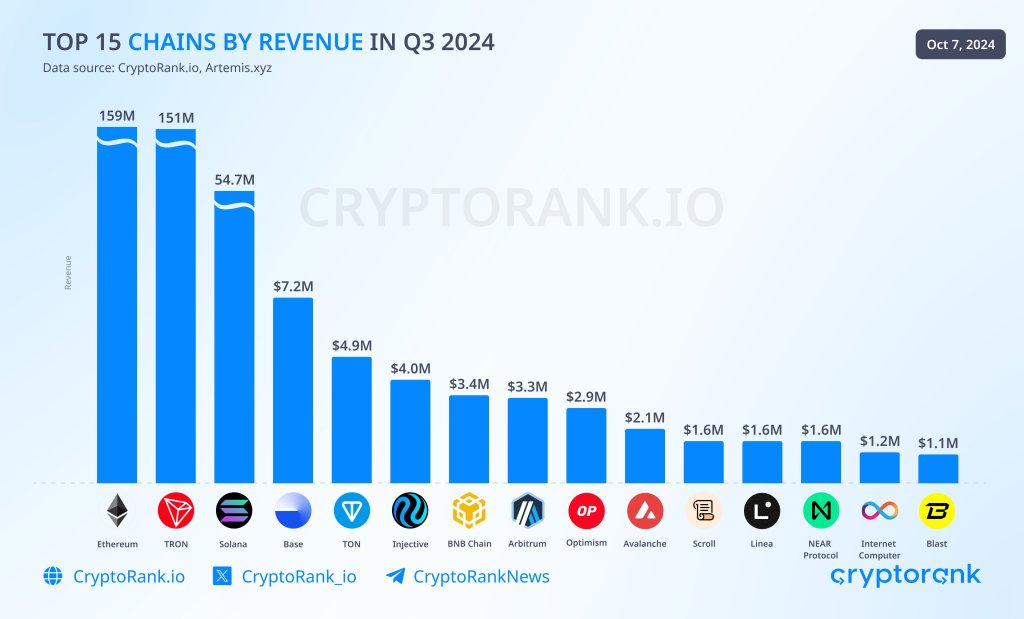
Injective Protocol generates more fees than BNB Chain, Avalanche | Source: @CryptoRank_io via X

With $4 million in revenue, Injective created more than the BNB Chain, one of the largest blockchains by market cap, and Avalanche, a network in the top 20, according to CoinMarketCap. These platforms generated $3.4 million and $2.1 million, respectively.

At this level, Injective also surpassed what some of the top Ethereum layer-2 solutions like Arbitrum, Optimism, and Blast generated over this period. For comparison, Arbitrum, despite being the largest and managing over $13.2 billion, according to L2Beat.
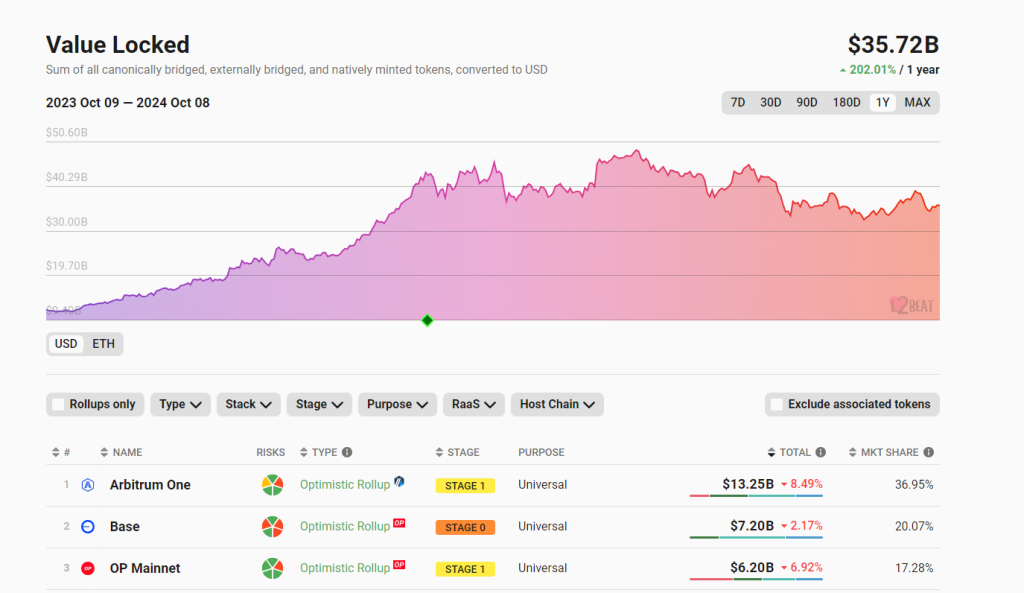
Ethereum layer-2 TVL | Source: L2Beat

Ethereum, Tron, Solana, and Base churned more revenue than Injective. Ethereum funneled $159 million to its validators from July through September, while Tron and Solana cumulatively moved over $200 million.

The expansion of revenue, mostly from Tron, a scalable platform, is due to the meme coin activity on its network following the launch of SunPump in August. At the same time, Solana also benefited from meme coins and an uptick in decentralized exchange (DEX) volume over this period.

Will INJ Rise To $50?

It remains to be seen whether the recovery of DeFi activities while boosting Injective and its total value locked (TVL). As of October 8, the protocol manages over $40 million, looking at DeFiLlama data. At the same time, the platform has processed over 1 billion onchain transactions.

In early October, Injective announced the launch of Injective 3.0. This upgrade allows the protocol to change its tokenomics and make INJ deflationary. With this activation, a portion of INJ will be removed from circulation, making it more scarce.

INJ price trending sideways on the daily chart | Source: INJUSDT on Binance, TradingView

Presently, INJ is inside a descending channel, finding support at $15. While buyers of Q1 2024 are still in the picture, the token is down 60% from March highs. A break above this descending channel could see the coin soar to 2024 highs of around $52.

Disclaimer: For information purposes only. Past performance is not indicative of future results.
placeholder
WTI (USOIL) Is down 2.03% on Sep 25: Here Is WhyWTI (USOIL) is down 2.03% at Sep 24 22:20(UTC+0), now at $92.517, with a 7-day down of 3.63%.What is driving WTI (USOIL)’s stock price down today?The drop in WTI crude oil prices was primarily driven by
Author  TradingKey
12 hours ago
WTI (USOIL) is down 2.03% at Sep 24 22:20(UTC+0), now at $92.517, with a 7-day down of 3.63%.What is driving WTI (USOIL)’s stock price down today?The drop in WTI crude oil prices was primarily driven by
placeholder
Silver Price Forecast: XAG/USD remains steady near $64.00 as oil prices easeSilver price (XAG/USD) inches higher after two days of losses, trading around $63.90 per troy ounce during Asian hours on Friday. Non-yielding Silver is finding underlying support as inflation concerns ease following a pullback in crude oil prices.
Author  FXStreet
14 hours ago
Silver price (XAG/USD) inches higher after two days of losses, trading around $63.90 per troy ounce during Asian hours on Friday. Non-yielding Silver is finding underlying support as inflation concerns ease following a pullback in crude oil prices.
placeholder
Gold Price Forecast: Gold Drops Below $4,300, Will It Continue to Fall? As of the European session on September 24, gold prices (XAUUSD) extended their correction, dipping below $4,300 intraday to hit a low of $4,262.45. After previously rebounding close to $
Author  TradingKey
Yesterday 09: 57
As of the European session on September 24, gold prices (XAUUSD) extended their correction, dipping below $4,300 intraday to hit a low of $4,262.45. After previously rebounding close to $
placeholder
Yen touches 158.37 as Tokyo reopens, then slips back — ¥15.4 trillion of intervention and the 200-day line stand between here and 160USD/JPY reached 158.37 overnight, its highest since early September, then eased to 157.88 as Japanese markets reopened after a three-day holiday. The Ministry of Finance has spent ¥15.4 trillion defending the yen since late July and the BOJ ran a rate check on September 18. The 200-day average sits at 158.43.
Author  Irene Q.
Yesterday 06: 59
USD/JPY reached 158.37 overnight, its highest since early September, then eased to 157.88 as Japanese markets reopened after a three-day holiday. The Ministry of Finance has spent ¥15.4 trillion defending the yen since late July and the BOJ ran a rate check on September 18. The 200-day average sits at 158.43.
placeholder
US input costs rose at the fastest pace in four years — the September flash PMI beat is an inflation story, not a growth storyUS September flash PMIs came in far above expectations, with the composite at 58.4, a five-year high. But the detail that moved markets was input cost inflation at its fastest since October 2022, driven by fuel, transport and supply shortages. Brent is back above $100 and the 10-year Treasury yield has hit its highest since 2007.
Author  Suzie
Yesterday 06: 46
US September flash PMIs came in far above expectations, with the composite at 58.4, a five-year high. But the detail that moved markets was input cost inflation at its fastest since October 2022, driven by fuel, transport and supply shortages. Brent is back above $100 and the 10-year Treasury yield has hit its highest since 2007.
goTop
quote