


Canada's Big Six banks build tokenized deposit rails in race over on-chain money
The six biggest banks in Canada are working together on Canadian dollar tokenized deposits. This is part of a bigger worldwide venture that aims to see what type of currency will be used for the settlement of tokenized payments, securities, and real-world assets.
In the project, Bank of Montreal, National Bank of Canada, Royal Bank of Canada, Bank of Nova Scotia, Canadian Imperial Bank of Commerce, and Toronto-Dominion Bank will join forces. Canada’s leading banks are now investigating the possibility of using regulated commercial bank deposits in place of relying exclusively on cryptocurrencies for blockchain settlement.
A bank deposit, represented on a blockchain
As reported by Dow Jones Newswires, this project is the first step in upgrading domestic payment systems.
Tokenized deposits are basically ordinary bank deposits, with the only difference of being represented and transferred through distributed-ledger technology (DLT), while not being a unique asset class. According to the IMF, these deposits are written off as bank liabilities that are held, recorded and transacted on blockchain or other DLT infrastructure.
The value of tokenized deposits lies in their programmability without leaving the regulated banking space. Banks may boost efficiency and speed in making payments while operating around the clock and carrying instructions as complex code. The first step is to facilitate the transfer of deposits between the financial institutions of Canada and possibly later, with other digital-asset networks.
Why OSFI’s ruling gives the project a foundation
The project enjoys the advantage of clear regulations. In a statement released on September 10, the Office of the Superintendent of Financial Institutions (OSFI) said tokenized deposits are not different from conventional deposits legally speaking, and reiterated its technology-neutral approach to the matter.
“The underlying technology of a financial product or service does not determine its legal nature.” — OSFI
This distinction has significant implications. This is because banks can continue to operate under the existing regulatory framework governing financial institutions rather than having to wait for legislators to create a new legal regime to cover tokenized deposits. However, OSFI continues to expect regulated entities to comply with applicable regulatory requirements with respect to technology, cyber and third-party risks.
Canada has already conducted tests on some of the basic infrastructure. Project Samara was a Bank of Canada experiment that involved TD, RBC, and Export Development Canada in implementing DLT and wholesale central-bank digital currency in a tokenized bond transaction. The project concluded that atomic settlement can work in principle, although there are some challenges in relation to complexity, governance, liquidity, operations, and legal alignment.
The same bet, playing out across four initiatives
Canada is not the only one in this approach. In May, the Bank for International Settlements reported that Project Agorá had shown that tokenization would enhance the efficiency of wholesale cross-border payments through the use of tokenized central-bank reserves and deposits held by commercial banks. The project is coming to the stage of real-world testing of the concept, and the Bank of Canada is part of it.
In June this year, major banks in the United States introduced a bank-led initiative. The Clearing House will operate the program, allowing tokenized deposits to be cleared and settled while linking blockchain with existing systems such as RTP and CHIPS.
“This initiative brings together the innovation of digital finance with the trust, scale, and settlement certainty of established bank payment infrastructure.” — Mark Monaco, Bank of America
Cryptopolitan reported that JPMorgan, Citigroup, Bank of America and Wells Fargo were among the institutions supporting the U.S. network.
In July, SWIFT stated that its blockchain ledger was prepared for a real trial, stating it had 17 banks from six different continents ready to try out tokenized cross-border payments.
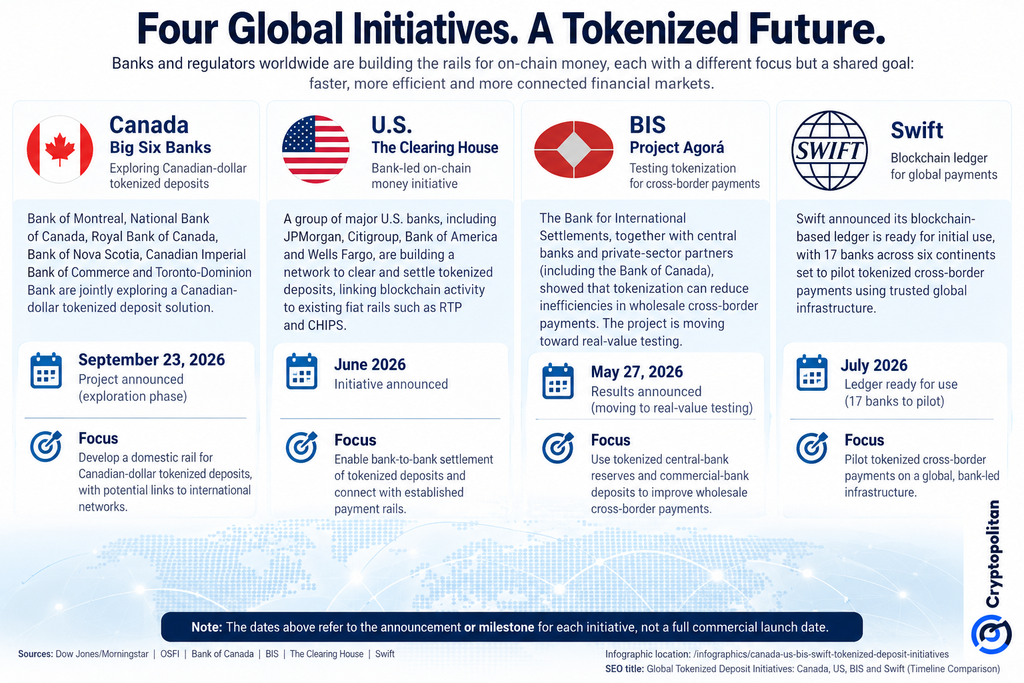
These four projects point in the same direction: regulated bank money is trying to stay in the center of the financial market while the settlement moves to blockchain.
Deposits versus stablecoins, and the missing settlement layer
The deeper contest is between different forms of digital money. Tokenized deposits remain commercial-bank liabilities, while stablecoins are separate digital liabilities backed by reserve assets. The question is not simply which technology is faster, but which form of money institutions ultimately trust as the settlement layer for tokenized finance.
The opportunity is large but still early. Citi Institute estimates tokenized assets could reach $5.5 trillion by 2030 in its base case. Binance Research put real-world-asset value on-chain at about $34.18 billion as of September 15, with only around 0.01% of addressable assets tokenized and roughly 12% of tracked tokenized capital actively used in lending, liquidity or collateral.
For now, Canada’s Big Six are exploring, not launching. The next questions are which technology they choose, whether more institutions join, and how Canada’s domestic system eventually connects with the U.S., BIS and SWIFT initiatives already moving toward live use.
Cryptopolitan reported that JPMorgan, Citigroup, Bank of America and Wells Fargo were among the institutions supporting the U.S. network. Swift, meanwhile, said in July that its blockchain ledger was ready for initial use, with 17 banks across six continents preparing to pilot tokenized cross-border payments.
Four initiatives point in the same direction: regulated bank money is fighting to remain central as settlement moves on-chain.
Deposits versus stablecoins, and the missing settlement layer
The deeper contest is between different forms of digital money. Tokenized deposits remain commercial-bank liabilities, while stablecoins are separate digital liabilities backed by reserve assets. The question is not simply which technology is faster, but which form of money institutions ultimately trust as the settlement layer for tokenized finance.
The opportunity is large but still early. Citi Institute estimates tokenized assets could reach $5.5 trillion by 2030 in its base case. Binance Research put real-world-asset value on-chain at about $34.18 billion as of September 15, with only around 0.01% of addressable assets tokenized and roughly 12% of tracked tokenized capital actively used in lending, liquidity or collateral.
For now, Canada’s Big Six are exploring, not launching. The next questions are which technology they choose, whether more institutions join, and how Canada’s domestic system eventually connects with the U.S., BIS and Swift initiatives already moving toward live use.
Don’t just read crypto news. Understand it. Subscribe to our newsletter. It's free.
Recommended Articles


