


Binance faces DOJ probe as Iran sanctions crackdown widens
US federal prosecutors are looking into whether Binance knowingly allowed trading related to Iran on its platform. The investigation comes at a time when the US is intensifying its pressure on Iran, including in the crypto sector, and the question of what Binance has done, or not done, regarding sanctions compliance between 2023 and now is being examined in even greater detail.
The inquiry did not prove any conduct violations yet, but Binance’s sheer size indicates that the case could have implications above and beyond the trading platform. Binance reportedly comprised 38.7% of the market share of the top ten centralized exchanges, as reported by CoinGecko. In case compliance-related concerns lead to caution among institutions in dealing with Binance, such reactions may have repercussions on liquidity, selection of counterparty, and distribution of trading activities on the market.
Manhattan prosecutors want to know what Binance knew
Reuters has reported that the investigation is being led by the Manhattan U.S. Attorney’s Office as well as the Criminal Division of the Department of Justice. Authorities are investigating Binance as to whether the company knowingly processed trades from Iran that are banned under current regulations.
A spokesperson from Binance stated that the firm has “a zero-tolerance approach to sanctions violations” and that they always cooperate with law enforcement agencies. The Justice Department refused to comment on the matter.
From a $61 million forfeiture to a $1.5 billion network
This investigation comes only days after the Southern District of New York filed a civil forfeiture complaint for about $61 million in cryptocurrency purportedly related to illegal transactions involving Iranian oil subject to sanctions.
According to prosecutors, Blessed Trust and Hexa Whale used Binance accounts to transfer the money to the Iranian government and the Islamic Revolutionary Guard Corps. The complaint reports that a group of self-custodied wallets under the name of “Entity A” received and distributed over $1.5 billion in illegal oil funds.
It is important to note that Binance is not a party in this forfeiture case. As previously reported by Cryptopolitan, CEO Richard Teng said the complaint “was not filed against @binance and does not allege any wrongdoing by Binance.”
Washington has made crypto itself a sanctions target
The policy context changed on August 24 as the Treasury Department initiated Operation Economic Outcast. The Office of Foreign Assets Control imposed sanctions on almost 60 entities, individuals, and vessels associated with Iran. It also made five sectoral determinations under Executive Order 13902 regarding the fields of digital assets, technology, gold, aviation, and shipping.
According to TRM Labs, this raises the risk of being hit by secondary sanctions for institutions that process large transactions for Iranian exchanges or firms engaged in digital assets, including foreign institutions that need to access the US financial markets.
What Binance says it has fixed
Binance points to the reforms made after its 2023 settlement. The exchange and then-CEO Changpeng Zhao pleaded guilty to federal charges, while Binance agreed to more than $4.3 billion in penalties and a three-year independent compliance monitor. The Justice Department said Binance had facilitated more than $898 million in trades between US users and Iran-based users from 2018 to 2022.
Binance now says users residing or located in Iran are prohibited and that Hexa Whale and Blessed Trust were removed after internal investigations. The exchange says its direct exposure to four major Iranian exchanges fell 97.3% over two years, from $4.19 million to $110,000.
Separately, Binance says its direct exposure to major illicit-flow categories fell 96% between January 2023 and June 2025. Those figures come from Binance itself.
Why compliance now moves market share
Compliance is playing an increasingly larger role in the minds of institutional investors. According to a survey conducted by Coinbase and EY-Parthenon in January 2026, involving 351 decision-makers from institutions, 66% of respondents mentioned that compliance is an important criterion when picking their custodian. This figure is almost three times as high as the previous year, when only 25% mentioned that compliance is important to them. Moreover, the survey revealed that 49% of respondents are paying more attention to risk management, liquidity, and position sizing.
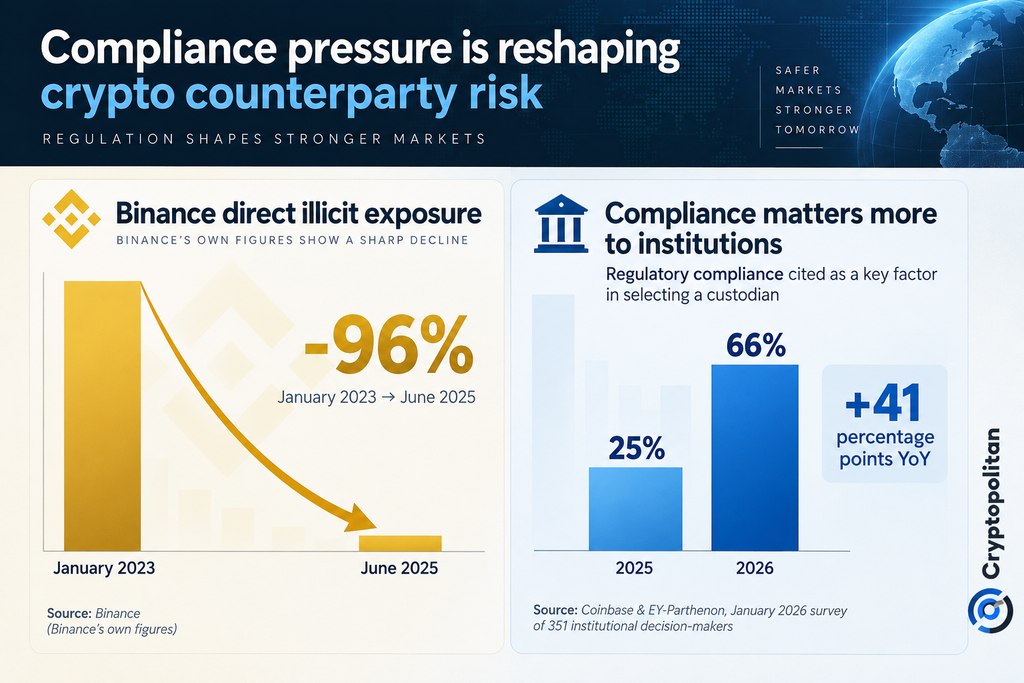
This trend becomes especially evident against the background of the fact that Binance controls 38.7% of the total trades among the top 10 exchanges. As a result, if more institutions start to avoid doing business through Binance while the investigation from the Department of Justice is under way, trading activity will eventually be carried out through other exchanges. This, in turn, may affect liquidity on Binance, as well as the distribution of trading volume among competing exchanges.
If you're reading this, you’re already ahead. Stay there with our newsletter.
Recommended Articles


