


Bitcoin Outperforms Gold. BTC Price Rises for Five Straight Days to Break $63,000, What Is the Next Target?
TradingKey - Bitcoin's five-day winning streak broke through the short-term resistance level of $73,000, releasing a strong bullish signal and setting the stage to further challenge its previous high of $67,000.
During the Asian trading session on July 6, Bitcoin ( BTC) extended its gains, approaching the $74,000 mark intraday and rising to a high of $63,914. Since entering July, the price of Bitcoin has continuously rebounded, rising from a low of $58,000 to around $74,000, with a maximum gain of 27%, outperforming gold ( XAUUSD ). During the same period, the price of gold rose from around $3,900/ounce to around $4,200, with a maximum gain of about 8%.
Over the past week (especially from July 2 to July 3), both gold and Bitcoin experienced significant and strong rebounds. Their core macro drivers were highly aligned: the latest U.S. non-farm payroll (NFP) data was a major miss, triggering strong market expectations for a pivot toward easing in the Federal Reserve's monetary policy.
On July 2, data released by the U.S. Bureau of Labor Statistics (BLS) showed that the U.S. added only 57,000 non-farm payroll jobs in June, far below the market consensus of 110,000 to 113,000. Furthermore, the data for April and May were significantly revised downward by 74,000. Following the data release, the CME FedWatch Tool showed that the probability of a rate hike in September immediately dropped from 65% to around 50%.
On the same day, Federal Reserve Governor Kevin Warsh stated that inflation risks had eased. The combination of these two factors led to a softening of real U.S. Treasury yields and the U.S. Dollar Index (DXY), directly clearing the biggest macro obstacles for non-yielding inflation-hedging and safe-haven assets, from which gold and Bitcoin benefited and rose. However, why was Bitcoin's gain larger than gold's?
Compared to gold, there are three core reasons why Bitcoin demonstrated stronger resilience: First, Bitcoin had an extremely high negative correlation of approximately -0.85 with the DXY in the first half of 2026. As a digital asset with higher sensitivity to monetary policy, its rebound was naturally more explosive than that of gold. Second, Bitcoin's sentiment index once plunged to 11, falling into a state of extreme fear, and the realized profit/loss ratio fell to its lowest level since 2022, which constitutes a severe oversold signal technically. Third, compared to its latest peak, Bitcoin's maximum drawdown reached 53%, whereas gold's previous pullback was smaller, at only around 30%. Therefore, when positive news arrived, gold lacked the space for an outsized retaliatory rebound that comes after a "spring is compressed to its limit."
Currently, the Bitcoin price remains within the range of $58,000 to $67,000, but it has broken above the middle band of $63,000, which often signals continued gains. It is expected to rise further this week to touch the upper band of $67,000, provided there is no sudden major negative news.
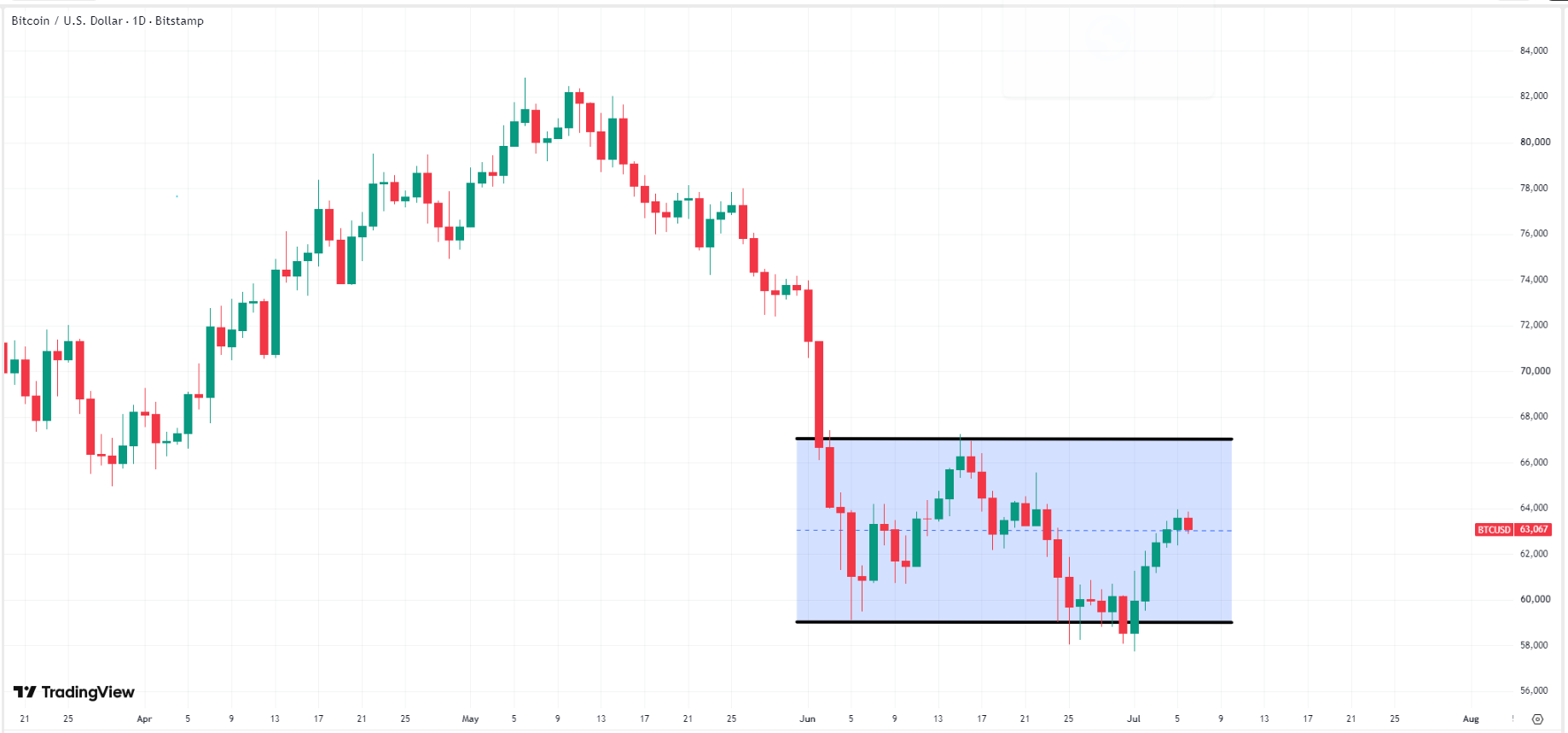
Bitcoin price chart, Source: TradingView
Recommended Articles


