


WTI Crude Oil Price Forecast: Trump Says US-Iran Talks Progressing Smoothly, Oil May Fall Below $60

 Trending Articles
- Gold Price Forecast: PCE Data Weakens Fed Rate Hike Expectations, Can Gold Price Hold Steady at $4,000?
- Iran insists on control of Hormuz amid reports of US talks
- Gold Price Forecast: Gold Price Falls Below $4,000, PCE Data May Push Gold Down to $3,900
- June Non-Farm Payrolls Preview: Did White House Economic Advisor Give an Early Hint? How Will US Stocks, Dollar and Gold React?
- Crypto market sheds over 50% of its value amid Bitcoin's brief decline below $60K
- Bitcoin Price Trend Forecast: Continued ETF Outflows Limit Bitcoin Price Rebound Space, $58,000 Becomes Key Level for Bulls and Bears
TradingKey - As of the European session on July 2, WTI ( USOIL) crude oil prices fluctuated with a weak bias around $68, extending their prior downward trend. From a technical perspective, against the backdrop of easing US-Iran tensions, WTI crude oil prices have continued to decline, briefly breaking below the $68 threshold today to touch a low of $67.45, marking a new low since March this year.
Trump sends optimistic signals; Iran insists on control of Hormuz
From a fundamental perspective, the most critical factor influencing recent WTI crude oil price movements is the negotiations between the US and Iran regarding the Strait of Hormuz and the ceasefire mechanism. Previously, the US-Iran conflict had heightened market concerns over disruptions to Gulf shipping, adding a geopolitical risk premium to oil prices. However, as the two sides resumed technical contacts in Doha, Qatar, market fears of supply disruptions have cooled significantly.
Trump recently stated that the US and Iran are 'getting along very well' and noted that the recent meetings in Qatar went smoothly. He also indicated that Iran's denuclearization process is 'progressing well' and that the two sides held 'very good meetings.'
For WTI, Trump's remarks directly eroded the risk premium. Previously, the primary logic supporting oil prices was that if the US-Iran conflict escalated again or if Iran restricted transit through the Strait of Hormuz, the global crude supply chain could be disrupted. However, as Trump and Qatari officials reported positive progress in indirect US-Iran talks—focusing on Strait shipping, ceasefire implementation, and partially frozen funds—market expectations of short-term crude supply disruptions are cooling down.
However, Iran's stance remains firm. Iranian officials insist that Tehran should retain control over transit arrangements in the Strait of Hormuz, including deciding how vessels enter and exit the strait, as well as potentially charging fees on related vessels in the future. Tehran also emphasized that it is unwilling to shift the focus of negotiations to other disputes before the issue of control over the Strait of Hormuz is resolved.
The diverging statements from the US and Iran have created a situation where short-term easing and medium-term uncertainty coexist for oil prices. In the short term, Trump's optimistic remarks and the progress in Qatari negotiations have weighed on the oil risk premium; in the medium term, however, Iran's insistence on controlling the Strait could still lead to setbacks in subsequent talks. Should the two sides clash again over navigation rights, fee collection, or military escorts, WTI crude could quickly rebound.
WTI Crude Oil Price Analysis: Downside Room Opens Up, Prices May Fall Below $60
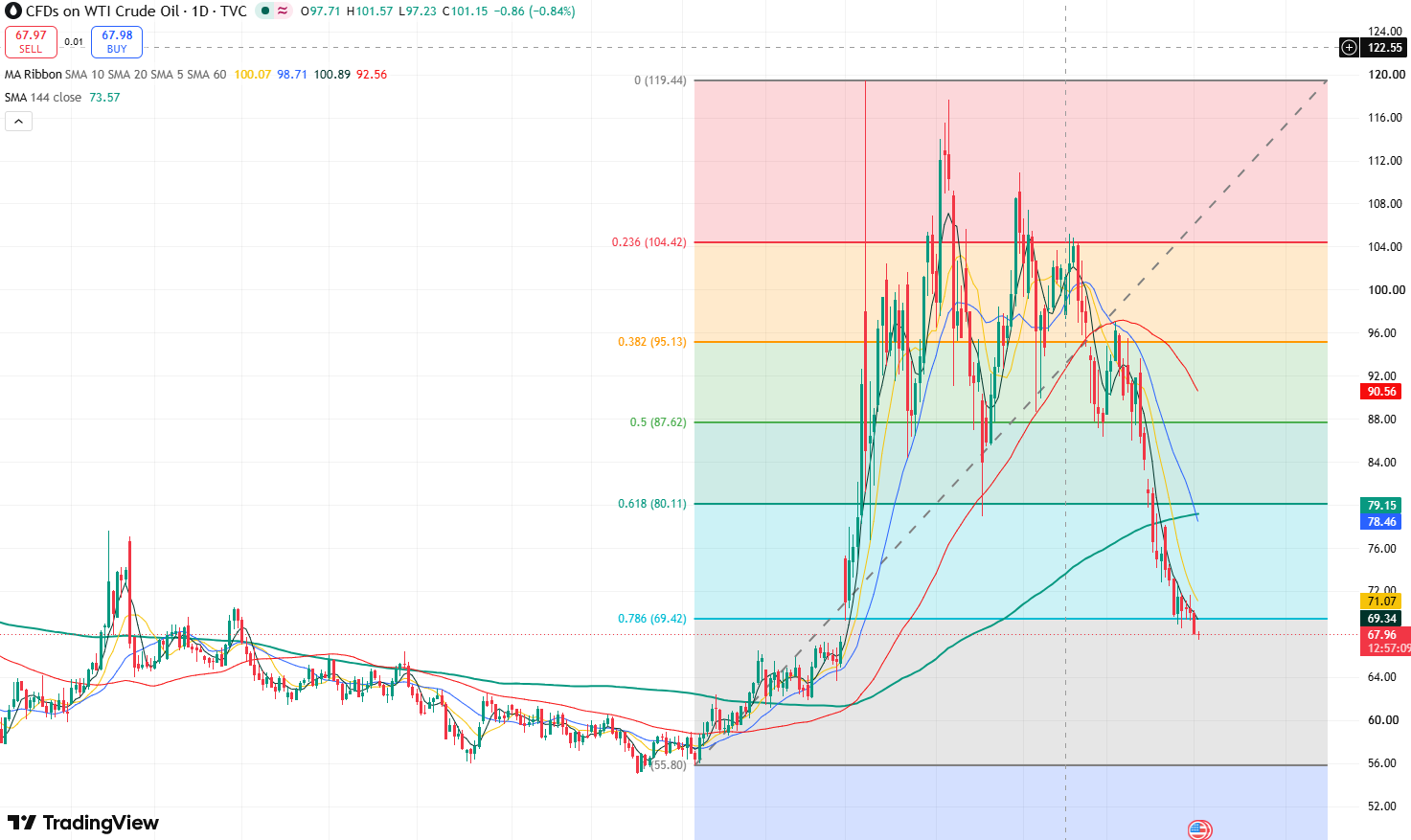
WTI Crude Oil Daily Chart, Source: TradingView
Looking at the daily chart of WTI crude oil, the overall trend has shifted downward following a confirmed break below $80 on June 16. Meanwhile, the moving average system shows that the SMA 5, 10, and 20 have all crossed below the SMA 144, forming a death cross structure that further reinforces bearish momentum.
Currently, WTI crude oil has broken below the $70 mark as well as the 0.786 Fibonacci retracement level at $69.40. This further opens up downside potential, with prices poised to test the $60 support level, and potentially even fall toward the $56 area.
In terms of trading strategy, shorting on rallies is recommended.
Read more
* The content presented above, whether from a third party or not, is considered as general advice only. This article should not be construed as containing investment advice, investment recommendations, an offer of or solicitation for any transactions in financial instruments.


