


New Fed Chair to Cut Forward Guidance? Warsh Rejects Dot-Plot Expectations, Bullish or Bearish for Bitcoin?
TradingKey - If Warsh rejects dot plot projections, it could suppress institutional capital and weaken market risk appetite in the short term, but is a long-term positive for Bitcoin.
On June 17, Asian time, global financial markets held their collective breath in anticipation of the first FOMC interest rate meeting under the leadership of the new Federal Reserve (Fed) Chair, Kevin Warsh. However, the latest bombshell out of Wall Street was not about the interest rate itself, but rather that Warsh is about to launch a historic institutional reform of the Federal Reserve.
Market reports suggest that, in order to break the 14-year tradition of "forward guidance," Warsh may, in an unprecedented move, "refuse to submit" his personal projections for future interest rates on the dot plot at this meeting. This has sparked a fierce debate on Wall Street over the future transparency and independence of the Federal Reserve's monetary policy, while also leaving the cryptocurrency market without direction, with Bitcoin ( BTC) seeing its rally stalled.
Over the past 24 hours, Bitcoin fell 0.3%, fluctuating around $65,000, and is currently trading at $65,852. On June 6, the price of Bitcoin reclaimed the $60,000 mark and subsequently continued to rebound, boosted by the easing of geopolitical tensions between the U.S. and Iran, gaining approximately 10% to date. Although it is a foregone conclusion that the Fed will keep interest rates unchanged this time, the market remains highly expectant regarding future Fed rate cuts and Warsh's potentially dovish stance. Unexpectedly, Warsh might refuse to provide forward guidance, but this is not necessarily a bad thing for Bitcoin.
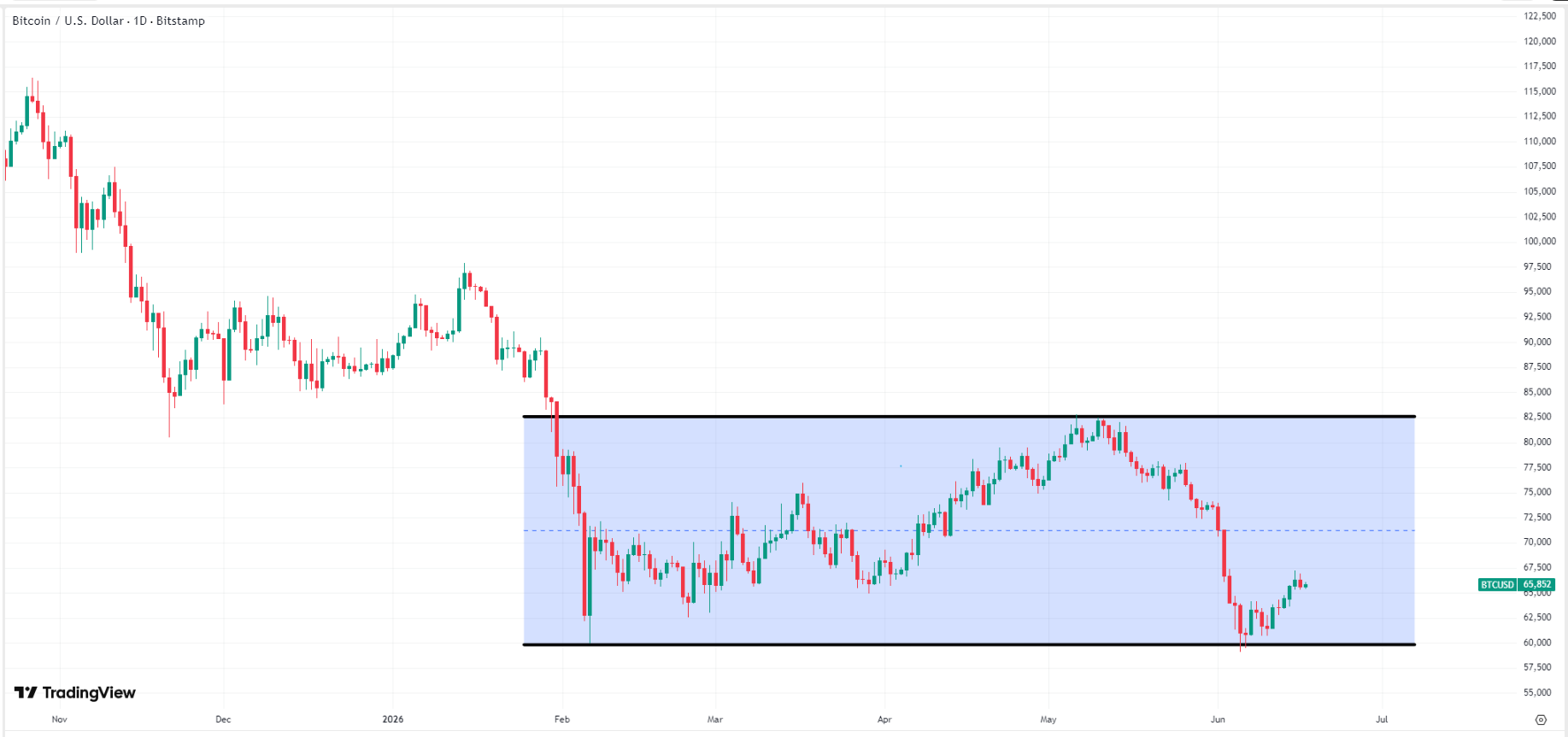 Bitcoin price chart, Source: TradingView
For the past 14 years, Wall Street has been accustomed to using the dot plot to value and price Treasury yields, corporate loans, and even IPOs of giants like SpaceX. If Warsh withdraws it, the market will immediately panic upon losing this anchor of expectation, causing the Treasury volatility index and the VIX fear index to surge instantly, while institutional capital avoids taking risks, choosing to "de-leverage and treat cash as king." This could lead to a sudden withdrawal of liquidity, putting short-term pressure on Bitcoin.
In essence, the dot plot is the Fed's "centrally planned" style of psychological expectation management for the market. Warsh's refusal to provide projections means the Fed is letting go, allowing the market to price assets freely based on data. When the commander-in-chief of traditional fiat currency chooses to hide his cards, global capital's trust in the transparency of the fiat system will decline. Meanwhile, as a decentralized asset where "code is law," Bitcoin's scarcity—characterized by public rules and a transparent supply—will be infinitely magnified. Analysts at Galaxy Digital and Ark Invest remain optimistic, believing that Warsh eliminating the dot plot essentially dismantles the credibility of the traditional fiat system, which will directly activate Bitcoin's defensive attributes.
Furthermore, the recent easing of geopolitical conflicts has turned negative market sentiment into optimism, and Warsh hiding the dot plot does not change this current sentiment. On the contrary, if Warsh were to deliver hawkish forward guidance, it would be detrimental to Bitcoin. Simply put, Warsh's rejection of the dot plot projections is a short-term negative for Bitcoin but a long-term positive. However, before the other shoe drops in Warsh's "monetary experiment," investors should avoid highly leveraged contracts, whether taking long or short positions.
Recommended Articles


