
Dollar’s Shrinking Value Adds Fuel To XRP Bull Case: Finance Expert

Source Newsbtc

XRP has lost 38% of its value over the past year. Bitcoin hasn’t done much better, sliding more than 16%. Yet a finance expert is telling investors those numbers miss the bigger picture.

Cash Is Losing Ground Too

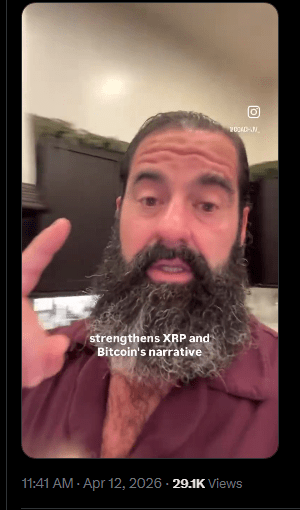
John Vasquez, who goes by Coach JV on social media, says the real story isn’t short-term price drops — it’s what’s happening to the dollar.

Data shows the purchasing power of the US dollar has fallen 28% over the past decade, dropping from 43.10 to 30.9 on the Consumer Price Index.

Over that same 10-year stretch, both Bitcoin and XRP have climbed nearly 200 times in value. By that measure, Vasquez argues, holding cash has quietly been the bigger loser.

His comments came through a post on X, where he laid out his case for why global tensions are strengthening the long-term argument for crypto assets — not weakening it.

Oil, Credit, And The Dollar’s Global Standing

Vasquez pointed to rising oil prices linked to disruptions near the Strait of Hormuz as a driver of inflation pressure. At the same time, he warned of tightening credit conditions and what he called a developing global credit crisis.

Countries moving away from dependence on the US dollar — a shift often described as de-dollarization — are also part of what he sees reshaping the financial order.

Reports indicate he also cited Japan’s interest rate changes and the unwinding of so-called carry trades as added stress points for the global system.

These are moves by investors who borrow in low-interest currencies to buy higher-yielding assets elsewhere. When those trades unwind, markets can move fast and hard.

He described two possible roads ahead: one where central banks keep printing money and hold interest rates low, extending current imbalances, and another where stock and credit markets suffer a sharp correction. Neither path, in his view, favors holding cash.

Crypto Still Struggles As A Near-Term Hedge

Crypto prices haven’t cooperated with that theory. Since Middle East tensions flared again in February, Bitcoin and XRP have held steady but gone nowhere.

Markets have shown relative stability but not gains. That sits awkwardly against the argument that geopolitical risk drives money into decentralized assets.

Still, Vasquez says the strategy is to accumulate during downturns, not react to them. His long-term positioning includes XRP, Bitcoin, silver, and income-generating assets.

His core message is preparation — financial and psychological — for an economic environment that looks increasingly unstable.

Featured image from Meta, chart from TradingView

Disclaimer: For information purposes only. Past performance is not indicative of future results.
placeholder
Bitcoin CME gaps at $35,000, $27,000 and $21,000, which one gets filled first?Prioritize filling the $27,000 gap and even try higher.
Author  FXStreet
Aug 22, 2023
Prioritize filling the $27,000 gap and even try higher.
placeholder
Pinduoduo Earnings Incoming: Morgan Stanley Sees Long-Term Profit Potential​Insights – On November 21, Chinese e-commerce giant Pinduoduo (PDD) will release its Q3 2024 earnings.
Author  Mitrade
Nov 20, 2024
​Insights – On November 21, Chinese e-commerce giant Pinduoduo (PDD) will release its Q3 2024 earnings.
placeholder
Elon Musk’s xAI and Neuralink Launch New Funding Rounds​Billionaire Elon Musk recently raised funds for his two high-profile tech companies, xAI and Neuralink.
Author  Insights
Jun 03, 2025
​Billionaire Elon Musk recently raised funds for his two high-profile tech companies, xAI and Neuralink.
placeholder
Bitcoin briefly loses 2025 gains as crypto plunges over the weekend.Bitcoin experienced a sharp decline this weekend, briefly erasing its 2025 gains and dipping below its year-opening value of $93,507. The cryptocurrency fell to a low of $93,029 on Sunday, representing a 25% drop from its all-time high in October. Although it has rebounded slightly to around $94,209, the pressures on the market remain significant. The downturn occurred despite the reopening of the U.S. government on Thursday, which many had hoped would provide essential support for crypto markets. This year initially appeared promising for cryptocurrencies, particularly after the inauguration of President Donald Trump, who has established the most pro-crypto administration thus far. However, ongoing political tensions—including Trump's tariff strategies and the recent government shutdown, lasting a historic 43 days—have contributed to several rapid price pullbacks for Bitcoin throughout the year. Market dynamics are also being influenced by Bitcoin whales—investors holding large amounts of Bitcoin—who have been offloading portions of their assets, consequently stalling price rallies even as positive regulatory developments emerge. Despite these sell-offs, analysts from Glassnode argue that this behavior aligns with typical patterns seen among long-term investors during the concluding stages of bull markets, suggesting it is not indicative of a mass exodus. Notably, Bitcoin is not alone in its struggles, as Ethereum and Solana have also recorded declines of 7.95% and 28.3%, respectively, since the start of the year, while numerous altcoins have faced even steeper losses. Looking ahead, questions linger regarding the viability of the four-year cycle thesis, particularly given the increasing institutional support and regulatory frameworks now in place in the crypto landscape. Matt Hougan, chief investment officer at Bitwise, remains optimistic, suggesting a potential Bitcoin resurgence in 2026 driven by the “debasement trade” thesis and a broader trend toward increased adoption of stablecoins, tokenization, and decentralized finance. Hougan emphasized the soundness of the underlying fundamentals, pointing to a positive outlook for the sector in the longer term.
Author  Mitrade
Nov 17, 2025
Bitcoin experienced a sharp decline this weekend, briefly erasing its 2025 gains and dipping below its year-opening value of $93,507. The cryptocurrency fell to a low of $93,029 on Sunday, representing a 25% drop from its all-time high in October. Although it has rebounded slightly to around $94,209, the pressures on the market remain significant. The downturn occurred despite the reopening of the U.S. government on Thursday, which many had hoped would provide essential support for crypto markets. This year initially appeared promising for cryptocurrencies, particularly after the inauguration of President Donald Trump, who has established the most pro-crypto administration thus far. However, ongoing political tensions—including Trump's tariff strategies and the recent government shutdown, lasting a historic 43 days—have contributed to several rapid price pullbacks for Bitcoin throughout the year. Market dynamics are also being influenced by Bitcoin whales—investors holding large amounts of Bitcoin—who have been offloading portions of their assets, consequently stalling price rallies even as positive regulatory developments emerge. Despite these sell-offs, analysts from Glassnode argue that this behavior aligns with typical patterns seen among long-term investors during the concluding stages of bull markets, suggesting it is not indicative of a mass exodus. Notably, Bitcoin is not alone in its struggles, as Ethereum and Solana have also recorded declines of 7.95% and 28.3%, respectively, since the start of the year, while numerous altcoins have faced even steeper losses. Looking ahead, questions linger regarding the viability of the four-year cycle thesis, particularly given the increasing institutional support and regulatory frameworks now in place in the crypto landscape. Matt Hougan, chief investment officer at Bitwise, remains optimistic, suggesting a potential Bitcoin resurgence in 2026 driven by the “debasement trade” thesis and a broader trend toward increased adoption of stablecoins, tokenization, and decentralized finance. Hougan emphasized the soundness of the underlying fundamentals, pointing to a positive outlook for the sector in the longer term.
placeholder
WTI jumps roughly 8% toward $100 as US blockades Strait of HormuzWest Texas Intermediate (WTI) – the US oil benchmark – has opened the week with a bullish gap, climbing roughly 8%, looking to retarget the $100 threshold.
Author  Mitrade
Yesterday 01: 37
West Texas Intermediate (WTI) – the US oil benchmark – has opened the week with a bullish gap, climbing roughly 8%, looking to retarget the $100 threshold.
goTop
quote