


How America’s Debt Interest Is Becoming Its Biggest Budget Problem
America’s debt burden is worsening, with the cost of servicing it rising and consuming a growing share of government income.
While total US national debt has surpassed $39 trillion, the bigger concern is no longer just how much is owed but how expensive it has become to maintain.
US Debt Burden Deepens as Interest Costs Spiral Higher
According to preliminary estimates, the US government paid $529 billion in interest between October 2025 and March 2026. That translates to roughly $88 billion per month, or more than $22 billion per week, highlighting the scale and speed of the growing burden.
The figure is comparable to combined federal spending on the Department of Defense ($461 billion) and the Department of Education ($70 billion) over the same period, highlighting how debt servicing is beginning to rival core government outlays.
The pressure is also accelerating. Over the same six-month period a year earlier, interest payments stood at $497 billion, marking a $33 billion, or 7%, increase year over year.
“Because the debt was larger than it was in the first half of fiscal year 2025, and because of higher long-term interest rates. Declines in short-term interest rates partially mitigated the overall rise in interest payments,” CBO noted.
Beyond absolute figures, the structural strain is becoming more evident. Data highlighted by The Kobeissi Letter shows the US government spent 18 cents of every dollar of revenue on interest in Fiscal Year 2025.
This was the highest level since the 1990s. That share has tripled since 2015, signaling a significant shift in fiscal dynamics.
Looking ahead, the Congressional Budget Office projects this burden will rise further, reaching 25 cents of every dollar of revenue by 2035. Notably, these projections assume stable economic conditions, with no major recession or sharp rise in Treasury yields, leaving room for even greater strain if the outlook deteriorates.
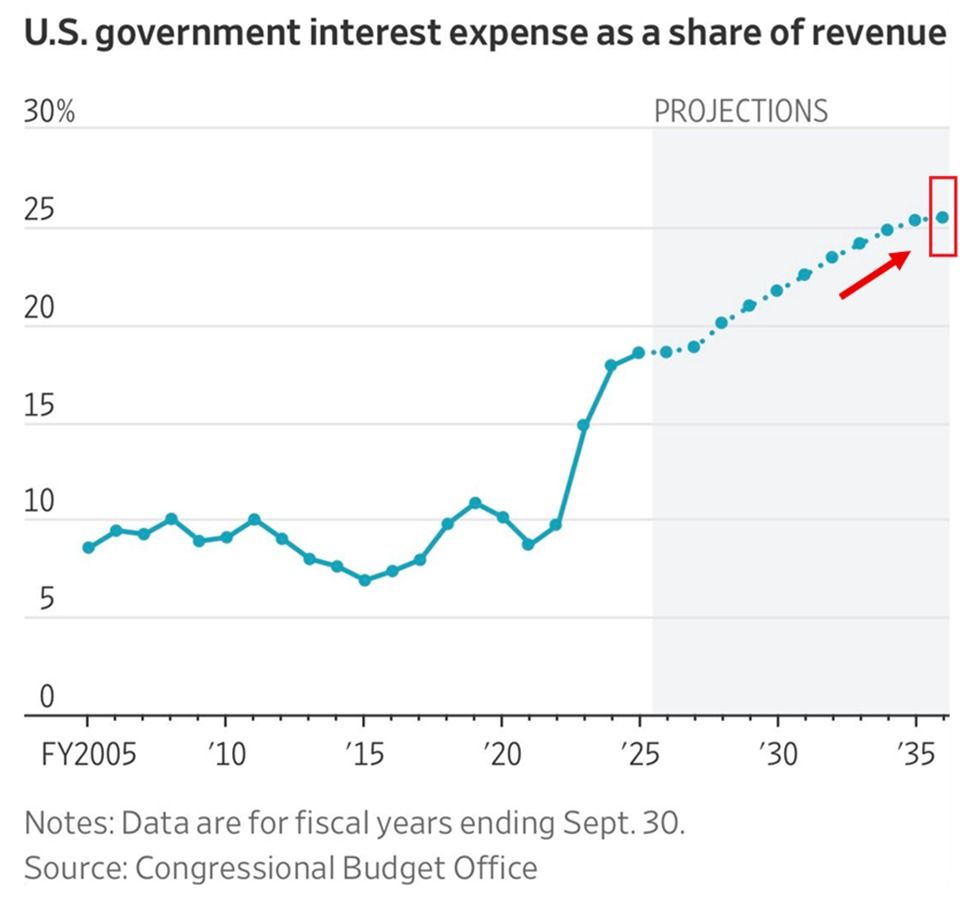 US Interest on Debt. Source: X/The Kobeissi Letter
As borrowing costs climb, the US debt story is increasingly defined not by its size, but by the mounting cost of carrying it.
Follow us on X to get the latest news as it happens
What It Means for Crypto
The structural deterioration in US public finances strengthens the structural case for hard assets with limited supply, including gold and Bitcoin (BTC). Notably, Bitcoin has shown relative resilience during the ongoing US-Iran conflict.
Gold, by contrast, has dipped amid escalating tensions. Still, deteriorating macro conditions could just as easily push investors toward risk-off positioning.
Whether Bitcoin ultimately proves to be a reliable inflation hedge or behaves more like a high-beta risk asset remains a live debate. What is less contested is that the fiscal conditions fueling that debate are intensifying, not improving.
Subscribe to our YouTube channel to watch leaders and journalists provide expert insights
Recommended Articles


