

Capital Is Rotating From Bitcoin To Ethereum – On-Chain Data Shows It Is Not Over

Source Newsbtc

Ethereum is holding above key price levels as the market prepares for a decisive move. The chart looks constructive. The March data from XWIN Research Japan explains why the chart may be understating what is actually happening beneath it.

The report documents a capital rotation that played out in plain sight last month — and that most participants attributed to momentum rather than structure. While Bitcoin gained 1.83% in March, Ethereum rose 7.12%. That performance gap is not the headline. The market cap divergence is. Bitcoin’s market cap declined 0.43% over the same period while Ethereum’s expanded 2.97% — meaning capital was not just flowing toward ETH, it was flowing away from BTC simultaneously. That is the definition of reallocation, not coincidence.

The structural reading goes further. Ethereum’s realized volatility in March reached 62.8% against Bitcoin’s 49.8% — confirming ETH’s role as the higher-beta asset in the relationship. Despite a correlation of approximately 0.94 between the two assets, Ethereum amplifies moves in liquidity and risk appetite disproportionately. When conditions improve, ETH responds harder. When they deteriorate, ETH absorbs more damage.

March’s conditions improved. ETH responded accordingly. The question the report raises — and the one the current price level demands — is whether the conditions that produced March’s rotation are strengthening or fading.

The Price Is Moving. The Structure Behind It Is Moving Faster

The XWIN Research Japan analysis identifies three simultaneous developments that together describe something more durable than a momentum trade. Exchange outflows for Ethereum continue to build — coins leaving trading venues, reducing the immediately available sell-side pool, and reflecting a growing preference for long-term holding over active trading. Supply is thinning not because buyers have arrived in force, but because sellers have stepped back.

The on-chain picture adds the demand dimension. The Coinbase Premium Gap remains negative — US institutional demand has not fully returned — but it is improving. That directional shift matters more than the current level: a gap moving toward zero is a market in early recovery, not stagnation. Active Addresses, meanwhile, continue trending higher, confirming that Ethereum’s network is being used more regardless of price direction. Real usage expanding before institutional capital arrives is the textbook early-cycle structure.

Ethereum Coinbase Premium Gap | Source: CryptoQuant

The distinction the report draws between Ethereum and Bitcoin is structural rather than competitive. Bitcoin functions as a store of value — its thesis is monetary. Ethereum functions as financial infrastructure — stablecoins, DeFi, tokenized assets, settlement layers — its thesis is utility. In a market where real usage is already expanding and institutional demand is approaching rather than present, the infrastructure asset tends to re-rate before the monetary asset fully recovers.

ETH is currently receiving capital inflows, tightening supply, and growing its network simultaneously. That combination does not produce a guaranteed outcome. It produces a structurally stronger setup than the price alone currently reflects.

Ethereum Tests Strength After Post-Capitulation Recovery

Ethereum is attempting to build a recovery structure after the sharp February breakdown that reset market positioning. The chart shows a clear capitulation event, followed by a period of stabilization and gradual higher lows. Price is now trading around $2,200, a level that has shifted from resistance into a short-term pivot.
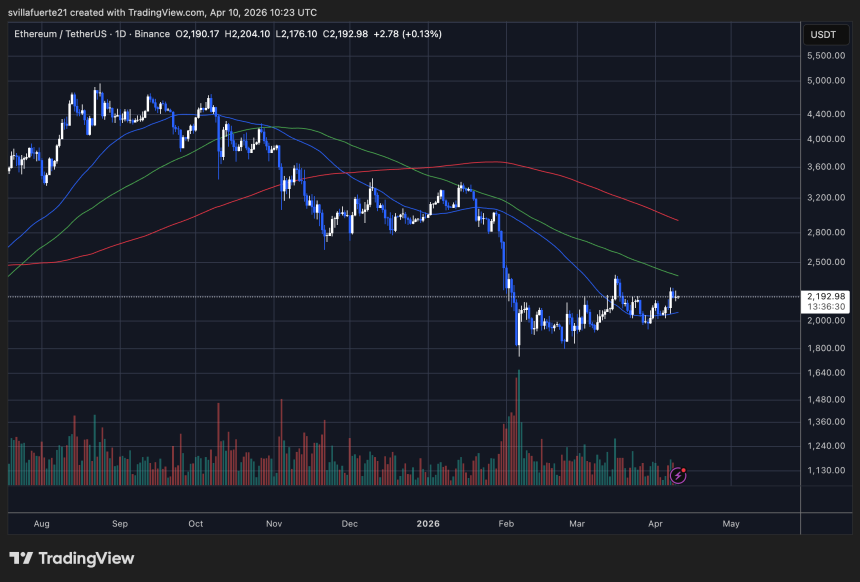
Ethereum testing short-term resistance | Source: ETHUSDT chart on TradingView

This transition is constructive, but not yet decisive. ETH remains below its 100-day (green) and 200-day (red) moving averages, both trending downward, which keeps the broader structure bearish. However, the 50-day moving average (blue) is beginning to flatten and price is interacting closely with it, signaling that short-term momentum is stabilizing.

The key development is the change in behavior. The violent sell-off has been replaced by controlled consolidation, with reduced volatility and more consistent buying on dips. Volume spiked during the February decline, indicating forced liquidations, and has since normalized, suggesting that the market is no longer under stress.

Structurally, Ethereum is transitioning from distribution to early accumulation. A confirmed shift would require a sustained move above the $2,400–$2,600 range, where the 100-day average sits. Until then, this remains a recovery attempt within a broader downtrend, but with improving underlying conditions.

Featured image from ChatGPT, chart from TradingView.com 

Disclaimer: For information purposes only. Past performance is not indicative of future results.
placeholder
Bitcoin CME gaps at $35,000, $27,000 and $21,000, which one gets filled first?Prioritize filling the $27,000 gap and even try higher.
Author  FXStreet
Aug 22, 2023
Prioritize filling the $27,000 gap and even try higher.
placeholder
Pinduoduo Earnings Incoming: Morgan Stanley Sees Long-Term Profit Potential​Insights – On November 21, Chinese e-commerce giant Pinduoduo (PDD) will release its Q3 2024 earnings.
Author  Mitrade
Nov 20, 2024
​Insights – On November 21, Chinese e-commerce giant Pinduoduo (PDD) will release its Q3 2024 earnings.
placeholder
Elon Musk’s xAI and Neuralink Launch New Funding Rounds​Billionaire Elon Musk recently raised funds for his two high-profile tech companies, xAI and Neuralink.
Author  Insights
Jun 03, 2025
​Billionaire Elon Musk recently raised funds for his two high-profile tech companies, xAI and Neuralink.
placeholder
Bitcoin briefly loses 2025 gains as crypto plunges over the weekend.Bitcoin experienced a sharp decline this weekend, briefly erasing its 2025 gains and dipping below its year-opening value of $93,507. The cryptocurrency fell to a low of $93,029 on Sunday, representing a 25% drop from its all-time high in October. Although it has rebounded slightly to around $94,209, the pressures on the market remain significant. The downturn occurred despite the reopening of the U.S. government on Thursday, which many had hoped would provide essential support for crypto markets. This year initially appeared promising for cryptocurrencies, particularly after the inauguration of President Donald Trump, who has established the most pro-crypto administration thus far. However, ongoing political tensions—including Trump's tariff strategies and the recent government shutdown, lasting a historic 43 days—have contributed to several rapid price pullbacks for Bitcoin throughout the year. Market dynamics are also being influenced by Bitcoin whales—investors holding large amounts of Bitcoin—who have been offloading portions of their assets, consequently stalling price rallies even as positive regulatory developments emerge. Despite these sell-offs, analysts from Glassnode argue that this behavior aligns with typical patterns seen among long-term investors during the concluding stages of bull markets, suggesting it is not indicative of a mass exodus. Notably, Bitcoin is not alone in its struggles, as Ethereum and Solana have also recorded declines of 7.95% and 28.3%, respectively, since the start of the year, while numerous altcoins have faced even steeper losses. Looking ahead, questions linger regarding the viability of the four-year cycle thesis, particularly given the increasing institutional support and regulatory frameworks now in place in the crypto landscape. Matt Hougan, chief investment officer at Bitwise, remains optimistic, suggesting a potential Bitcoin resurgence in 2026 driven by the “debasement trade” thesis and a broader trend toward increased adoption of stablecoins, tokenization, and decentralized finance. Hougan emphasized the soundness of the underlying fundamentals, pointing to a positive outlook for the sector in the longer term.
Author  Mitrade
Nov 17, 2025
Bitcoin experienced a sharp decline this weekend, briefly erasing its 2025 gains and dipping below its year-opening value of $93,507. The cryptocurrency fell to a low of $93,029 on Sunday, representing a 25% drop from its all-time high in October. Although it has rebounded slightly to around $94,209, the pressures on the market remain significant. The downturn occurred despite the reopening of the U.S. government on Thursday, which many had hoped would provide essential support for crypto markets. This year initially appeared promising for cryptocurrencies, particularly after the inauguration of President Donald Trump, who has established the most pro-crypto administration thus far. However, ongoing political tensions—including Trump's tariff strategies and the recent government shutdown, lasting a historic 43 days—have contributed to several rapid price pullbacks for Bitcoin throughout the year. Market dynamics are also being influenced by Bitcoin whales—investors holding large amounts of Bitcoin—who have been offloading portions of their assets, consequently stalling price rallies even as positive regulatory developments emerge. Despite these sell-offs, analysts from Glassnode argue that this behavior aligns with typical patterns seen among long-term investors during the concluding stages of bull markets, suggesting it is not indicative of a mass exodus. Notably, Bitcoin is not alone in its struggles, as Ethereum and Solana have also recorded declines of 7.95% and 28.3%, respectively, since the start of the year, while numerous altcoins have faced even steeper losses. Looking ahead, questions linger regarding the viability of the four-year cycle thesis, particularly given the increasing institutional support and regulatory frameworks now in place in the crypto landscape. Matt Hougan, chief investment officer at Bitwise, remains optimistic, suggesting a potential Bitcoin resurgence in 2026 driven by the “debasement trade” thesis and a broader trend toward increased adoption of stablecoins, tokenization, and decentralized finance. Hougan emphasized the soundness of the underlying fundamentals, pointing to a positive outlook for the sector in the longer term.
placeholder
WTI holds steady above $92.00 as Strait of Hormuz remains closed; bulls seem hesitant West Texas Intermediate (WTI) – the benchmark US Crude Oil price – trades with a mild positive bias during the Asian session on Friday, though it lacks bullish conviction amid hopes of Iran ceasefire stabilizing.
Author  FXStreet
Yesterday 01: 35
West Texas Intermediate (WTI) – the benchmark US Crude Oil price – trades with a mild positive bias during the Asian session on Friday, though it lacks bullish conviction amid hopes of Iran ceasefire stabilizing.
goTop
quote