

Google Had Pages. AI Has One Answer. Is It You?

Source Beincrypto

For two decades, the path to discovery in fintech was predictable: run ads, rank on Google, capture clicks, and convert traffic. The funnel was messy, but it was visible. Today, that funnel is breaking.

When a high-intent buyer – whether looking for a SaaS payment processor or a secure crypto custody solution – has a question, they no longer browse ten blue links. They open ChatGPT, Perplexity, or Gemini. The AI responds instantly, naming only two or three platforms and explaining why.

If your brand isn’t mentioned in that single answer, you never got a chance. You quietly lose deals you never knew you were in.
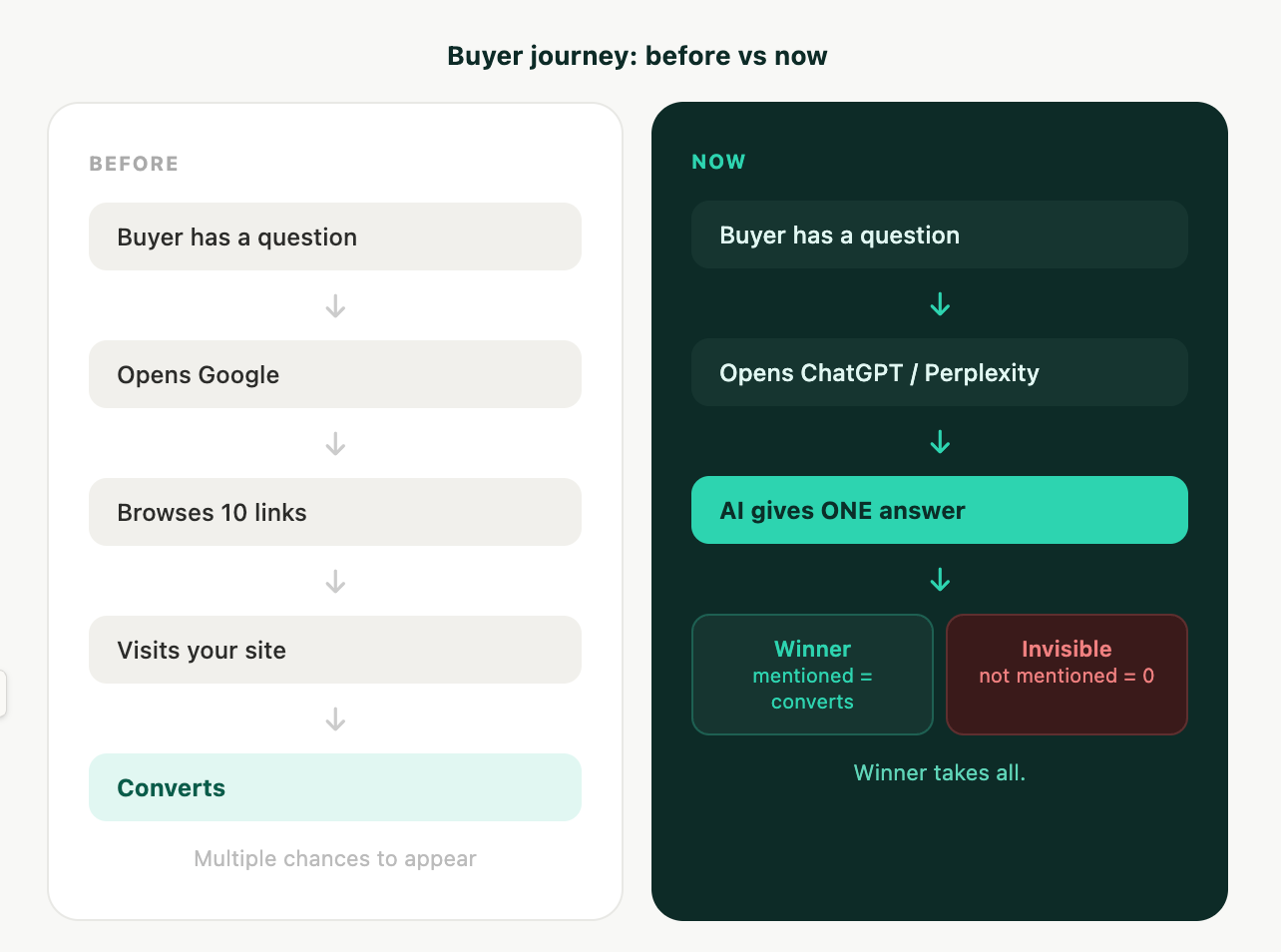
Your Analytics Dashboard Is Lying to You

The most dangerous part of this shift is that the problem is invisible.

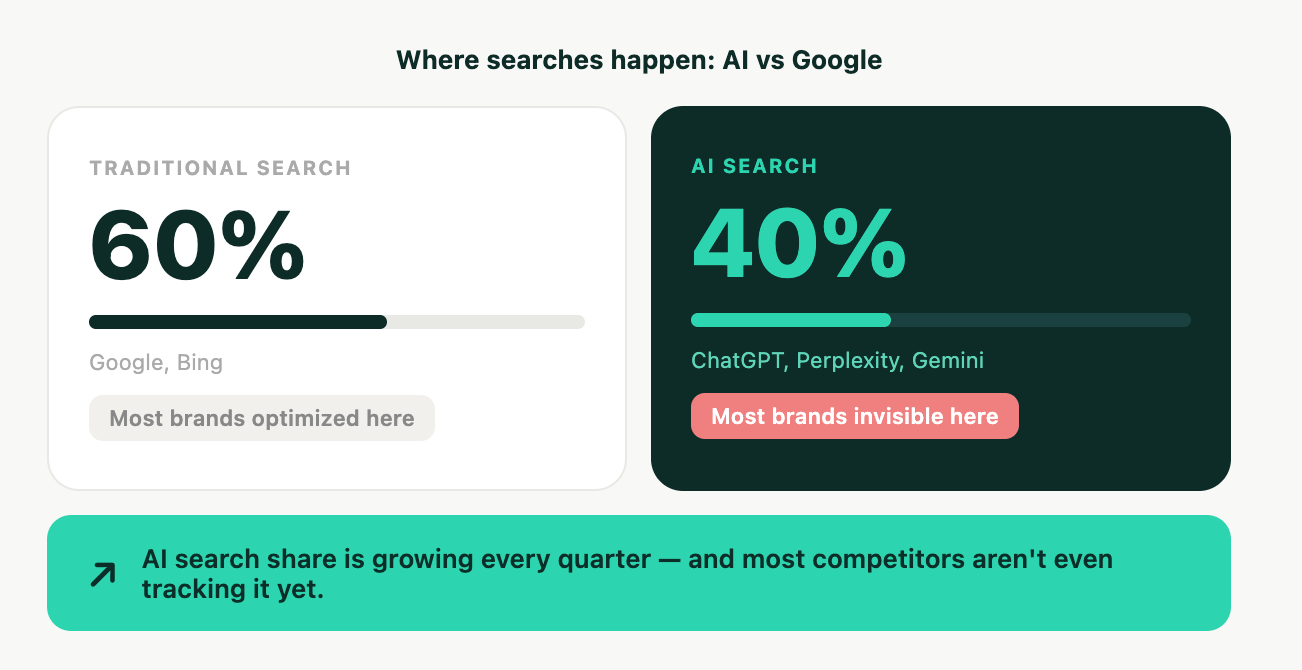
  • The Ghost Trend: Your Google rankings and paid traffic may look stable, while a growing percentage of your highest-intent buyers are asking AI systems for recommendations instead.
  • Attribution Gap: ChatGPT and Perplexity don’t send referral traffic or show up in UTM reports the same way Google does.
  • Market Share Shift: Traditional search now accounts for roughly 60% of queries, while AI search has already captured 40% and is growing every quarter.
The 3 Rules to Appear in AI Answers (AIO)

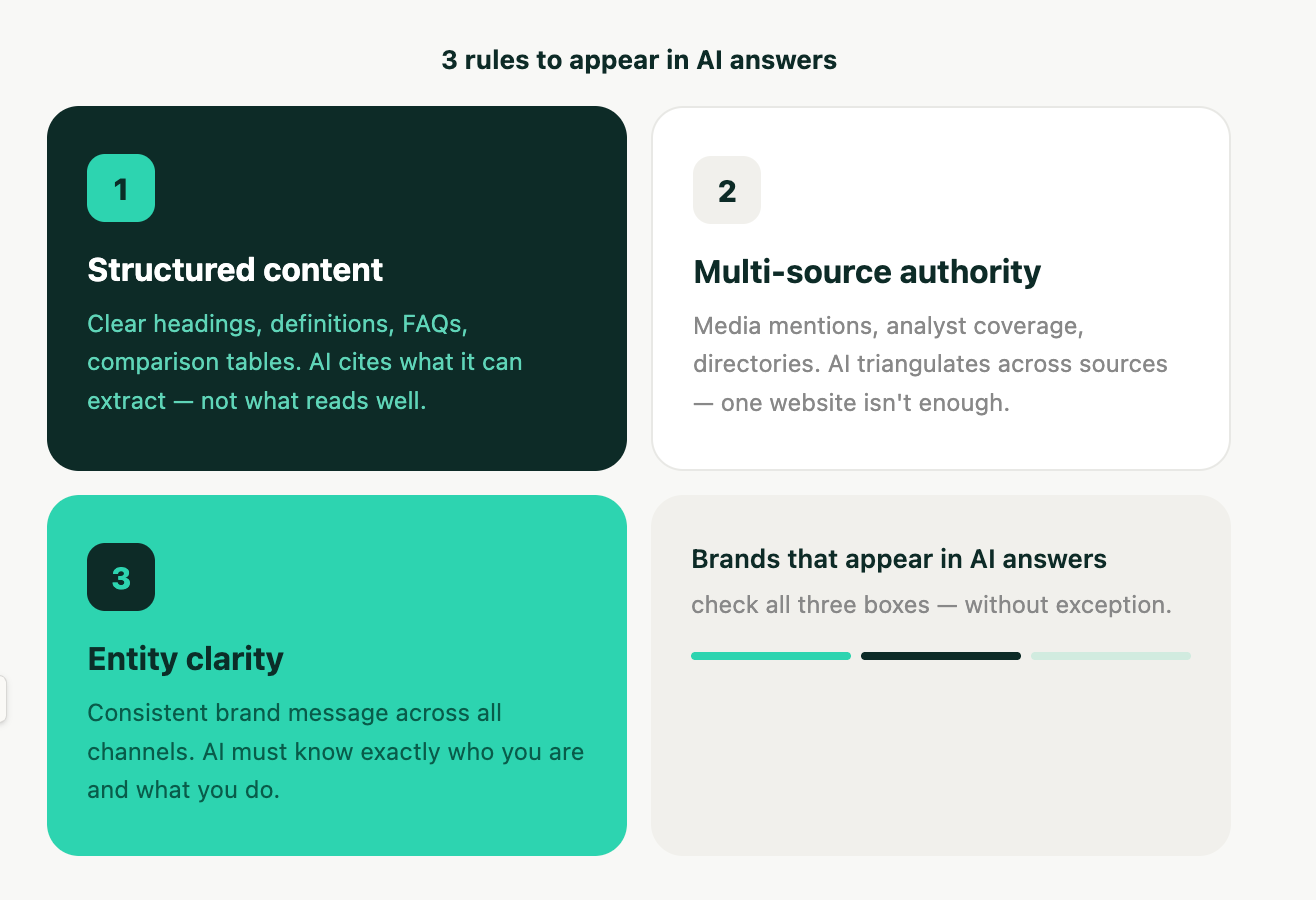
AI systems don’t pick favorites by chance – they cite those who align with their data extraction algorithms. For the crypto industry, where trust is built on code audits and transparency, this is critical.

Structured Content (The Machine Must Be Able to “Read”)

AI doesn’t cite what is “beautifully written”; it cites what is easy to extract.

  • Technical Foundation: Use clear headers, FAQ schemas, and comparison tables.
  • Shift in Focus: Instead of long, fluffy narratives, create “atomic” blocks of information that LLMs can easily synthesize into a direct answer.

Multi-Source Authority (Triangulation of Trust)

LLMs don’t take your website’s word for it – they cross-reference data.

  • Cross-Verification: Your presence in industry-leading media (like BeInCrypto), analyst reports, and independent directories creates a “web of trust”.
  • Social Proof: For crypto projects, this means being mentioned in relevant communities, GitHub discussions, and forums that are indexed by AI.

Entity Clarity

The AI must unequivocally understand who you are, what problem you solve, and for whom.

  • Unified Message: Inconsistent positioning across different resources leads to the AI ignoring your brand due to data uncertainty.
  • Specifics: Clearly define your niche (e.g., “An L2 protocol for scaling gaming dApps”) so the AI can accurately match you to a specific user query.
Real Results from AI Optimization

The results of treating AI search as a distinct channel are measurable and significant:
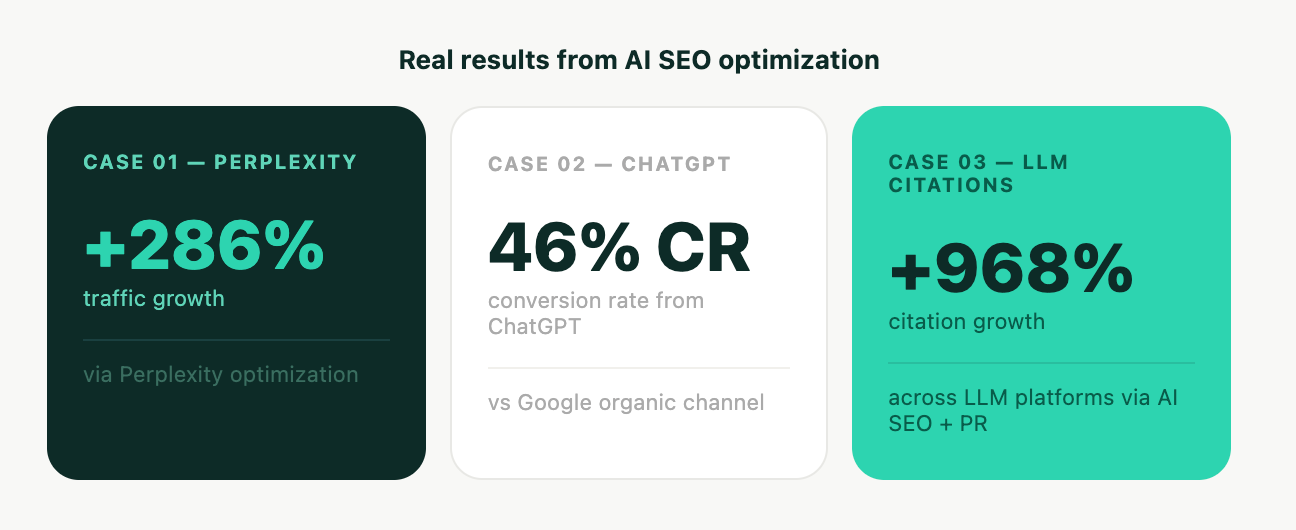
  • Perplexity Optimization: +286% traffic growth.
  • ChatGPT Recommendations: 46% conversion rate compared to traditional organic channels.
  • LLM Citations: +968% growth in brand mentions across AI platforms.

2026: The End of the “Organic” Window

AI search is currently where Google was in the early 2000s – purely organic.

  • The Opportunity: There are currently no paid placements in ChatGPT or sponsored slots in Perplexity. You earn your spot through authority.
  • The Compounding Effect: Unlike Google Ads, AI presence compounds. Brands that establish their citation footprint now become harder to displace over time.

What to do Right Now

The fintech brands that show up in AI answers today didn’t get there by accident.

  1. Audit your visibility: Ask ChatGPT and Perplexity the questions your buyers actually ask.
  2. Close the gaps: Structure your site content for extraction and build your presence across the sources AI trusts.
  3. Clarify your entity: Make it impossible for an LLM to misunderstand your brand’s value proposition.

The window is open for now. Your buyers are already asking AI for recommendations – is your brand in the room when they do?

Editor’s note: These insights are based on data from STIVE, an AI visibility firm working with B2B and fintech brands.

Disclaimer: For information purposes only. Past performance is not indicative of future results.
placeholder
Bitcoin CME gaps at $35,000, $27,000 and $21,000, which one gets filled first?Prioritize filling the $27,000 gap and even try higher.
Author  FXStreet
Aug 22, 2023
Prioritize filling the $27,000 gap and even try higher.
placeholder
Pinduoduo Earnings Incoming: Morgan Stanley Sees Long-Term Profit Potential​Insights – On November 21, Chinese e-commerce giant Pinduoduo (PDD) will release its Q3 2024 earnings.
Author  Mitrade
Nov 20, 2024
​Insights – On November 21, Chinese e-commerce giant Pinduoduo (PDD) will release its Q3 2024 earnings.
placeholder
Elon Musk’s xAI and Neuralink Launch New Funding Rounds​Billionaire Elon Musk recently raised funds for his two high-profile tech companies, xAI and Neuralink.
Author  Insights
Jun 03, 2025
​Billionaire Elon Musk recently raised funds for his two high-profile tech companies, xAI and Neuralink.
placeholder
Bitcoin briefly loses 2025 gains as crypto plunges over the weekend.Bitcoin experienced a sharp decline this weekend, briefly erasing its 2025 gains and dipping below its year-opening value of $93,507. The cryptocurrency fell to a low of $93,029 on Sunday, representing a 25% drop from its all-time high in October. Although it has rebounded slightly to around $94,209, the pressures on the market remain significant. The downturn occurred despite the reopening of the U.S. government on Thursday, which many had hoped would provide essential support for crypto markets. This year initially appeared promising for cryptocurrencies, particularly after the inauguration of President Donald Trump, who has established the most pro-crypto administration thus far. However, ongoing political tensions—including Trump's tariff strategies and the recent government shutdown, lasting a historic 43 days—have contributed to several rapid price pullbacks for Bitcoin throughout the year. Market dynamics are also being influenced by Bitcoin whales—investors holding large amounts of Bitcoin—who have been offloading portions of their assets, consequently stalling price rallies even as positive regulatory developments emerge. Despite these sell-offs, analysts from Glassnode argue that this behavior aligns with typical patterns seen among long-term investors during the concluding stages of bull markets, suggesting it is not indicative of a mass exodus. Notably, Bitcoin is not alone in its struggles, as Ethereum and Solana have also recorded declines of 7.95% and 28.3%, respectively, since the start of the year, while numerous altcoins have faced even steeper losses. Looking ahead, questions linger regarding the viability of the four-year cycle thesis, particularly given the increasing institutional support and regulatory frameworks now in place in the crypto landscape. Matt Hougan, chief investment officer at Bitwise, remains optimistic, suggesting a potential Bitcoin resurgence in 2026 driven by the “debasement trade” thesis and a broader trend toward increased adoption of stablecoins, tokenization, and decentralized finance. Hougan emphasized the soundness of the underlying fundamentals, pointing to a positive outlook for the sector in the longer term.
Author  Mitrade
Nov 17, 2025
Bitcoin experienced a sharp decline this weekend, briefly erasing its 2025 gains and dipping below its year-opening value of $93,507. The cryptocurrency fell to a low of $93,029 on Sunday, representing a 25% drop from its all-time high in October. Although it has rebounded slightly to around $94,209, the pressures on the market remain significant. The downturn occurred despite the reopening of the U.S. government on Thursday, which many had hoped would provide essential support for crypto markets. This year initially appeared promising for cryptocurrencies, particularly after the inauguration of President Donald Trump, who has established the most pro-crypto administration thus far. However, ongoing political tensions—including Trump's tariff strategies and the recent government shutdown, lasting a historic 43 days—have contributed to several rapid price pullbacks for Bitcoin throughout the year. Market dynamics are also being influenced by Bitcoin whales—investors holding large amounts of Bitcoin—who have been offloading portions of their assets, consequently stalling price rallies even as positive regulatory developments emerge. Despite these sell-offs, analysts from Glassnode argue that this behavior aligns with typical patterns seen among long-term investors during the concluding stages of bull markets, suggesting it is not indicative of a mass exodus. Notably, Bitcoin is not alone in its struggles, as Ethereum and Solana have also recorded declines of 7.95% and 28.3%, respectively, since the start of the year, while numerous altcoins have faced even steeper losses. Looking ahead, questions linger regarding the viability of the four-year cycle thesis, particularly given the increasing institutional support and regulatory frameworks now in place in the crypto landscape. Matt Hougan, chief investment officer at Bitwise, remains optimistic, suggesting a potential Bitcoin resurgence in 2026 driven by the “debasement trade” thesis and a broader trend toward increased adoption of stablecoins, tokenization, and decentralized finance. Hougan emphasized the soundness of the underlying fundamentals, pointing to a positive outlook for the sector in the longer term.
placeholder
Gold edges lower below $4,750 amid fragile Middle East ceasefire Gold price (XAU/USD) trades in negative territory around $4,705 during the early Asian session on Thursday. The precious metal edges lower amid a temporary two-week ceasefire between the US and Iran.   
Author  FXStreet
Yesterday 09: 04
Gold price (XAU/USD) trades in negative territory around $4,705 during the early Asian session on Thursday. The precious metal edges lower amid a temporary two-week ceasefire between the US and Iran.   
goTop
quote