

XRP rises as Singapore BLOOM project onboards Ripple to test RLUSD cross-border capabilities

Source Fxstreet
  • XRP rises above $1.42 as crypto prices broadly recover on Wednesday.
  • Ripple joins Singapore’s BLOOM sandbox initiative to test RLUSD stablecoin for cross-border trade settlements.
  • XRP derivatives market strengthens amid growing risk appetite, with futures Open Interest reaching $2.42 billion.

Ripple (XRP) edges up above $1.42 at the time of writing on Wednesday, reflecting a moderately bullish widespread bias that has seen Bitcoin (BTC) extend gains above $71,000.

Ripple to test RLUSD cross-border settlement in Singapore’s BLOOM sandbox

Ripple has been onboarded to participate in BLOOM, an initiative by the Monetary Authority of Singapore (MAS). BLOOM, short for Borderless, Liquid, Open, Online, Multi-currency, is a sandbox designed to support settlement capabilities for tokenized liabilities and regulated stablecoins.

The initiative leverages Ripple’s institutional-grade infrastructure built on the XRP Ledger (XRPL) and the Unloq platform to showcase Singapore’s interoperable settlement infrastructure. Together, Ripple and Unloq aim to utilize assets such as stablecoins and tokenized liabilities to address existing inefficiencies in cross-border trade settlement.

“Built on the XRP Ledger, SC+ Solution, Unloq’s smart-contract-driven trade finance platform uses RLUSD to automatically trigger payments the moment the shipment is verified,” Ripple stated in the press release.

XRP attracts retail interest, ETF inflows

Interest in XRP is gradually improving this week, with futures Open Interest (OI) rising to $2.42 billion on Wednesday from $2.39 billion on Tuesday. Reflecting the notional value of outstanding futures contracts, the OI dropped to $2.33 billion on Monday after peaking at $2.87 on March 17. A persistent increase in OI is required to sustain steady price increases.
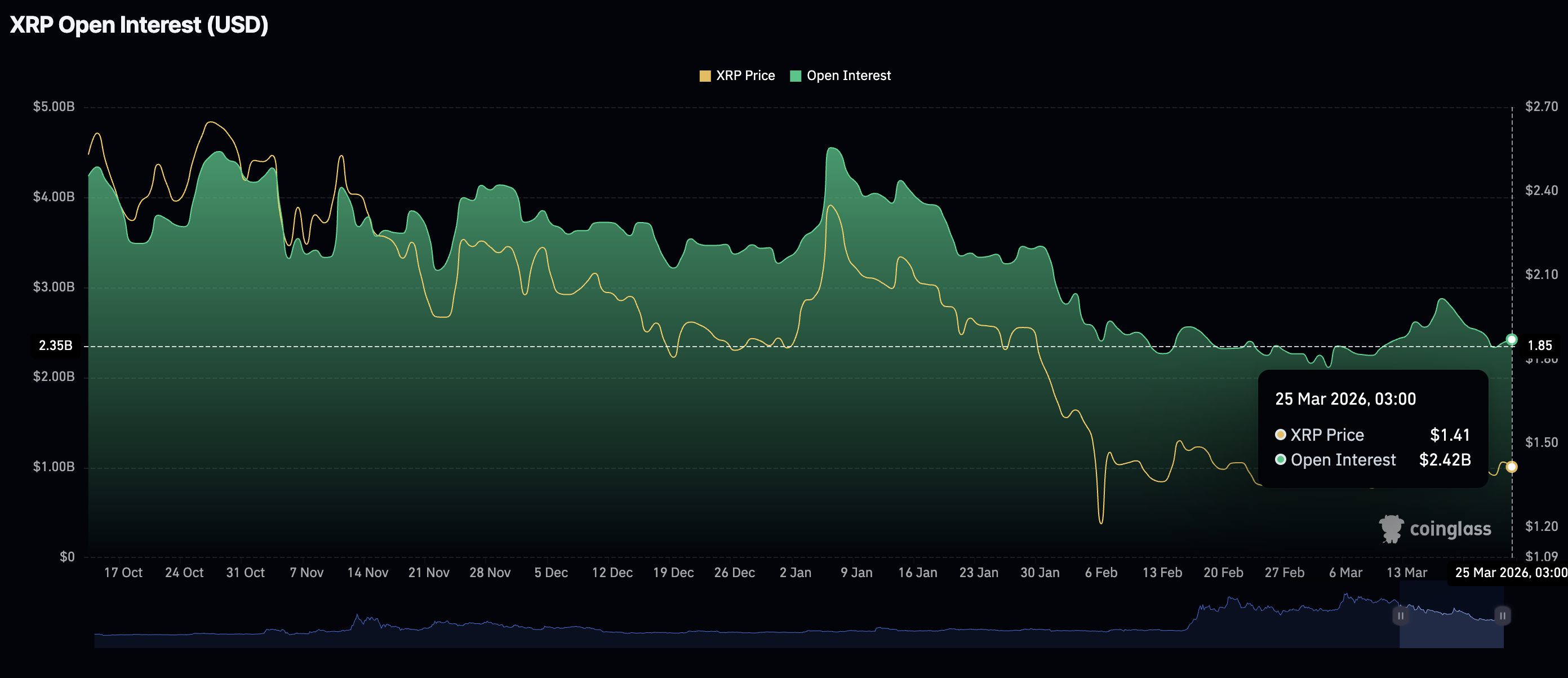
XRP Futures OI | Source: CoinGlass

Meanwhile, unlike Bitcoin and Ethereum Exchange-Traded Funds (ETFs), which saw outflows of $75 million and $41 million, respectively, XRP recorded mild inflows of $1.4 million on Tuesday. SoSoValue data shows net assets under management averaging $978 million while cumulative inflows stand at $1.21 billion.
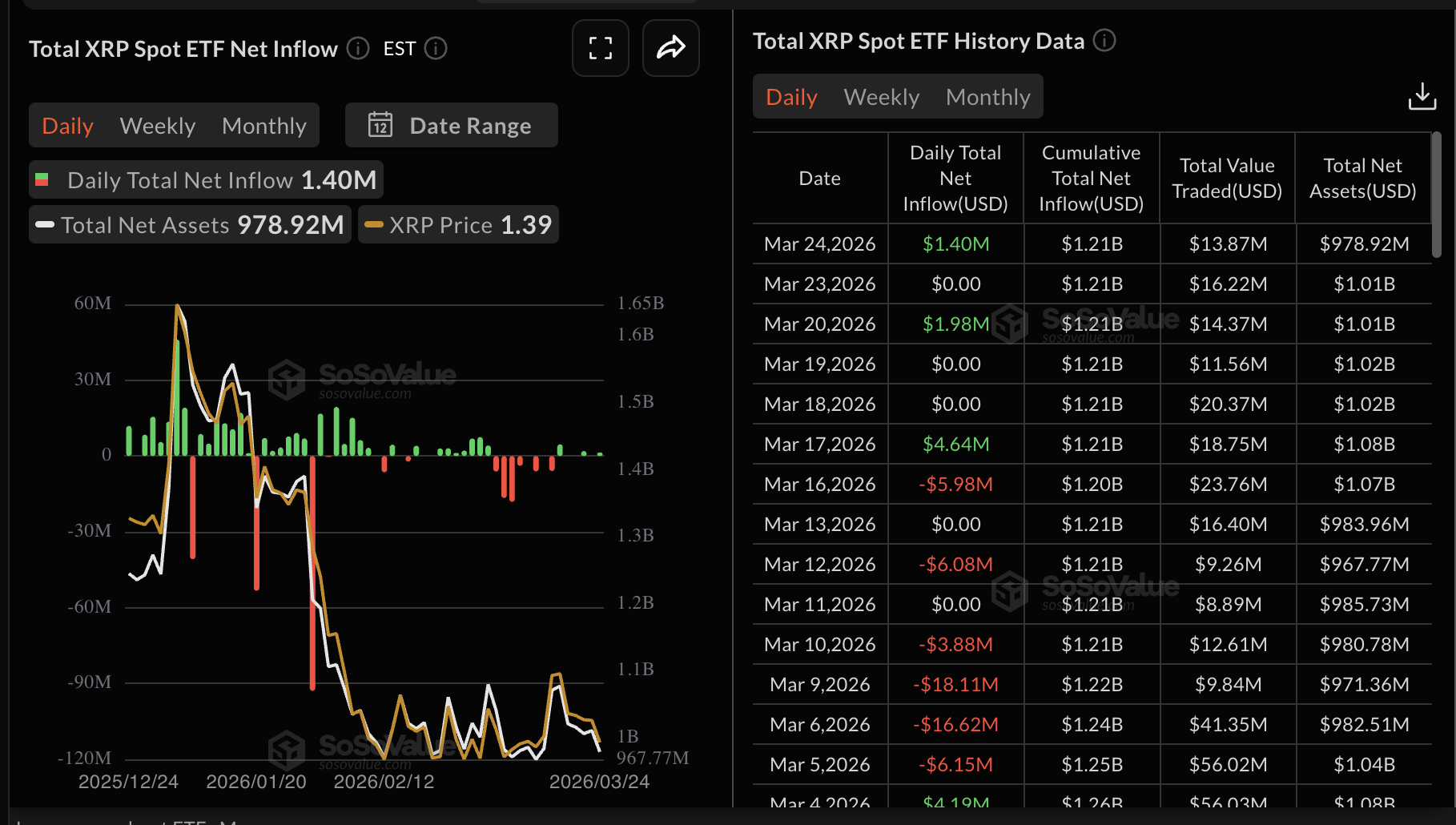
XRP ETF inflows | Source: SoSoValue

Technical outlook: XRP rebound steadies as support holds

XRP hovers above $1.42 amid a mildly bullish outlook, supported by the Moving Average Convergence Divergence (MACD) indicator, which holds marginally above the signal line on the daily chart. The Relative Strength Index (RSI) softens just under the 50 mark on the same chart, reinforcing a consolidative phase rather than a bullish one.

Still, the price holds well below the 50-day, 100-day and 200-day Exponential Moving Averages (EMAs), keeping the broader structure under downside pressure despite the medium-term uptrend line origin near $1.12.

XRP/USDT daily chart

Meanwhile, immediate support lies at $1.40, a pivotal threshold, followed by the weekly low of $1.36, where a decisive close below would open a deeper pullback toward the $1.30 demand zone. On the topside, initial resistance stands at $1.49, aligning with the 50-day EMA. A sustained break above that hurdle would expose XRP to the $1.54 area, which capped the latest rally.

Cryptocurrency metrics FAQs

The developer or creator of each cryptocurrency decides on the total number of tokens that can be minted or issued. Only a certain number of these assets can be minted by mining, staking or other mechanisms. This is defined by the algorithm of the underlying blockchain technology. On the other hand, circulating supply can also be decreased via actions such as burning tokens, or mistakenly sending assets to addresses of other incompatible blockchains.

Market capitalization is the result of multiplying the circulating supply of a certain asset by the asset’s current market value.

Trading volume refers to the total number of tokens for a specific asset that has been transacted or exchanged between buyers and sellers within set trading hours, for example, 24 hours. It is used to gauge market sentiment, this metric combines all volumes on centralized exchanges and decentralized exchanges. Increasing trading volume often denotes the demand for a certain asset as more people are buying and selling the cryptocurrency.

Funding rates are a concept designed to encourage traders to take positions and ensure perpetual contract prices match spot markets. It defines a mechanism by exchanges to ensure that future prices and index prices periodic payments regularly converge. When the funding rate is positive, the price of the perpetual contract is higher than the mark price. This means traders who are bullish and have opened long positions pay traders who are in short positions. On the other hand, a negative funding rate means perpetual prices are below the mark price, and hence traders with short positions pay traders who have opened long positions.

(The technical analysis of this story was written with the help of an AI tool.)

Disclaimer: For information purposes only. Past performance is not indicative of future results.
placeholder
Bitcoin CME gaps at $35,000, $27,000 and $21,000, which one gets filled first?Prioritize filling the $27,000 gap and even try higher.
Author  FXStreet
Aug 22, 2023
Prioritize filling the $27,000 gap and even try higher.
placeholder
Pinduoduo Earnings Incoming: Morgan Stanley Sees Long-Term Profit Potential​Insights – On November 21, Chinese e-commerce giant Pinduoduo (PDD) will release its Q3 2024 earnings.
Author  Mitrade
Nov 20, 2024
​Insights – On November 21, Chinese e-commerce giant Pinduoduo (PDD) will release its Q3 2024 earnings.
placeholder
Elon Musk’s xAI and Neuralink Launch New Funding Rounds​Billionaire Elon Musk recently raised funds for his two high-profile tech companies, xAI and Neuralink.
Author  Insights
Jun 03, 2025
​Billionaire Elon Musk recently raised funds for his two high-profile tech companies, xAI and Neuralink.
placeholder
Bitcoin briefly loses 2025 gains as crypto plunges over the weekend.Bitcoin experienced a sharp decline this weekend, briefly erasing its 2025 gains and dipping below its year-opening value of $93,507. The cryptocurrency fell to a low of $93,029 on Sunday, representing a 25% drop from its all-time high in October. Although it has rebounded slightly to around $94,209, the pressures on the market remain significant. The downturn occurred despite the reopening of the U.S. government on Thursday, which many had hoped would provide essential support for crypto markets. This year initially appeared promising for cryptocurrencies, particularly after the inauguration of President Donald Trump, who has established the most pro-crypto administration thus far. However, ongoing political tensions—including Trump's tariff strategies and the recent government shutdown, lasting a historic 43 days—have contributed to several rapid price pullbacks for Bitcoin throughout the year. Market dynamics are also being influenced by Bitcoin whales—investors holding large amounts of Bitcoin—who have been offloading portions of their assets, consequently stalling price rallies even as positive regulatory developments emerge. Despite these sell-offs, analysts from Glassnode argue that this behavior aligns with typical patterns seen among long-term investors during the concluding stages of bull markets, suggesting it is not indicative of a mass exodus. Notably, Bitcoin is not alone in its struggles, as Ethereum and Solana have also recorded declines of 7.95% and 28.3%, respectively, since the start of the year, while numerous altcoins have faced even steeper losses. Looking ahead, questions linger regarding the viability of the four-year cycle thesis, particularly given the increasing institutional support and regulatory frameworks now in place in the crypto landscape. Matt Hougan, chief investment officer at Bitwise, remains optimistic, suggesting a potential Bitcoin resurgence in 2026 driven by the “debasement trade” thesis and a broader trend toward increased adoption of stablecoins, tokenization, and decentralized finance. Hougan emphasized the soundness of the underlying fundamentals, pointing to a positive outlook for the sector in the longer term.
Author  Mitrade
Nov 17, 2025
Bitcoin experienced a sharp decline this weekend, briefly erasing its 2025 gains and dipping below its year-opening value of $93,507. The cryptocurrency fell to a low of $93,029 on Sunday, representing a 25% drop from its all-time high in October. Although it has rebounded slightly to around $94,209, the pressures on the market remain significant. The downturn occurred despite the reopening of the U.S. government on Thursday, which many had hoped would provide essential support for crypto markets. This year initially appeared promising for cryptocurrencies, particularly after the inauguration of President Donald Trump, who has established the most pro-crypto administration thus far. However, ongoing political tensions—including Trump's tariff strategies and the recent government shutdown, lasting a historic 43 days—have contributed to several rapid price pullbacks for Bitcoin throughout the year. Market dynamics are also being influenced by Bitcoin whales—investors holding large amounts of Bitcoin—who have been offloading portions of their assets, consequently stalling price rallies even as positive regulatory developments emerge. Despite these sell-offs, analysts from Glassnode argue that this behavior aligns with typical patterns seen among long-term investors during the concluding stages of bull markets, suggesting it is not indicative of a mass exodus. Notably, Bitcoin is not alone in its struggles, as Ethereum and Solana have also recorded declines of 7.95% and 28.3%, respectively, since the start of the year, while numerous altcoins have faced even steeper losses. Looking ahead, questions linger regarding the viability of the four-year cycle thesis, particularly given the increasing institutional support and regulatory frameworks now in place in the crypto landscape. Matt Hougan, chief investment officer at Bitwise, remains optimistic, suggesting a potential Bitcoin resurgence in 2026 driven by the “debasement trade” thesis and a broader trend toward increased adoption of stablecoins, tokenization, and decentralized finance. Hougan emphasized the soundness of the underlying fundamentals, pointing to a positive outlook for the sector in the longer term.
placeholder
Gold declines below $4,500 on stalled US-Iran ceasefire talks, US NFP data loomsGold price (XAU/USD) edges lower to near $4,470 during the early Asian session on Friday. The precious metal remains volatile amid ongoing geopolitical turmoil. Traders will closely monitor the developments surrounding the US-Iran peace deal and the US May employment report later on Friday. 
Author  FXStreet
Jun 05, Fri
Gold price (XAU/USD) edges lower to near $4,470 during the early Asian session on Friday. The precious metal remains volatile amid ongoing geopolitical turmoil. Traders will closely monitor the developments surrounding the US-Iran peace deal and the US May employment report later on Friday. 
Related Instrument
goTop
quote