

Analyst Shares Timeline For When A New Bitcoin Bull Run Will Begin This Year

Source Newsbtc

Bitcoin’s recent break above $70,000 is leading to questions of whether this is the start of a new impulsive leg higher or just another stop in a longer bottoming process.

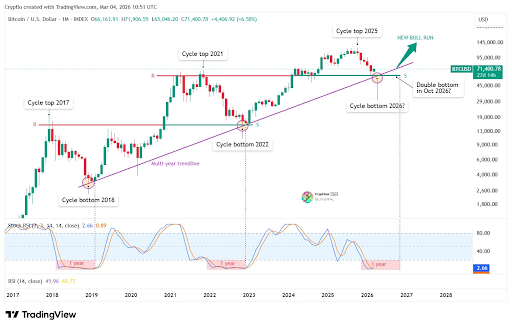
Crypto analyst CrypFlow, posting on X, laid out a technical case for why Bitcoin may be in the early stages of forming a major cycle bottom and why October 2026 could mark the launchpad for the next full-scale bull run. The analysis is based on multi-year trendlines, cycle behavior, and the Stochastic RSI indicator.

Bitcoin Is Respecting Trendline That Has Held Since 2018

Technical analysis of Bitcoin’s price action on the monthly timeframe shows that the leading cryptocurrency’s price action is still respecting a multi-year trendline that has quietly shaped Bitcoin’s biggest cycle lows. That ascending trendline connects the 2018 cycle bottom with the 2022 bottom and now appears to be acting as support again in 2026. Bitcoin’s current position is now sitting right on top of that structure.

CrypFlow also pointed to a major horizontal zone that previously acted as resistance around the 2021 cycle top. That old ceiling around $69,000 is now being tested as support in the current price action. That kind of role reversal is very important for Bitcoin’s price action, because it shows the cryptocurrency may be trying to build a base at the intersection of that old resistance band and the rising trendline.
Bitcoin

If Bitcoin manages to stay above the current zone near $69,000 without falling to the $50,000 region, it would mirror the structure seen at the 2022 bottom. That low formed at a similar confluence where the rising trendline met the previous cycle’s resistance from the 2017 peak.

Timeline For A New Bull Run

Price levels get all the attention. Time gets almost none, and according to CrypFlow, that is precisely where most people are getting this cycle wrong. The analyst pointed to the Stochastic RSI to track how long this indicator has spent below the zero line during each major bear market cycle, and the historical pattern is striking in its consistency. 

In the 2018/2019 cycle, the Stochastic RSI spent approximately 365 days below zero before Bitcoin mounted its real reversal and the next bull market began. The same held true in the 2022/2023 bear market cycle, where Bitcoin spent roughly one full year below zero before the sustained recovery kicked in. This cycle, however, Bitcoin’s Stochastic RSI has only been below zero for around 120 days.

Putting it all together, this opens up a scenario where Bitcoin forms a double bottom later this year, likely around October 2026, before the next major bull run begins. This doesn’t necessarily mean Bitcoin is about to crash further. What it does suggest, according to CrypFlow, is that the price action hasn’t completed the slow, grinding work that true cycle bottoms are built on.

Bitcoin
Disclaimer: For information purposes only. Past performance is not indicative of future results.
placeholder
Bitcoin CME gaps at $35,000, $27,000 and $21,000, which one gets filled first?Prioritize filling the $27,000 gap and even try higher.
Author  FXStreet
Aug 22, 2023
Prioritize filling the $27,000 gap and even try higher.
placeholder
Pinduoduo Earnings Incoming: Morgan Stanley Sees Long-Term Profit Potential​Insights – On November 21, Chinese e-commerce giant Pinduoduo (PDD) will release its Q3 2024 earnings.
Author  Mitrade
Nov 20, 2024
​Insights – On November 21, Chinese e-commerce giant Pinduoduo (PDD) will release its Q3 2024 earnings.
placeholder
The dollar weakened, equities dipped, and gold hit record highsThe dollar weakened, equities fell, and gold set new records on Wednesday as investors waited for a Fed rate cut later in the day.
Author  Cryptopolitan
Sep 17, 2025
The dollar weakened, equities fell, and gold set new records on Wednesday as investors waited for a Fed rate cut later in the day.
placeholder
Bitcoin briefly loses 2025 gains as crypto plunges over the weekend.Bitcoin experienced a sharp decline this weekend, briefly erasing its 2025 gains and dipping below its year-opening value of $93,507. The cryptocurrency fell to a low of $93,029 on Sunday, representing a 25% drop from its all-time high in October. Although it has rebounded slightly to around $94,209, the pressures on the market remain significant. The downturn occurred despite the reopening of the U.S. government on Thursday, which many had hoped would provide essential support for crypto markets. This year initially appeared promising for cryptocurrencies, particularly after the inauguration of President Donald Trump, who has established the most pro-crypto administration thus far. However, ongoing political tensions—including Trump's tariff strategies and the recent government shutdown, lasting a historic 43 days—have contributed to several rapid price pullbacks for Bitcoin throughout the year. Market dynamics are also being influenced by Bitcoin whales—investors holding large amounts of Bitcoin—who have been offloading portions of their assets, consequently stalling price rallies even as positive regulatory developments emerge. Despite these sell-offs, analysts from Glassnode argue that this behavior aligns with typical patterns seen among long-term investors during the concluding stages of bull markets, suggesting it is not indicative of a mass exodus. Notably, Bitcoin is not alone in its struggles, as Ethereum and Solana have also recorded declines of 7.95% and 28.3%, respectively, since the start of the year, while numerous altcoins have faced even steeper losses. Looking ahead, questions linger regarding the viability of the four-year cycle thesis, particularly given the increasing institutional support and regulatory frameworks now in place in the crypto landscape. Matt Hougan, chief investment officer at Bitwise, remains optimistic, suggesting a potential Bitcoin resurgence in 2026 driven by the “debasement trade” thesis and a broader trend toward increased adoption of stablecoins, tokenization, and decentralized finance. Hougan emphasized the soundness of the underlying fundamentals, pointing to a positive outlook for the sector in the longer term.
Author  Mitrade
Nov 17, 2025
Bitcoin experienced a sharp decline this weekend, briefly erasing its 2025 gains and dipping below its year-opening value of $93,507. The cryptocurrency fell to a low of $93,029 on Sunday, representing a 25% drop from its all-time high in October. Although it has rebounded slightly to around $94,209, the pressures on the market remain significant. The downturn occurred despite the reopening of the U.S. government on Thursday, which many had hoped would provide essential support for crypto markets. This year initially appeared promising for cryptocurrencies, particularly after the inauguration of President Donald Trump, who has established the most pro-crypto administration thus far. However, ongoing political tensions—including Trump's tariff strategies and the recent government shutdown, lasting a historic 43 days—have contributed to several rapid price pullbacks for Bitcoin throughout the year. Market dynamics are also being influenced by Bitcoin whales—investors holding large amounts of Bitcoin—who have been offloading portions of their assets, consequently stalling price rallies even as positive regulatory developments emerge. Despite these sell-offs, analysts from Glassnode argue that this behavior aligns with typical patterns seen among long-term investors during the concluding stages of bull markets, suggesting it is not indicative of a mass exodus. Notably, Bitcoin is not alone in its struggles, as Ethereum and Solana have also recorded declines of 7.95% and 28.3%, respectively, since the start of the year, while numerous altcoins have faced even steeper losses. Looking ahead, questions linger regarding the viability of the four-year cycle thesis, particularly given the increasing institutional support and regulatory frameworks now in place in the crypto landscape. Matt Hougan, chief investment officer at Bitwise, remains optimistic, suggesting a potential Bitcoin resurgence in 2026 driven by the “debasement trade” thesis and a broader trend toward increased adoption of stablecoins, tokenization, and decentralized finance. Hougan emphasized the soundness of the underlying fundamentals, pointing to a positive outlook for the sector in the longer term.
placeholder
Silver Price Forecast: XAG/USD falls to near $72.00 amid fading safe-haven demandSilver price (XAG/USD) continues to lose ground after registering tiny losses in the previous day, trading around $72.90 during the Asian hours on Thursday. The safe-haven demand for the precious metal fades amid rising optimism over Middle East peace.
Author  FXStreet
Apr 02, Thu
Silver price (XAG/USD) continues to lose ground after registering tiny losses in the previous day, trading around $72.90 during the Asian hours on Thursday. The safe-haven demand for the precious metal fades amid rising optimism over Middle East peace.
goTop
quote