

The 11% Pi Coin Price Recovery Could Be Setting Up a New Low — Here Is How?

Source Beincrypto

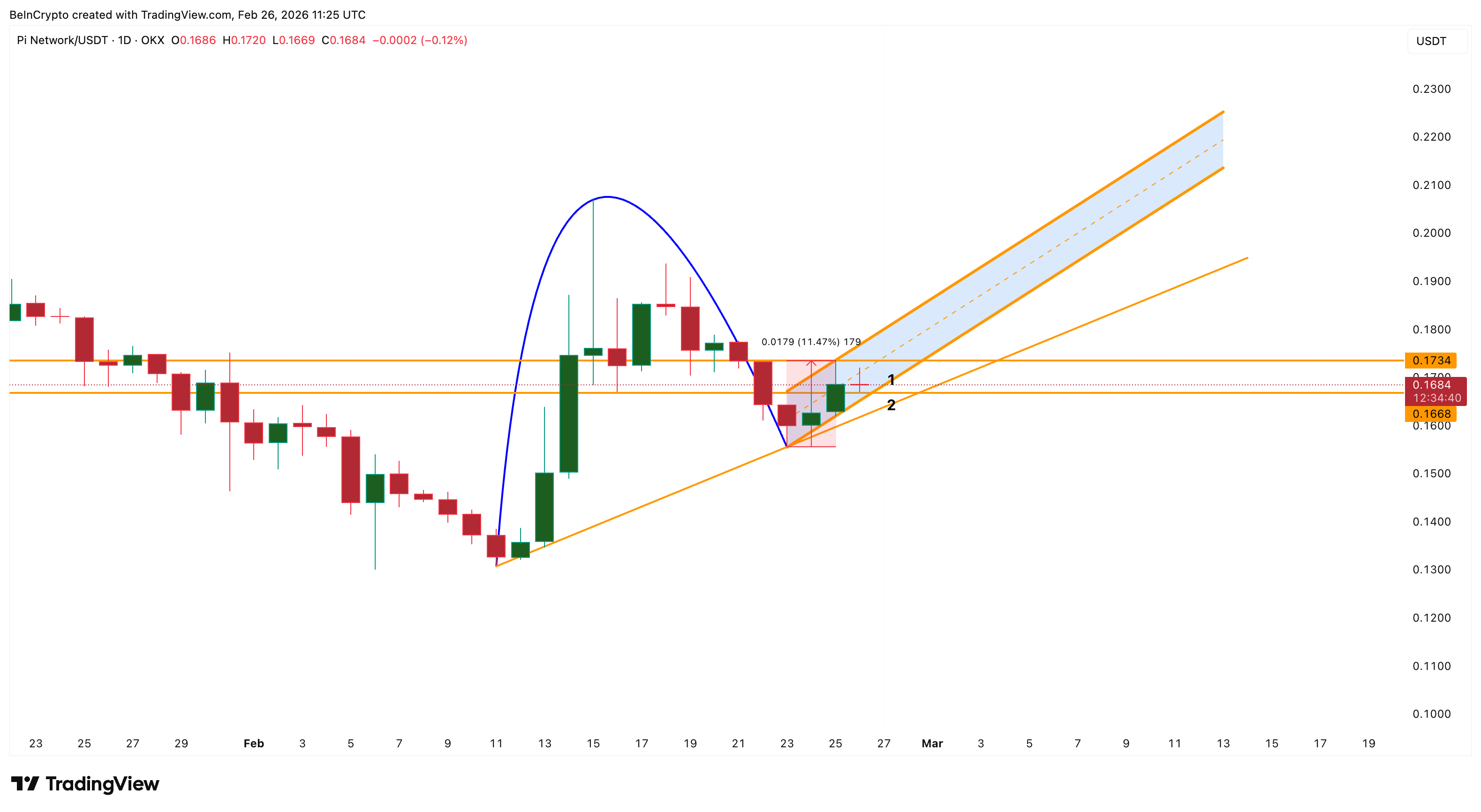
Pi Coin price has rebounded nearly 11% since its February 23 low, climbing back to the $0.174 zone. This kind of recovery usually signals strength and attracts fresh buyers expecting a larger rally.

But this rebound may not be bullish at all. Instead, it may be forming the final phase of a bearish structure. At the same time, retail traders are aggressively buying the dip, even as deeper indicators show the recovery is weakening. This creates a situation where the rebound itself could increase the risk of a fresh drop, courtesy of a technical pattern.

Pi Coin Rebound Is Happening Inside a Bearish Pattern, Yet Retail Buys Anyway

Pi Coin’s rebound is currently forming an inverted cup-and-handle pattern, a bearish structure that often leads to price declines. The current price rise represents the handle portion of this pattern. Handle rebounds often appear strong, but they typically fail below resistance and lead to breakdowns.
Pi Coin Price StructurePi Coin Price Structure: TradingView

Want more token insights like this? Sign up for Editor Harsh Notariya’s Daily Crypto Newsletter here.

At the same time, money and volume indicators show a dangerous contradiction.

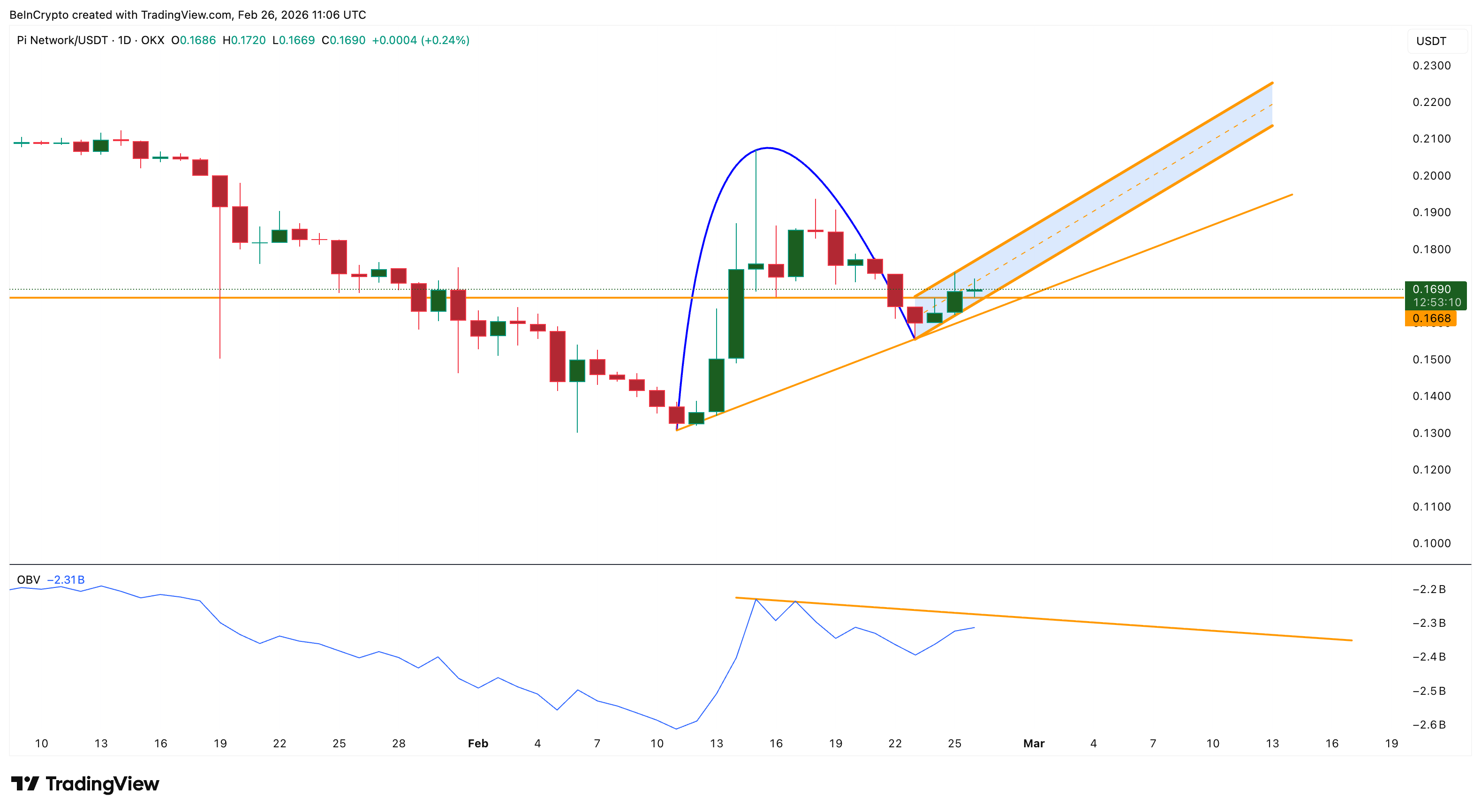
The On-Balance Volume (OBV), which tracks buying volume, has been rising steadily since February 23. This shows that traders are actively buying the dip and supporting the rebound. A push above the descending trendline could extend the dangerous rebound further, while keeping the entrants interested.
Pi Coin OBVPi Coin OBV: TradingView

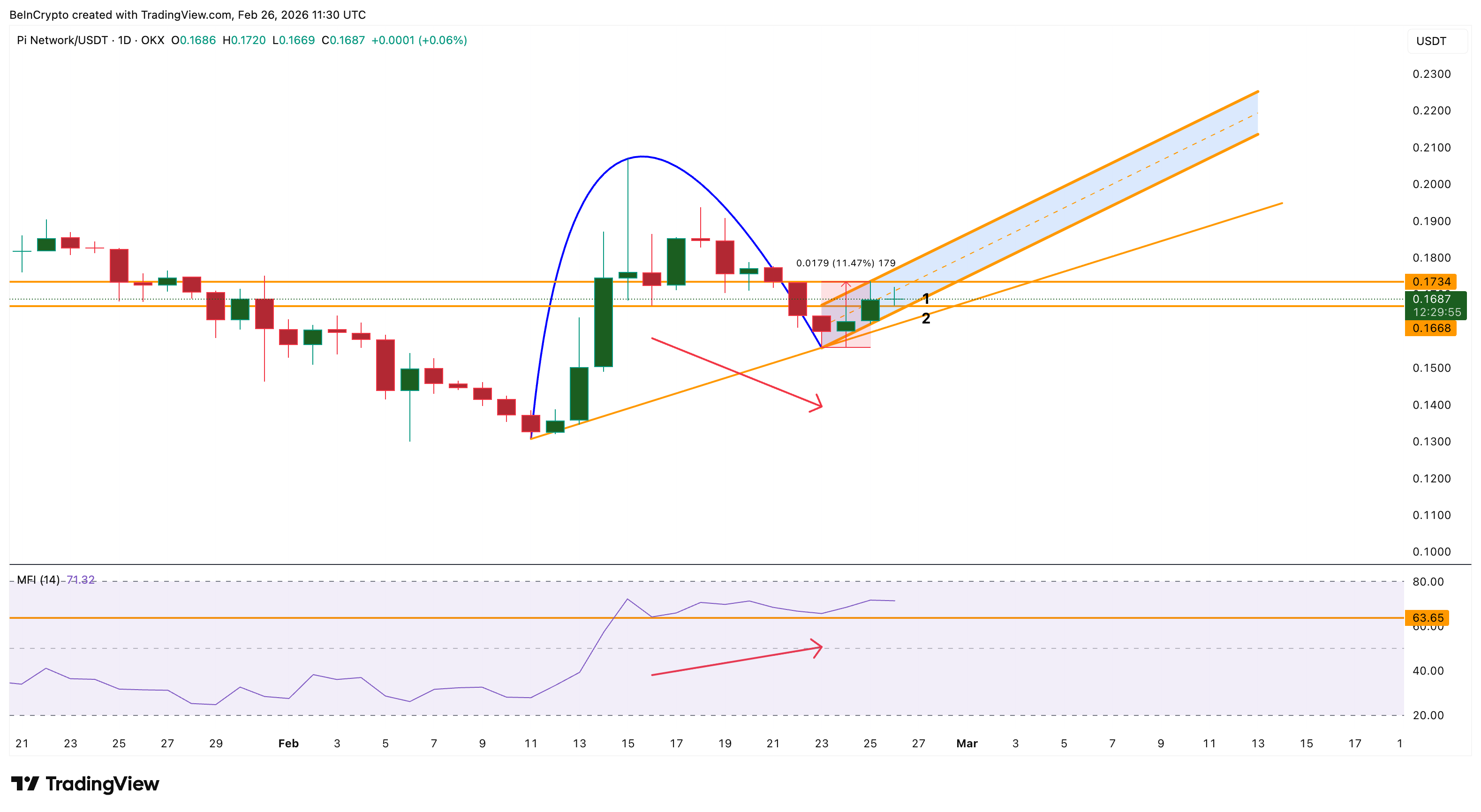
The Money Flow Index (MFI), which measures buying pressure using price and volume, confirms this behavior. Between February 16 and February 23, Pi Coin price continued falling and formed lower lows. But during the same period, MFI formed higher lows. This creates a bullish divergence in MFI.
Dip Buying Remains StrongDip Buying Remains Strong: TradingView

A bullish divergence happens when buying pressure increases even while the price falls. The OBV-MFI rise confirms aggressive dip-buying. But this is exactly what makes the situation dangerous. Retail buying is possibly increasing, but the PI price is still trapped inside a bearish structure. This creates the conditions for a potential trap.

Momentum Is Rising, But Price Strength Remains Weak

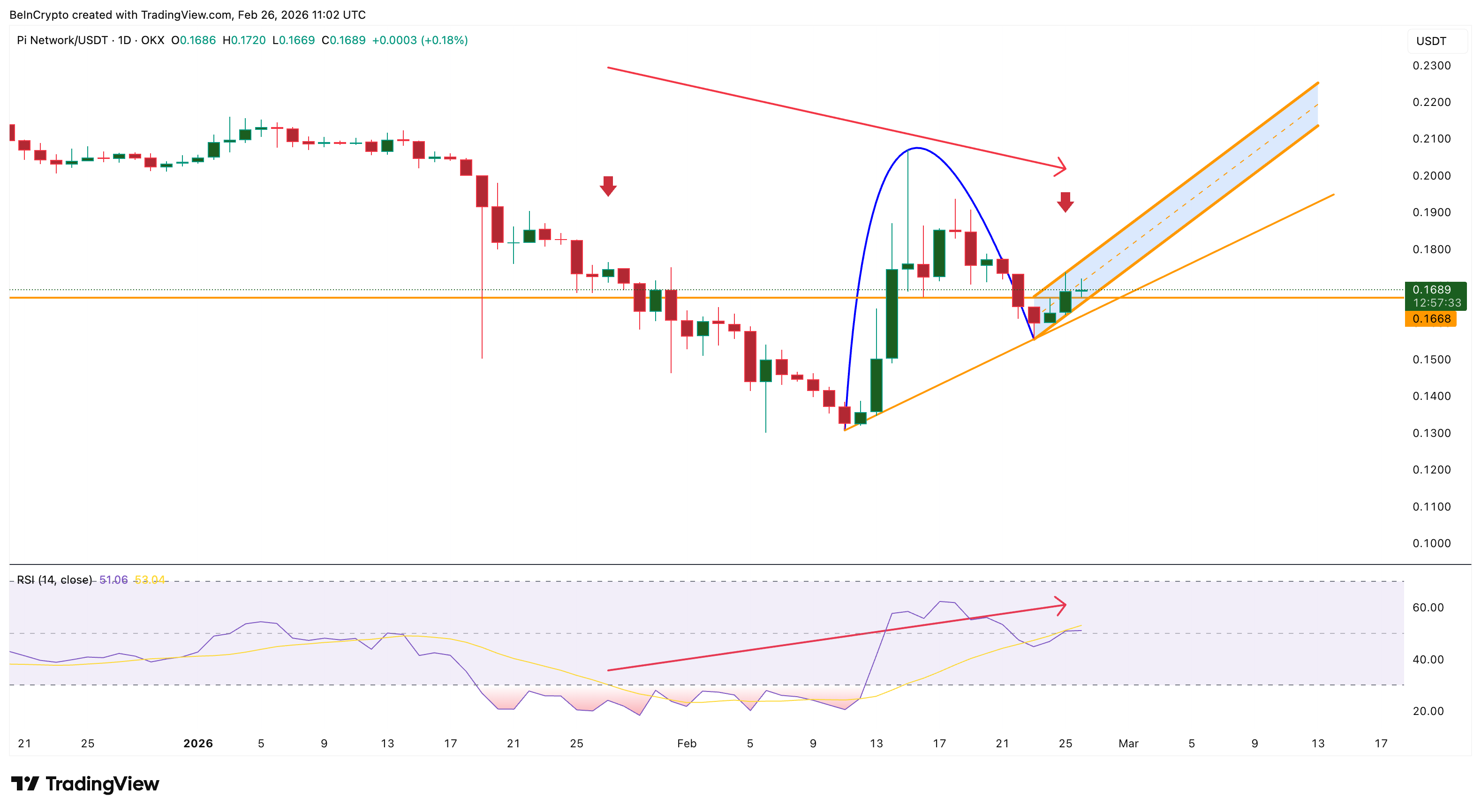
The weakness becomes clearer when looking at momentum strength compared to price structure. Between January 27 and February 25, the Pi Coin price formed a lower high. This means the rebound remained weaker than the previous rally and confirmed that the broader trend is still down.

At the same time, the Relative Strength Index (RSI), which measures momentum strength, formed a higher high. This creates a hidden bearish divergence.
RSI Flashes CautionRSI Flashes Caution: TradingView

A hidden bearish divergence happens when momentum rises, but the price fails to break resistance. This usually signals that buyers are losing control, and the rebound may soon reverse into a pullback, extending the broader downtrend. When this happens inside a bearish chart pattern, the probability of a breakdown increases

This confirms that even though the Pi Coin price is rising, sellers might still be in control. But if retail is buying, who is selling?

Larger Investors Are Quietly Selling the Pi Network Token

The contradiction becomes even more significant when examining large-scale financial activity. The Chaikin Money Flow (CMF), which tracks whether money is entering or leaving an asset, has been falling steadily and remains below zero. This shows that overall capital is still leaving Pi Coin.

This creates another bearish divergence. The Pi Coin price trended higher between February 11 and February 24, whereas the CMF, the technical proxy for large money, trended lower.
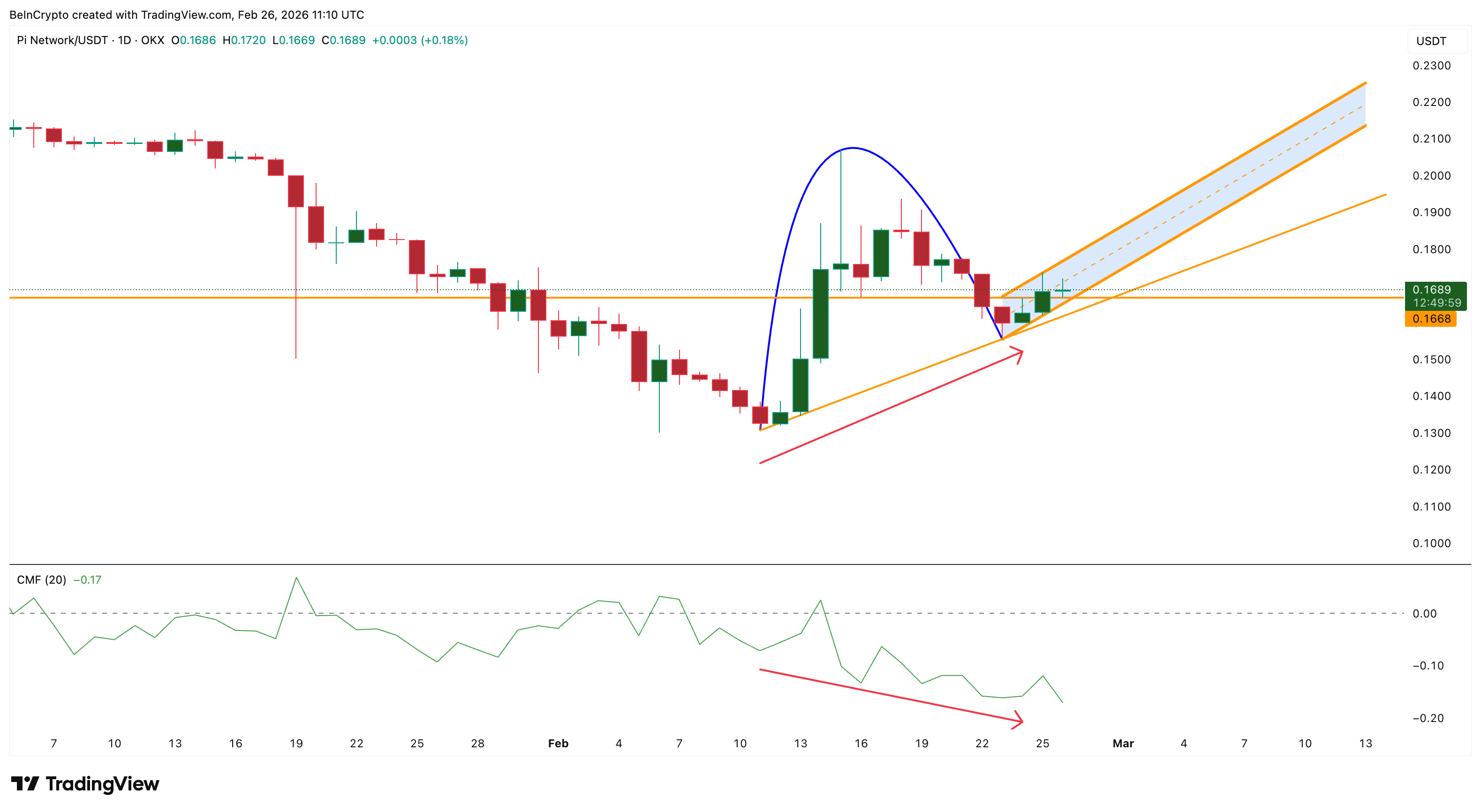
Money Flows Out Of PIMoney Flows Out Of PI: TradingView

This strongly suggests that larger investors are likely selling into the rebound while retail traders continue buying. This type of behavior often appears before breakdowns. Retail buying helps push prices higher temporarily, but without support from larger investors, the move becomes unsustainable. This explains why Pi Coin’s rebound may be misleading and could even be a trap.

Pi Coin Price Levels Now Decide Whether Recovery Fails or Survives

Pi Coin is now approaching the most critical stage of this structure. If Pi Coin falls below $0.161, the bearish inverted cup and handle breakdown would likely confirm. This could push Pi Coin toward $0.130 (current low) and potentially as low as $0.122, which would mark a new low.

This would confirm that the 11% rebound was only a temporary recovery inside a larger downtrend. However, recovery is still possible if buyers regain control.
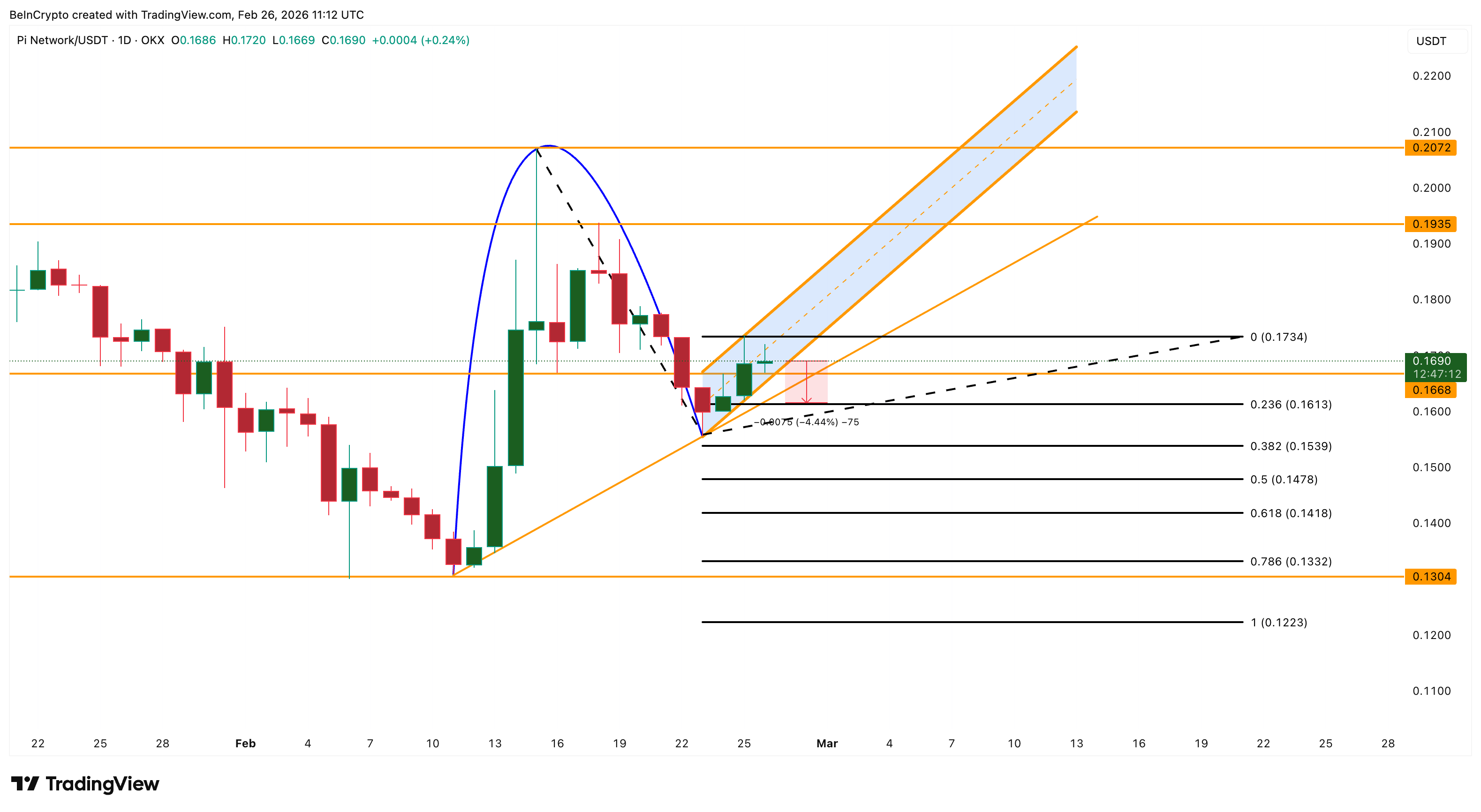
Pi Coin Price AnalysisPi Coin Price Analysis: TradingView

A move above $0.173 would show early strength returning. A break above $0.193 would weaken the bearish pattern significantly. A move above $0.207 would invalidate the bearish structure completely.

Until those resistance levels are reclaimed, the risk remains that Pi Coin’s rebound is not the start of a recovery. Instead, it may be the setup for the next decline.

Disclaimer: For information purposes only. Past performance is not indicative of future results.
placeholder
Bitcoin CME gaps at $35,000, $27,000 and $21,000, which one gets filled first?Prioritize filling the $27,000 gap and even try higher.
Author  FXStreet
Aug 22, 2023
Prioritize filling the $27,000 gap and even try higher.
placeholder
Pinduoduo Earnings Incoming: Morgan Stanley Sees Long-Term Profit Potential​Insights – On November 21, Chinese e-commerce giant Pinduoduo (PDD) will release its Q3 2024 earnings.
Author  Mitrade
Nov 20, 2024
​Insights – On November 21, Chinese e-commerce giant Pinduoduo (PDD) will release its Q3 2024 earnings.
placeholder
Elon Musk’s xAI and Neuralink Launch New Funding Rounds​Billionaire Elon Musk recently raised funds for his two high-profile tech companies, xAI and Neuralink.
Author  Insights
Jun 03, 2025
​Billionaire Elon Musk recently raised funds for his two high-profile tech companies, xAI and Neuralink.
placeholder
Bitcoin briefly loses 2025 gains as crypto plunges over the weekend.Bitcoin experienced a sharp decline this weekend, briefly erasing its 2025 gains and dipping below its year-opening value of $93,507. The cryptocurrency fell to a low of $93,029 on Sunday, representing a 25% drop from its all-time high in October. Although it has rebounded slightly to around $94,209, the pressures on the market remain significant. The downturn occurred despite the reopening of the U.S. government on Thursday, which many had hoped would provide essential support for crypto markets. This year initially appeared promising for cryptocurrencies, particularly after the inauguration of President Donald Trump, who has established the most pro-crypto administration thus far. However, ongoing political tensions—including Trump's tariff strategies and the recent government shutdown, lasting a historic 43 days—have contributed to several rapid price pullbacks for Bitcoin throughout the year. Market dynamics are also being influenced by Bitcoin whales—investors holding large amounts of Bitcoin—who have been offloading portions of their assets, consequently stalling price rallies even as positive regulatory developments emerge. Despite these sell-offs, analysts from Glassnode argue that this behavior aligns with typical patterns seen among long-term investors during the concluding stages of bull markets, suggesting it is not indicative of a mass exodus. Notably, Bitcoin is not alone in its struggles, as Ethereum and Solana have also recorded declines of 7.95% and 28.3%, respectively, since the start of the year, while numerous altcoins have faced even steeper losses. Looking ahead, questions linger regarding the viability of the four-year cycle thesis, particularly given the increasing institutional support and regulatory frameworks now in place in the crypto landscape. Matt Hougan, chief investment officer at Bitwise, remains optimistic, suggesting a potential Bitcoin resurgence in 2026 driven by the “debasement trade” thesis and a broader trend toward increased adoption of stablecoins, tokenization, and decentralized finance. Hougan emphasized the soundness of the underlying fundamentals, pointing to a positive outlook for the sector in the longer term.
Author  Mitrade
Nov 17, 2025
Bitcoin experienced a sharp decline this weekend, briefly erasing its 2025 gains and dipping below its year-opening value of $93,507. The cryptocurrency fell to a low of $93,029 on Sunday, representing a 25% drop from its all-time high in October. Although it has rebounded slightly to around $94,209, the pressures on the market remain significant. The downturn occurred despite the reopening of the U.S. government on Thursday, which many had hoped would provide essential support for crypto markets. This year initially appeared promising for cryptocurrencies, particularly after the inauguration of President Donald Trump, who has established the most pro-crypto administration thus far. However, ongoing political tensions—including Trump's tariff strategies and the recent government shutdown, lasting a historic 43 days—have contributed to several rapid price pullbacks for Bitcoin throughout the year. Market dynamics are also being influenced by Bitcoin whales—investors holding large amounts of Bitcoin—who have been offloading portions of their assets, consequently stalling price rallies even as positive regulatory developments emerge. Despite these sell-offs, analysts from Glassnode argue that this behavior aligns with typical patterns seen among long-term investors during the concluding stages of bull markets, suggesting it is not indicative of a mass exodus. Notably, Bitcoin is not alone in its struggles, as Ethereum and Solana have also recorded declines of 7.95% and 28.3%, respectively, since the start of the year, while numerous altcoins have faced even steeper losses. Looking ahead, questions linger regarding the viability of the four-year cycle thesis, particularly given the increasing institutional support and regulatory frameworks now in place in the crypto landscape. Matt Hougan, chief investment officer at Bitwise, remains optimistic, suggesting a potential Bitcoin resurgence in 2026 driven by the “debasement trade” thesis and a broader trend toward increased adoption of stablecoins, tokenization, and decentralized finance. Hougan emphasized the soundness of the underlying fundamentals, pointing to a positive outlook for the sector in the longer term.
placeholder
Silver Price Forecast: XAG/USD falls to near $72.00 amid fading safe-haven demandSilver price (XAG/USD) continues to lose ground after registering tiny losses in the previous day, trading around $72.90 during the Asian hours on Thursday. The safe-haven demand for the precious metal fades amid rising optimism over Middle East peace.
Author  FXStreet
Apr 02, Thu
Silver price (XAG/USD) continues to lose ground after registering tiny losses in the previous day, trading around $72.90 during the Asian hours on Thursday. The safe-haven demand for the precious metal fades amid rising optimism over Middle East peace.
goTop
quote