

Most Crypto Assets Need To Go To Zero, Research Firm Says

Source Newsbtc

Castle Labs is arguing that crypto’s long tail is structurally overbuilt and that most tokens will ultimately be priced toward zero unless they can prove real business traction and tighter token alignment. The thesis, published in a long X post, frames the current market as a selection phase rather than a broad-based recovery story.

The core point is not that crypto itself is failing, but that token supply has far outpaced sustainable demand. Castle Labs says the result is a market where a handful of majors dominate while thousands of smaller assets compete for shrinking liquidity.

Too Many Crypto Tokens

Castle Labs points to concentration data to make the case. According to the post, the top five crypto assets account for 84.4% of total market capitalization, leaving the rest of the market with 15.6%, or roughly $330 billion, spread across thousands of tokens.

It contrasts that with US equities, where the MAG7 represent 31% of the market and the S&P 500 represents 84.7%. In Castle Labs’ framing, crypto has reached roughly the same concentration level as the top 500 US companies, but with only five assets doing the heavy lifting.

“Over the years, so many coins have been created that 99% of them need to go to zero for the industry’s good,” the firm wrote. It adds that the mismatch has become harder to ignore for investors who bought into crypto’s institutional adoption narrative but remain deep underwater in alt-heavy portfolios.

Castle Labs outlines three broad paths for rebalancing: majors lose share to smaller tokens, external liquidity lifts the broader market, or weaker tokens lose value while majors absorb more of the capital. It argues the third outcome is the most likely, even if the first would be healthier in theory.

A major part of the argument is simple market mechanics. Castle Labs says token unlocks will continue to add supply into a market where demand is already selective, citing $8.51 billion in unlock value this year and $17.12 billion over the next five years.

That overhang, it argues, is colliding with poor business performance across much of the sector. Out of more than 5,600 protocols listed on DeFiLlama, Castle Labs says only 76 generated more than $1 million in revenue in the last 30 days, and only 237 cleared $100,000.

Revenue is concentrated too. The post says the top 10 protocols in 2025 accounted for 80% of total crypto revenue, while the top three accounted for 64%, with Tether alone representing 44%. It also notes that only three of those top 10 revenue generators had launched tokens so far: Hyperliquid, Pumpfun, and Jupiter and says only HYPE materially outperformed.

That backdrop helps explain Castle Labs’ skepticism toward new listings. It says there were about 118 major token launches in 2025, and 84.7% traded below their TGE valuation, which it describes as evidence of inflated launch pricing and weak post-launch structure.

The Alignment Problem

Castle Labs also argues the market is punishing tokens that are not economically aligned with the products they represent. It cites Circle’s acquisition of Interop Labs, where Axelar’s token AXL was not part of the deal, as an example of product value and token value diverging.

“Tokens are not a legal representation of the business and don’t offer any actual rights over the company’s profits, unlike equity,” the firm wrote. “Investors, when they receive tokens, have these rights through the equity they hold. So they are in a better position, but token holders? They are at the project’s mercy when it comes to aligning their product with their token.”

In that framework, buybacks are treated as one of the clearest signs of alignment. Castle Labs highlights Hyperliquid and Aave, and says Uniswap is only fully aligned with tokenholders after more than five years of its token’s existence.

The firm’s conclusion is blunt but specific: capital should rotate toward protocols with real revenue, tokenholder alignment, and credible mechanisms to offset dilution. Whether that thesis holds in the next cycle may depend less on narrative and more on whether more projects adopt the kind of KPI- and revenue-led launch models Castle Labs says are now starting to emerge.

At press time, the total crypto market cap stood at $2.16 trillion.
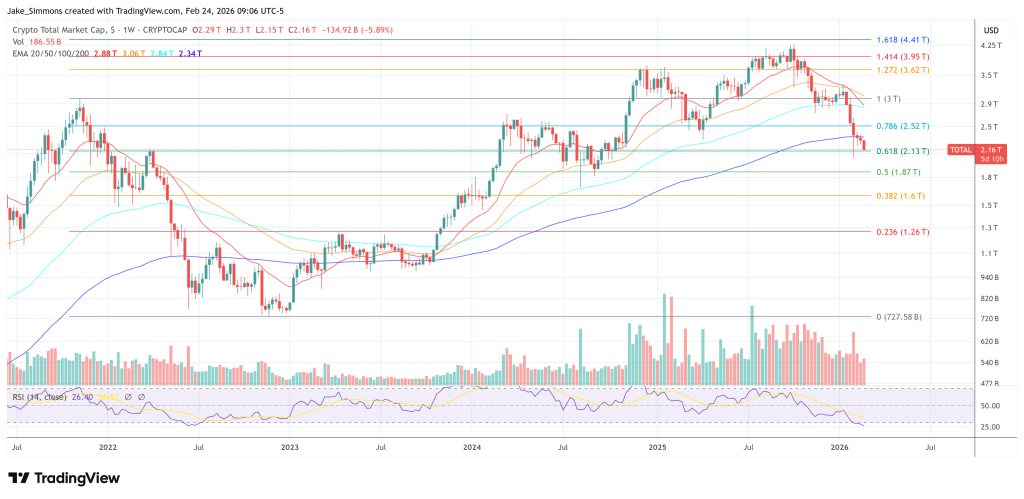
Total crypto market cap
Disclaimer: For information purposes only. Past performance is not indicative of future results.
placeholder
Bitcoin CME gaps at $35,000, $27,000 and $21,000, which one gets filled first?Prioritize filling the $27,000 gap and even try higher.
Author  FXStreet
Aug 22, 2023
Prioritize filling the $27,000 gap and even try higher.
placeholder
Pinduoduo Earnings Incoming: Morgan Stanley Sees Long-Term Profit Potential​Insights – On November 21, Chinese e-commerce giant Pinduoduo (PDD) will release its Q3 2024 earnings.
Author  Mitrade
Nov 20, 2024
​Insights – On November 21, Chinese e-commerce giant Pinduoduo (PDD) will release its Q3 2024 earnings.
placeholder
Elon Musk’s xAI and Neuralink Launch New Funding Rounds​Billionaire Elon Musk recently raised funds for his two high-profile tech companies, xAI and Neuralink.
Author  Insights
Jun 03, 2025
​Billionaire Elon Musk recently raised funds for his two high-profile tech companies, xAI and Neuralink.
placeholder
Bitcoin briefly loses 2025 gains as crypto plunges over the weekend.Bitcoin experienced a sharp decline this weekend, briefly erasing its 2025 gains and dipping below its year-opening value of $93,507. The cryptocurrency fell to a low of $93,029 on Sunday, representing a 25% drop from its all-time high in October. Although it has rebounded slightly to around $94,209, the pressures on the market remain significant. The downturn occurred despite the reopening of the U.S. government on Thursday, which many had hoped would provide essential support for crypto markets. This year initially appeared promising for cryptocurrencies, particularly after the inauguration of President Donald Trump, who has established the most pro-crypto administration thus far. However, ongoing political tensions—including Trump's tariff strategies and the recent government shutdown, lasting a historic 43 days—have contributed to several rapid price pullbacks for Bitcoin throughout the year. Market dynamics are also being influenced by Bitcoin whales—investors holding large amounts of Bitcoin—who have been offloading portions of their assets, consequently stalling price rallies even as positive regulatory developments emerge. Despite these sell-offs, analysts from Glassnode argue that this behavior aligns with typical patterns seen among long-term investors during the concluding stages of bull markets, suggesting it is not indicative of a mass exodus. Notably, Bitcoin is not alone in its struggles, as Ethereum and Solana have also recorded declines of 7.95% and 28.3%, respectively, since the start of the year, while numerous altcoins have faced even steeper losses. Looking ahead, questions linger regarding the viability of the four-year cycle thesis, particularly given the increasing institutional support and regulatory frameworks now in place in the crypto landscape. Matt Hougan, chief investment officer at Bitwise, remains optimistic, suggesting a potential Bitcoin resurgence in 2026 driven by the “debasement trade” thesis and a broader trend toward increased adoption of stablecoins, tokenization, and decentralized finance. Hougan emphasized the soundness of the underlying fundamentals, pointing to a positive outlook for the sector in the longer term.
Author  Mitrade
Nov 17, 2025
Bitcoin experienced a sharp decline this weekend, briefly erasing its 2025 gains and dipping below its year-opening value of $93,507. The cryptocurrency fell to a low of $93,029 on Sunday, representing a 25% drop from its all-time high in October. Although it has rebounded slightly to around $94,209, the pressures on the market remain significant. The downturn occurred despite the reopening of the U.S. government on Thursday, which many had hoped would provide essential support for crypto markets. This year initially appeared promising for cryptocurrencies, particularly after the inauguration of President Donald Trump, who has established the most pro-crypto administration thus far. However, ongoing political tensions—including Trump's tariff strategies and the recent government shutdown, lasting a historic 43 days—have contributed to several rapid price pullbacks for Bitcoin throughout the year. Market dynamics are also being influenced by Bitcoin whales—investors holding large amounts of Bitcoin—who have been offloading portions of their assets, consequently stalling price rallies even as positive regulatory developments emerge. Despite these sell-offs, analysts from Glassnode argue that this behavior aligns with typical patterns seen among long-term investors during the concluding stages of bull markets, suggesting it is not indicative of a mass exodus. Notably, Bitcoin is not alone in its struggles, as Ethereum and Solana have also recorded declines of 7.95% and 28.3%, respectively, since the start of the year, while numerous altcoins have faced even steeper losses. Looking ahead, questions linger regarding the viability of the four-year cycle thesis, particularly given the increasing institutional support and regulatory frameworks now in place in the crypto landscape. Matt Hougan, chief investment officer at Bitwise, remains optimistic, suggesting a potential Bitcoin resurgence in 2026 driven by the “debasement trade” thesis and a broader trend toward increased adoption of stablecoins, tokenization, and decentralized finance. Hougan emphasized the soundness of the underlying fundamentals, pointing to a positive outlook for the sector in the longer term.
placeholder
Silver Price Forecast: XAG/USD falls to near $72.00 amid fading safe-haven demandSilver price (XAG/USD) continues to lose ground after registering tiny losses in the previous day, trading around $72.90 during the Asian hours on Thursday. The safe-haven demand for the precious metal fades amid rising optimism over Middle East peace.
Author  FXStreet
Apr 02, Thu
Silver price (XAG/USD) continues to lose ground after registering tiny losses in the previous day, trading around $72.90 during the Asian hours on Thursday. The safe-haven demand for the precious metal fades amid rising optimism over Middle East peace.
goTop
quote