


Gold struggles near $4,000 as US Dollar strengthens ahead of Fed decision
- Gold trades under pressure as the US Dollar extends its rebound ahead of the Fed decision.
- The Fed is expected to hold rates steady, with traders looking for clues on a December hike.
- The technical picture remains weak, with momentum indicators favouring sellers.
Gold (XAU/USD) fluctuates near the $4,000 mark on Tuesday after posting modest gains at the start of the week. The metal struggles as the US Dollar (USD) extends its rebound following recent weakness, with traders repositioning ahead of the Federal Reserve’s (Fed) monetary policy announcement on Wednesday. At the time of writing, XAU/USD trades around $4,012, holding above last week’s three-month low of $3,975.
The US Dollar Index (DXY), which tracks the Greenback’s value against a basket of six major currencies, rises to a two-week high above 102.00 after touching 101.45 last week, its lowest level since October 1. A stronger US Dollar makes Gold more expensive for buyers using other currencies.
Dollar support builds as markets refocus on Fed and energy backdrop
Strategists at ING note that the Dollar has “found good support early this week,” as stabilising AI-related sentiment has allowed markets to “reconnect with the broader supportive backdrop of a hawkish Federal Reserve and high energy prices.” They add that “pre-FOMC positioning may also be kicking in,” with the forward-looking FX market viewing Chair Kevin Warsh’s “reiteration of inflation commitments as reinforcing the structural floor for the Dollar.” ING concludes that, in line with their earlier preview, they “sympathise with this view and expect a broadly supported Dollar this week.”
The US central bank is expected to keep rates unchanged after raising them by 25 basis points (bps) in September to 3.75%-4.00%, its first increase since 2023, as rising energy costs linked to the war in the Middle East added to inflation pressures.
With a pause widely expected, traders will focus on the policy statement and Chair Kevin Warsh’s press conference for clues about the next move. September’s updated dot plot showed a median rate projection of 4.1% for both end-2026 and end-2027, signalling one further quarter-point hike this year and no net change next year. Against this backdrop, traders price in around an 80% probability of another rate hike in December, according to the CME FedWatch Tool.
A hawkish message could leave Gold vulnerable to a sustained break below $4,000. On the other hand, an emphasis on taking time to assess incoming data could offer the metal some relief. Even so, a stronger recovery may remain difficult while inflation remains above the Fed’s 2% target and elevated energy costs threaten to keep price pressures high for longer. While Gold is often viewed as a hedge against inflation, higher interest rates increase the opportunity cost of holding the metal, which generates no yield.
West Texas Intermediate (WTI) Crude Oil trades around $101.50 per barrel as traders weigh diplomatic efforts against supply risks. Saudi Arabia, Turkey and Pakistan held talks with Iranian officials in Tehran on Monday, with the four countries agreeing to continue discussions. However, security risks to ships in the Strait of Hormuz and Houthi strikes on Saudi Arabia keep supply concerns alive.
Technical analysis: $4,000-$3,950 support zone in focus as sellers dominate
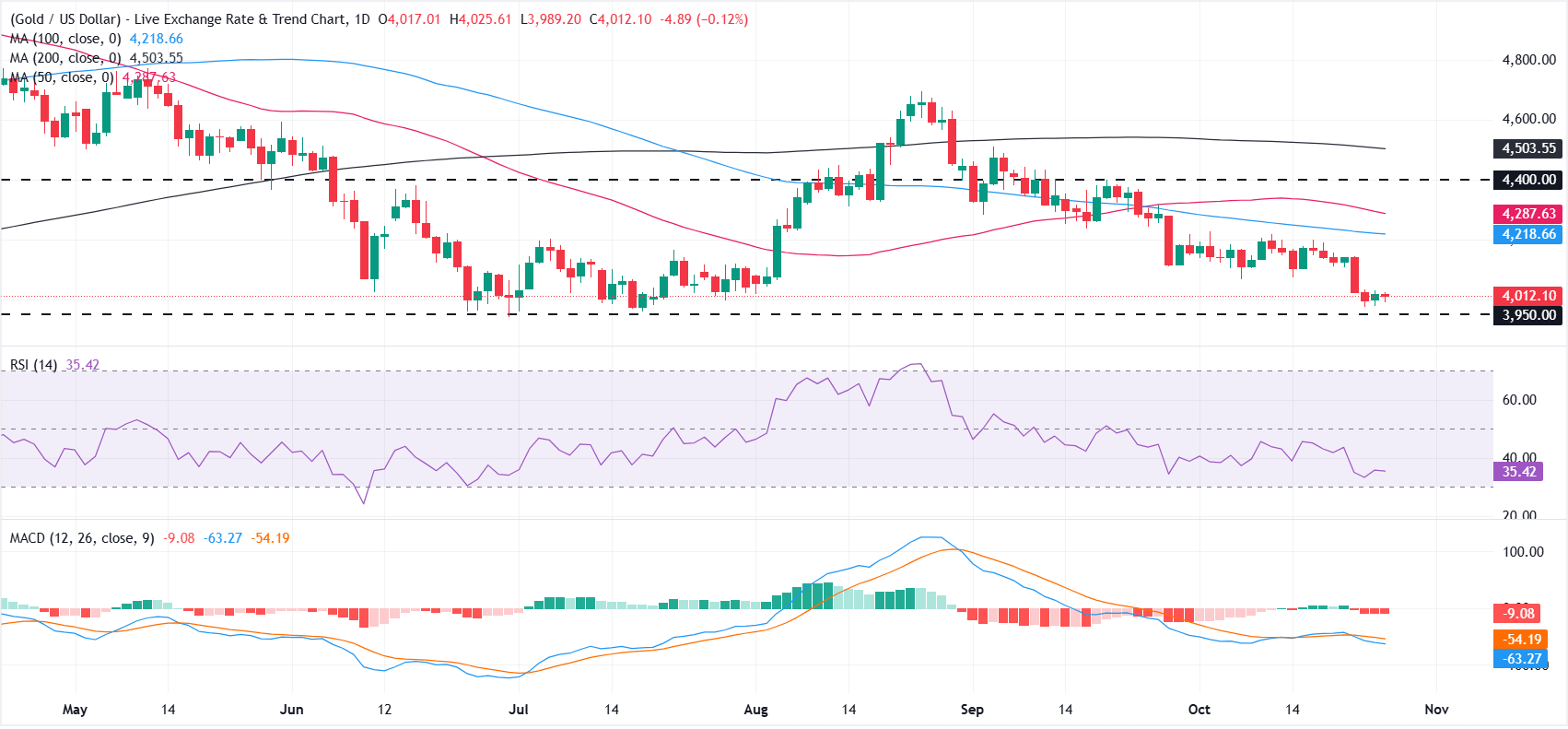
On the daily chart, XAU/USD maintains a bearish near-term bias as it trades below the 50-day, 100-day and 200-day Simple Moving Averages (SMAs), keeping sellers in control. The Relative Strength Index (RSI) at 35 points to weak buying momentum, while the Moving Average Convergence Divergence (MACD) remains in negative territory, suggesting that downside pressure persists.
On the upside, initial resistance stands at the 100-day SMA near $4,219, followed by the 50-day SMA at $4,288. A stronger recovery could bring the horizontal resistance at $4,400 into focus, ahead of the 200-day SMA around $4,504.
On the downside, the $4,000-$3,950 zone acts as immediate support, where a break would open the door to a deeper retracement, while recovery attempts are likely to struggle as long as price trades beneath the clustered daily moving averages.
(The technical analysis of this story was written with the help of an AI tool. Know more.)
Fed FAQs
Monetary policy in the US is shaped by the Federal Reserve (Fed). The Fed has two mandates: to achieve price stability and foster full employment. Its primary tool to achieve these goals is by adjusting interest rates. When prices are rising too quickly and inflation is above the Fed’s 2% target, it raises interest rates, increasing borrowing costs throughout the economy. This results in a stronger US Dollar (USD) as it makes the US a more attractive place for international investors to park their money. When inflation falls below 2% or the Unemployment Rate is too high, the Fed may lower interest rates to encourage borrowing, which weighs on the Greenback.
The Federal Reserve (Fed) holds eight policy meetings a year, where the Federal Open Market Committee (FOMC) assesses economic conditions and makes monetary policy decisions. The FOMC is attended by twelve Fed officials – the seven members of the Board of Governors, the president of the Federal Reserve Bank of New York, and four of the remaining eleven regional Reserve Bank presidents, who serve one-year terms on a rotating basis.
In extreme situations, the Federal Reserve may resort to a policy named Quantitative Easing (QE). QE is the process by which the Fed substantially increases the flow of credit in a stuck financial system. It is a non-standard policy measure used during crises or when inflation is extremely low. It was the Fed’s weapon of choice during the Great Financial Crisis in 2008. It involves the Fed printing more Dollars and using them to buy high grade bonds from financial institutions. QE usually weakens the US Dollar.
Quantitative tightening (QT) is the reverse process of QE, whereby the Federal Reserve stops buying bonds from financial institutions and does not reinvest the principal from the bonds it holds maturing, to purchase new bonds. It is usually positive for the value of the US Dollar.
Recommended Articles


