


Bloom Energy Stock Has Plunged Despite Explosive Growth. Is It Time to Buy?
Key Points
Bloom Energy recently reported outstanding third-quarter results.
Despite that, the company's stock price continued its recent downward trend.
Bloom still trades at a premium valuation, which could impact future returns.
- 10 stocks we like better than Bloom Energy ›
Sometimes, even extraordinary growth isn't enough to satisfy investors. Bloom Energy (NYSE:BE) recently reported a 138% surge in quarterly revenue, significantly improved its profitability, and raised its full-year guidance. Yet its stock has tumbled more than 40% from its high, including slumping after reporting earnings. The disconnect highlights an important investing lesson: A company's business can be performing exceptionally well even as its shares deliver disappointing returns.
Here's a look at whether the nearly 40% price discount makes the energy stock a buy or if its valuation is still too high.
Missed Nvidia in 2009? This Rare Signal Is Flashing Again. In 2009, a "Double Down" signal flashed for a little-known chipmaker called Nvidia. For the first time in years, that same "Total Conviction" signal is flashing for a company 1/100th the size of Nvidia. Continue »
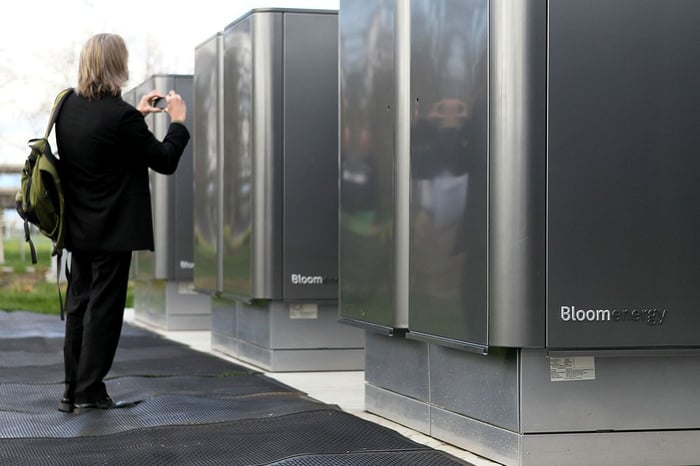
Image source: Getty Images.
Bloom Energy's business is firing on all cylinders
Bloom Energy's third-quarter results were nothing short of astounding. The company's revenue rocketed 138% to $1.2 billion. Its margins significantly expanded, driving a massive improvement in profitability (operating income increased from $7.8 million to $225.4 million). Meanwhile, it reported earnings of $0.78 per share, a vast improvement over the year-ago loss of $0.10 per share.
The company continued to capitalize on surging power demand from AI data centers and other power-hungry customers. Its on-site fuel cells are enabling companies to meet their energy needs at a time when grid connectivity is increasingly constrained. This strong demand is driving the company to boost its full-year outlook again. Bloom now expects to deliver $4.4 billion to $4.6 billion in revenue this year, a 122% increase at the midpoint. This accelerating demand is why the company's stock price has skyrocketed 1,700% over the past three years even after accounting for its recent slump.
Why is Bloom's stock falling despite its outstanding results?
Typically, a quarter as strong as Bloom's would send its stock soaring. However, Bloom's stock sank despite record revenue and a stellar outlook. I'd attribute that to two concerns.
First, while Bloom's earnings are growing, it's not converting earnings into cash flow. The company used $27 million in cash to support its operating activities in the third quarter (compared with positive cash flow from operating activities in the second quarter and the year-ago period). Add in $153.5 million of capital expenditures (significantly higher compared to prior periods), and its free cash flow was negative $181 million. That's not a huge concern as Bloom has nearly $2.5 billion of cash and equivalents on its balance sheet to absorb this expense, but it is worth watching.
The other factor is valuation. Bloom Energy expects to generate $3.10 to $3.40 per share of adjusted earnings this year. At its recent price of around $210 per share, Bloom trades at nearly 65 times earnings. That's expensive, as the S&P 500 Index and Nasdaq-100 Index trade between 19 and 21 times forward earnings.
Is Bloom Energy stock a buy?
Bloom Energy's roughly 40% decline from its peak has certainly shifted the risk/reward profile. However, it's not a screaming bargain by any means. For example, if Bloom Energy grows its adjusted earnings per share at a 25% compound annual rate over the next five years, its share price would be only around $250 if the company's valuation multiple compresses to 25 times earnings. That's about a 3%-4% annualized return. Bloom would have to deliver brisk growth while maintaining a premium valuation multiple to deliver a strong return.
That's certainly possible. Energy research firm Rystad Energy estimates that investments in fuel cells for data centers will rise from $2.8 billion last year to $30 billion by 2030. As the fuel cell leader, Bloom Energy will be one of the biggest beneficiaries. Its growing scale and industry partnerships could drive robust growth in revenue, earnings, and cash flow over the next several years.
The tension investors need to reconcile is the company's rapid growth against its premium valuation. Even after its sharp sell-off, the stock trades at a valuation that requires exceptional growth for years to come while maintaining a premium valuation multiple. Investors with a high risk tolerance might find the pullback intriguing, but I'd prefer to see an even more attractive valuation before buying more shares.
Should you buy stock in Bloom Energy right now?
Before you buy stock in Bloom Energy, consider this:
The Motley Fool Stock Advisor analyst team just identified what they believe are the 10 best stocks for investors to buy now… and Bloom Energy wasn’t one of them. The 10 stocks that made the cut could produce monster returns in the coming years.
Consider when Netflix made this list on December 17, 2004... if you invested $1,000 at the time of our recommendation, you’d have $355,124!* Or when Nvidia made this list on April 15, 2005... if you invested $1,000 at the time of our recommendation, you’d have $1,296,254!*
Now, it’s worth noting Stock Advisor’s total average return is 901% — a market-crushing outperformance compared to 210% for the S&P 500. Don't miss the latest top 10 list, available with Stock Advisor, and join an investing community built by individual investors for individual investors.
See the 10 stocks »
*Stock Advisor returns as of October 27, 2026.
Matt DiLallo has positions in Bloom Energy. The Motley Fool has positions in and recommends Bloom Energy. The Motley Fool has a disclosure policy.
Recommended Articles


