


Australian Dollar inches higher due to waning likelihood of early rate cuts from the RBA
- The Australian Dollar appreciates as the RBA is widely expected to maintain its hawkish policy stance in November.
- The commodity-linked AUD receives support from stimulus measures in China, Australia’s largest trading partner.
- The risk-sensitive AUD/USD pair could struggle as US President Biden stated that Israel could strike Iran's Oil infrastructure.
The Australian Dollar (AUD) gains ground due to the hawkish outlook surrounding the Reserve Bank of Australia (RBA). Recent data showed retail sales growth for August exceeding expectations, reducing the chances of an early rate cut from the RBA. Markets have nearly ruled out a rate cut in November. Furthermore, the AUD is benefiting from stimulus measures in China, Australia’s largest trading partner, which have lifted commodity prices.
The risk-sensitive AUD/USD pair could encounter headwinds as rising geopolitical tensions in the Middle East weigh on risk appetite. US President Joe Biden stated that the United States (US) is in discussions with Israel about potential strikes on Iran's Oil infrastructure. Israeli Prime Minister Benjamin Netanyahu warned that Iran "will pay a heavy price" for Tuesday’s attack, which involved the firing of at least 180 ballistic missiles at Israel, according to the BBC.
The Australian Dollar came under pressure as the US Dollar (USD) gained strength following a better-than-expected US ISM Services PMI and ADP Employment Change reports, which challenged dovish expectations for Federal Reserve (Fed) monetary policy. Traders are now looking ahead to Friday’s US employment data, including Nonfarm Payrolls (NFP) and Average Hourly Earnings, for further direction.
Daily Digest Market Movers: Australian Dollar receives support from hawkish sentiment surrounding the RBA
- The CME FedWatch Tool indicates that markets are assigning a 67.4% probability to a 25 basis point rate cut by the Federal Reserve in November, while the likelihood of a 50-basis-point cut is 32.6%, down from 35.2% a day ago.
- Federal Reserve Bank of Chicago President Austan Goolsbee reiterated on Thursday that the interest rates need to come down over the next year by “a lot.” Goolsbee further stated that he’d like to keep the unemployment rate at 4.2% from rising any further.
- US ISM Services PMI rose to 54.9 in September, from 51.5 in August and exceeding the market forecast of 51.7. Meanwhile, the Services Prices Paid Index, a key inflation indicator, climbed to 59.4 from 57.3.
- Australia’s Trade Balance for August stood at 5,644 million month-over-month, surpassing market expectations of 5,500 million and slightly higher than July’s surplus of 5,636 million. However, both Exports and Imports declined by 0.2% month-over-month in August.
- Australia's Judo Bank Services Purchasing Managers' Index (PMI) posted a reading of 50.5 in September, down from 52.5 in August. This indicates the eighth consecutive month of growth in services activity, albeit at a slower and marginal rate. Meanwhile, the Composite PMI declined slightly to 49.6 in September, compared to 49.8 in the previous month, data showed on Thursday.
- Federal Reserve Bank of Richmond President Tom Barkin addressed the Fed's recent rate actions on Wednesday, warning that the fight against inflation may not be over, as risks still persist. Barkin noted that the 50 basis points (bps) rate cut in September was justified because rates had become "out of sync" with the decline in inflation, while the unemployment rate was near its sustainable level.
- The ADP Employment Change report showed an increase of 143,000 jobs in September, surpassing the forecasted 120,000 jobs. Additionally, annual pay rose by 4.7% year-over-year. The total number of jobs added in August was revised upward from 99,000 to 103,000.
- On Monday, Federal Reserve (Fed) Chairman Jerome Powell said that the central bank is not in a hurry and will lower its benchmark rate ‘over time.’ Powell added that the recent half-point interest rate cut should not indicate similarly aggressive future actions, noting that upcoming rate changes are likely to be more modest.
Technical Analysis: Australian Dollar remains below 0.6850, nine-day EMA
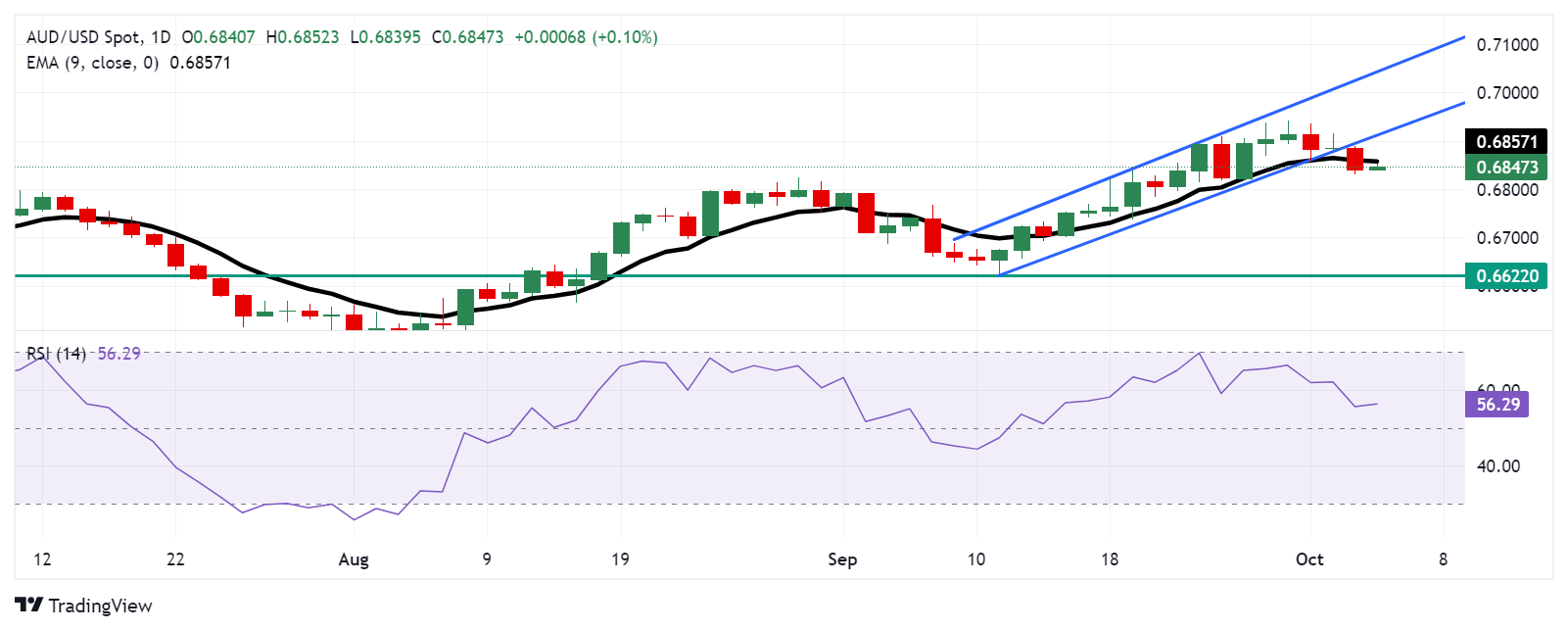
The AUD/USD pair trades near 0.6840 on Friday. Technical analysis of the daily chart indicates that the pair is positioned below the ascending channel, signaling an emergence of a bearish bullish bias. However, a move back into the channel would reinforce the bullish sentiment, as the 14-day Relative Strength Index (RSI) remains above the 50 level, suggesting that bullish momentum is still present.
Regarding resistance, the pair could test the immediate nine-day Exponential Moving Average (EMA) at 0.6857 level, followed by the lower boundary of the ascending channel at 0.6910 level. A return to the ascending channel would reinforce the bullish bias and support the AUD/USD pair to explore the area around the channel's upper boundary, at the 0.7040 level.
On the downside, the AUD/USD pair could target a psychological level of 0.6800. A break below this level could push the pair to navigate the region around its seven-week low of 0.6622, recorded on September 11.
AUD/USD: Daily Chart
Australian Dollar PRICE Today
The table below shows the percentage change of Australian Dollar (AUD) against listed major currencies today. Australian Dollar was the strongest against the Euro.
| USD | EUR | GBP | JPY | CAD | AUD | NZD | CHF | |
|---|---|---|---|---|---|---|---|---|
| USD | 0.03% | -0.05% | -0.31% | -0.03% | -0.09% | -0.04% | -0.05% | |
| EUR | -0.03% | -0.06% | -0.32% | -0.03% | -0.12% | -0.05% | -0.10% | |
| GBP | 0.05% | 0.06% | -0.27% | 0.04% | -0.06% | -0.00% | -0.05% | |
| JPY | 0.31% | 0.32% | 0.27% | 0.29% | 0.22% | 0.25% | 0.22% | |
| CAD | 0.03% | 0.03% | -0.04% | -0.29% | -0.08% | 0.00% | -0.08% | |
| AUD | 0.09% | 0.12% | 0.06% | -0.22% | 0.08% | 0.05% | -0.02% | |
| NZD | 0.04% | 0.05% | 0.00% | -0.25% | -0.01% | -0.05% | -0.07% | |
| CHF | 0.05% | 0.10% | 0.05% | -0.22% | 0.08% | 0.02% | 0.07% |
The heat map shows percentage changes of major currencies against each other. The base currency is picked from the left column, while the quote currency is picked from the top row. For example, if you pick the Australian Dollar from the left column and move along the horizontal line to the US Dollar, the percentage change displayed in the box will represent AUD (base)/USD (quote).
Australian Dollar FAQs
One of the most significant factors for the Australian Dollar (AUD) is the level of interest rates set by the Reserve Bank of Australia (RBA). Because Australia is a resource-rich country another key driver is the price of its biggest export, Iron Ore. The health of the Chinese economy, its largest trading partner, is a factor, as well as inflation in Australia, its growth rate and Trade Balance. Market sentiment – whether investors are taking on more risky assets (risk-on) or seeking safe-havens (risk-off) – is also a factor, with risk-on positive for AUD.
The Reserve Bank of Australia (RBA) influences the Australian Dollar (AUD) by setting the level of interest rates that Australian banks can lend to each other. This influences the level of interest rates in the economy as a whole. The main goal of the RBA is to maintain a stable inflation rate of 2-3% by adjusting interest rates up or down. Relatively high interest rates compared to other major central banks support the AUD, and the opposite for relatively low. The RBA can also use quantitative easing and tightening to influence credit conditions, with the former AUD-negative and the latter AUD-positive.
China is Australia’s largest trading partner so the health of the Chinese economy is a major influence on the value of the Australian Dollar (AUD). When the Chinese economy is doing well it purchases more raw materials, goods and services from Australia, lifting demand for the AUD, and pushing up its value. The opposite is the case when the Chinese economy is not growing as fast as expected. Positive or negative surprises in Chinese growth data, therefore, often have a direct impact on the Australian Dollar and its pairs.
Iron Ore is Australia’s largest export, accounting for $118 billion a year according to data from 2021, with China as its primary destination. The price of Iron Ore, therefore, can be a driver of the Australian Dollar. Generally, if the price of Iron Ore rises, AUD also goes up, as aggregate demand for the currency increases. The opposite is the case if the price of Iron Ore falls. Higher Iron Ore prices also tend to result in a greater likelihood of a positive Trade Balance for Australia, which is also positive of the AUD.
The Trade Balance, which is the difference between what a country earns from its exports versus what it pays for its imports, is another factor that can influence the value of the Australian Dollar. If Australia produces highly sought after exports, then its currency will gain in value purely from the surplus demand created from foreign buyers seeking to purchase its exports versus what it spends to purchase imports. Therefore, a positive net Trade Balance strengthens the AUD, with the opposite effect if the Trade Balance is negative.
Recommended Articles


