


Pound Sterling declines further ahead of UK Employment, US Inflation data
- The Pound Sterling underperforms the US Dollar as market expectations for the Fed opting for a big interest-rate cut have diminished.
- US employment growth came in lower than expected in August, while the jobless rate ticked down.
- This week, investors will majorly focus on the UK Employment and the US inflation data
The Pound Sterling (GBP) struggles to hold the key support of 1.3100 against the US Dollar (USD) in Monday’s London session. The GBP/USD pair faces selling pressure as the US Dollar (USD) extends its recovery, with US Dollar Index (DXY) jumping to near 101.40. The Greenback gains ground as market bets that the Federal Reserve (Fed) will start its policy-easing process aggressively have diminished after Friday’s United States (US)Nonfarm Payrolls (NFP) data.
According to the CME FedWatch tool, the probability of the Fed reducing interest rates by 50 basis points (bps) to 4.75%-5.00% in September has declined to 27% from the 41% recorded before the release of the data for August.
The NFP report showed that job growth is broadly cooling compared to the readings seen in the last couple of years, the Unemployment Rate ticked lower, as expected, and wage growth accelerated. Even though there is increasing evidence that the labor market is softening, the latest data is strong enough to keep the US economy safe from entering a recession. The assessment that the labor market is holding up weighs on market expectations of a large Fed rate cut, uplifting the US Dollar.
For fresh cues over the interest-rate outlook, investors will keenly focus on the US Consumer Price Index (CPI) data for August, which will be published on Wednesday. The inflation report is expected to show that both monthly headline and core CPI – which excludes food and energy prices – are estimated to have grown steadily by 0.2%. Annual headline CPI is expected to have decelerated sharply to 2.6% from July’s reading of 2.9%.
Daily digest market movers: Pound Sterling weakens against US Dollar
- The Pound Sterling exhibits a mixed performance against its major peers on Monday. The British currency is expected to trade broadly sideways as investors focus on the United Kingdom (UK) Employment data for the quarter ending July, which will be published on Tuesday.
- The UK labor market data could influence market speculation for the Bank of England (BoE) interest-rate path for the remainder of the year. According to the estimates, the Unemployment Rate is seen ticking lower to 4.1% from the former reading of 4.2%. Average Earnings Including bonuses are estimated to have softened to 4.1% from the prior release of 4.5%. Soft wage growth would increase expectations of more interest rate cuts by the BoE as it would imply a decline in inflation in the services sector.
- Meanwhile, a monthly report on Jobs from the Recruitment and Employment Confederation trade body and accountants KPMG showed that permanent job placements dropped at the fastest pace in five months, Reuters reported. The agency also noted that the pay growth offered for fresh hiring came in at a five-month low, one of the weakest readings since early 2021. "The news that while salaries rose last month it was at the weakest rate since March could help make the case for more rate cuts when the Monetary Policy Committee meets to decide the future path of interest rates," Jon Holt, KPMG's UK chief executive and senior partner, said.
Technical Analysis: Pound Sterling falls to near 1.3100
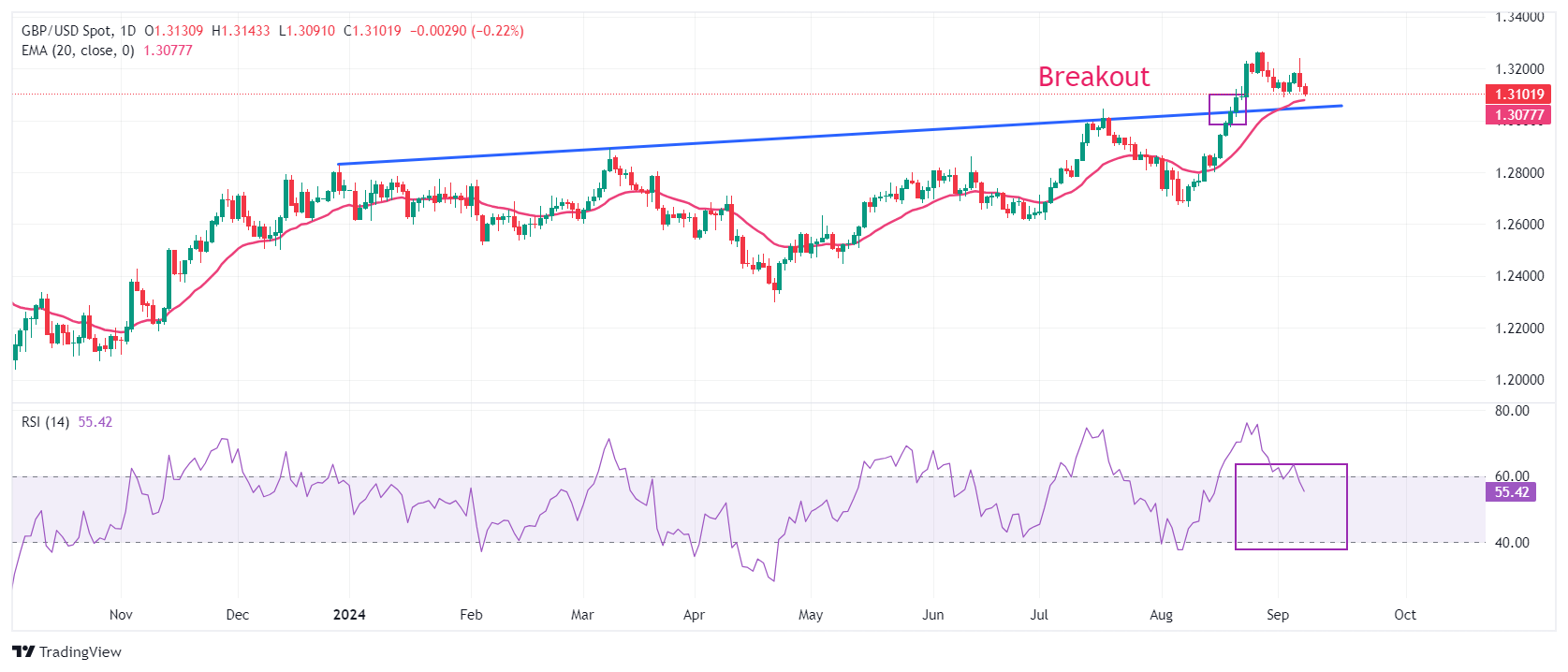
The Pound Sterling extends its downside to near the crucial support of 1.3100 against the US Dollar. The GBP/USD pair is expected to find intermediate support near the 20-day Exponential Moving Average (EMA), which trades around 1.3075. Also, the upward-sloping trendline from the December 28, 2023, high of 1.2828 will act as key support for the Pound Sterling bulls.
The 14-day Relative Strength Index (RSI) declines into the 40.00-60.00 range, suggesting that the bullish momentum has concluded for now. However, the bullish trend remains intact as the indicator remains above the neutral level of 50.
Looking up, the Cable will face resistance near the round-level resistance of 1.3200 and the psychological level of 1.3500.
Pound Sterling FAQs
The Pound Sterling (GBP) is the oldest currency in the world (886 AD) and the official currency of the United Kingdom. It is the fourth most traded unit for foreign exchange (FX) in the world, accounting for 12% of all transactions, averaging $630 billion a day, according to 2022 data. Its key trading pairs are GBP/USD, aka ‘Cable’, which accounts for 11% of FX, GBP/JPY, or the ‘Dragon’ as it is known by traders (3%), and EUR/GBP (2%). The Pound Sterling is issued by the Bank of England (BoE).
The single most important factor influencing the value of the Pound Sterling is monetary policy decided by the Bank of England. The BoE bases its decisions on whether it has achieved its primary goal of “price stability” – a steady inflation rate of around 2%. Its primary tool for achieving this is the adjustment of interest rates. When inflation is too high, the BoE will try to rein it in by raising interest rates, making it more expensive for people and businesses to access credit. This is generally positive for GBP, as higher interest rates make the UK a more attractive place for global investors to park their money. When inflation falls too low it is a sign economic growth is slowing. In this scenario, the BoE will consider lowering interest rates to cheapen credit so businesses will borrow more to invest in growth-generating projects.
Data releases gauge the health of the economy and can impact the value of the Pound Sterling. Indicators such as GDP, Manufacturing and Services PMIs, and employment can all influence the direction of the GBP. A strong economy is good for Sterling. Not only does it attract more foreign investment but it may encourage the BoE to put up interest rates, which will directly strengthen GBP. Otherwise, if economic data is weak, the Pound Sterling is likely to fall.
Another significant data release for the Pound Sterling is the Trade Balance. This indicator measures the difference between what a country earns from its exports and what it spends on imports over a given period. If a country produces highly sought-after exports, its currency will benefit purely from the extra demand created from foreign buyers seeking to purchase these goods. Therefore, a positive net Trade Balance strengthens a currency and vice versa for a negative balance.
Recommended Articles


