


Australian Dollar recovers losses following PPI data
- The Australian Dollar appreciates after the release of higher Producer Price Index figures.
- Australia's PPI rose by 4.8% YoY in Q2, against the previous quarter’s reading of 4.3%.
- The US Dollar received support due to increased risk aversion amid raised concerns about the US economy.
The Australian Dollar (AUD) recovers its daily losses against the US Dollar (US) following the higher Producer Price Index (PPI) data released on Friday. However, this upside could be limited due to increased risk aversion ahead of upcoming US labor market data, including the Nonfarm Payrolls report for July.
The Aussie Dollar faces challenges as second-quarter inflation data has diminished expectations for another rate hike by the Reserve Bank of Australia (RBA) at its policy meeting next week. Markets now estimate about a 50% chance of an RBA rate cut in November, a move anticipated much earlier than previously forecasted for April next year. These factors are contributing to the downward pressure on the Australian Dollar.
Recent manufacturing and employment data have raised concerns about the US economy, boosting risk aversion and supporting the US Dollar. Markets are grappling with a delicate balancing act, as an economic downturn heightens expectations for a rate cut by the Federal Reserve. The CME's FedWatch Tool indicates that traders are fully pricing in a 25 basis point rate cut on September 18, with a one-in-five chance of a 50 basis point cut.
Daily Digest Market Movers: Australian Dollar advances following PPI data
- US ISM Manufacturing Purchasing Managers Index (PMI) tumbled to an eight-month low of 46.8 in July, compared to the previous 48.5 reading and the forecasted move up to 48.8.
- US Initial Jobless Claims for the week ended July 26 rose to 249K from the previous week’s 235K, lurching past the forecast uptick to 236K.
- China’s Caixin Manufacturing Purchasing Managers Index (PMI) posted a reading of 49.8 for July, falling short of the expected reading of 51.5 and the previous reading of 51.8. Since both nations are close trade partners, changes in the Chinese economy can significantly impact the Australian market.
- The Australian Bureau of Statistics (ABS) reported a trade surplus of 5,589 million for June, surpassing the anticipated 5,000 million but still below the previous reading of 5,773 million.
- During a press conference, Federal Reserve Chair Jerome Powell stated that a rate cut in September is "on the table." Powell added that the central bank will closely monitor the labor market and remain vigilant for signs of a potential sharp downturn, per Reuters.
- The ABS reported on Wednesday that the Monthly CPI rose by 3.8% in the year to June, easing from the 4% posted in May. The quarterly CPI rose 1% QoQ and up 3.8% YoY in the second quarter of the year. The RBA Trimmed Mean CPI, the central bank’s preferred gauge, rose by 3.9% YoY in Q2, against the expected and previous reading of 4.0%.
Technical Analysis: Australian Dollar holds position around 0.6500
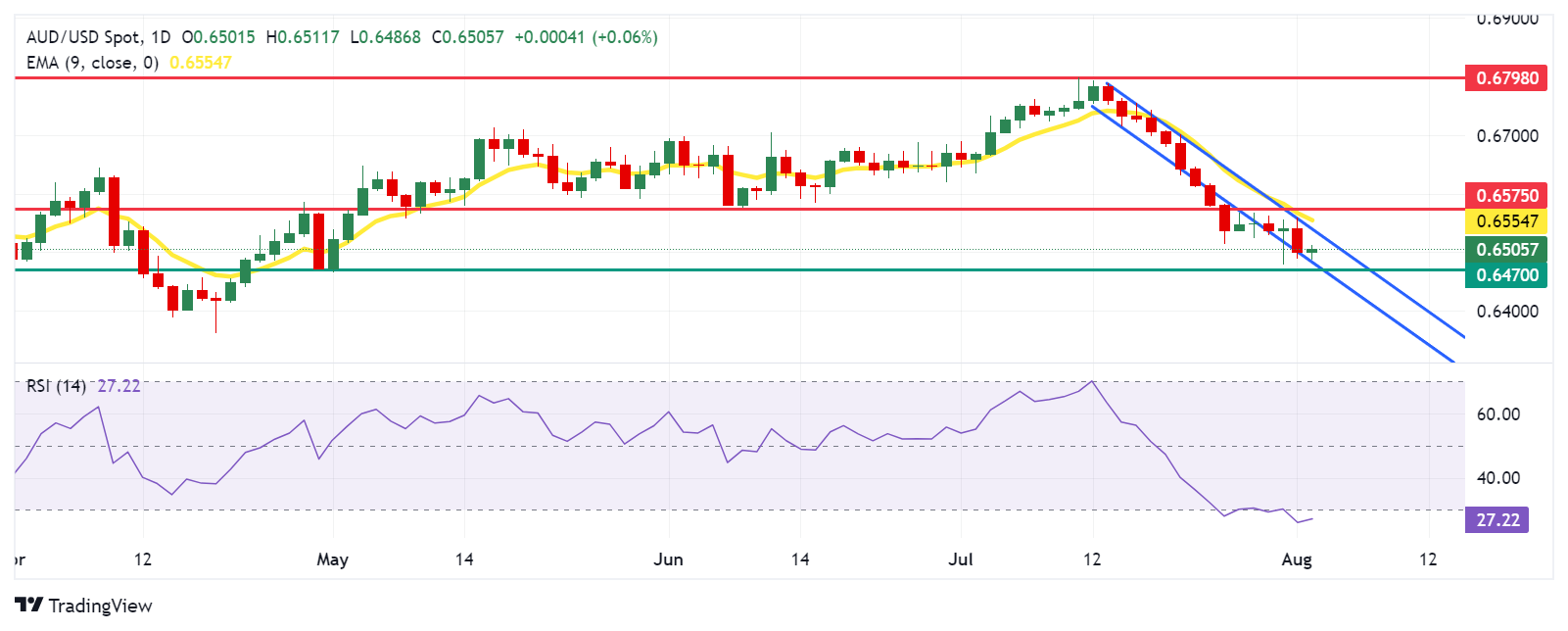
The Australian Dollar trades around 0.6510 on Friday. The daily chart analysis shows that the AUD/USD pair consolidates within a descending channel, indicating a bearish bias. The 14-day Relative Strength Index (RSI) is near the oversold 30 level, suggesting a potential upward correction might be imminent.
Immediate support for the AUD/USD pair is around the lower boundary of the descending channel at 0.6470, followed by the throwback support at approximately 0.6470.
On the upside, the upper boundary of the descending channel at 0.6530 serves as the immediate resistance, followed by the nine-day Exponential Moving Average (EMA) at 0.6555. The next barrier for the AUD/USD pair appears at the “throwback support turned resistance” at 0.6575. A break above this resistance could drive the AUD/USD pair toward a six-month high of 0.6798.
AUD/USD: Daily Chart
Australian Dollar PRICE Today
The table below shows the percentage change of Australian Dollar (AUD) against listed major currencies today. Australian Dollar was the strongest against the British Pound.
| USD | EUR | GBP | JPY | CAD | AUD | NZD | CHF | |
|---|---|---|---|---|---|---|---|---|
| USD | 0.03% | 0.17% | 0.06% | -0.01% | -0.03% | 0.11% | -0.02% | |
| EUR | -0.03% | 0.13% | 0.03% | -0.05% | -0.06% | 0.06% | -0.05% | |
| GBP | -0.17% | -0.13% | -0.11% | -0.18% | -0.20% | -0.06% | -0.16% | |
| JPY | -0.06% | -0.03% | 0.11% | -0.06% | -0.09% | 0.02% | -0.07% | |
| CAD | 0.01% | 0.05% | 0.18% | 0.06% | -0.02% | 0.13% | 0.01% | |
| AUD | 0.03% | 0.06% | 0.20% | 0.09% | 0.02% | 0.14% | 0.02% | |
| NZD | -0.11% | -0.06% | 0.06% | -0.02% | -0.13% | -0.14% | -0.09% | |
| CHF | 0.02% | 0.05% | 0.16% | 0.07% | -0.01% | -0.02% | 0.09% |
The heat map shows percentage changes of major currencies against each other. The base currency is picked from the left column, while the quote currency is picked from the top row. For example, if you pick the Australian Dollar from the left column and move along the horizontal line to the US Dollar, the percentage change displayed in the box will represent AUD (base)/USD (quote).
Australian Dollar FAQs
One of the most significant factors for the Australian Dollar (AUD) is the level of interest rates set by the Reserve Bank of Australia (RBA). Because Australia is a resource-rich country another key driver is the price of its biggest export, Iron Ore. The health of the Chinese economy, its largest trading partner, is a factor, as well as inflation in Australia, its growth rate and Trade Balance. Market sentiment – whether investors are taking on more risky assets (risk-on) or seeking safe-havens (risk-off) – is also a factor, with risk-on positive for AUD.
The Reserve Bank of Australia (RBA) influences the Australian Dollar (AUD) by setting the level of interest rates that Australian banks can lend to each other. This influences the level of interest rates in the economy as a whole. The main goal of the RBA is to maintain a stable inflation rate of 2-3% by adjusting interest rates up or down. Relatively high interest rates compared to other major central banks support the AUD, and the opposite for relatively low. The RBA can also use quantitative easing and tightening to influence credit conditions, with the former AUD-negative and the latter AUD-positive.
China is Australia’s largest trading partner so the health of the Chinese economy is a major influence on the value of the Australian Dollar (AUD). When the Chinese economy is doing well it purchases more raw materials, goods and services from Australia, lifting demand for the AUD, and pushing up its value. The opposite is the case when the Chinese economy is not growing as fast as expected. Positive or negative surprises in Chinese growth data, therefore, often have a direct impact on the Australian Dollar and its pairs.
Iron Ore is Australia’s largest export, accounting for $118 billion a year according to data from 2021, with China as its primary destination. The price of Iron Ore, therefore, can be a driver of the Australian Dollar. Generally, if the price of Iron Ore rises, AUD also goes up, as aggregate demand for the currency increases. The opposite is the case if the price of Iron Ore falls. Higher Iron Ore prices also tend to result in a greater likelihood of a positive Trade Balance for Australia, which is also positive of the AUD.
The Trade Balance, which is the difference between what a country earns from its exports versus what it pays for its imports, is another factor that can influence the value of the Australian Dollar. If Australia produces highly sought after exports, then its currency will gain in value purely from the surplus demand created from foreign buyers seeking to purchase its exports versus what it spends to purchase imports. Therefore, a positive net Trade Balance strengthens the AUD, with the opposite effect if the Trade Balance is negative.
Recommended Articles


