


British Pound clings to 1.3300 on UK budget ahead of Fed’s decision
- GBP/USD hovers near 1.3300, extending its four-day losing streak.
- UK Chancellor pledges to eliminate current budget deficit within three years.
- December Fed hike odds reach 85% as markets await Warsh's guidance.
The Pound Sterling retreats for the fourth consecutive day versus the US Dollar, down 0.02% as investors brace for the Federal Reserve policy decision and also digest the UK’s Autumn Budget. The GBP/USD trades near 1.3300, barely unchanged.
GBP/USD weighed as investors await the Fed decision despite Britain's fiscal discipline pledges
UK finance minister John Healey presented the budget “built on fiscal discipline which matches immediate action today, with clear direction for the future.” He said that the Office for Budget Responsibility (OBR) revealed that the war in the Middle East complicates forecasts, and that this budget “puts us on track to eliminate the current budget deficit and get Britain’s finances into the black within 3 years.”
This barely moved GBP/USD, which remained under pressure amid rising tensions in the Middle East.
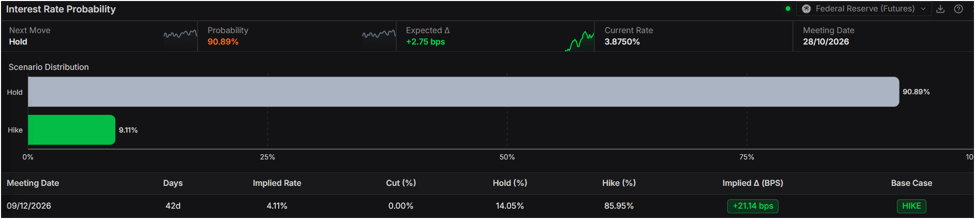
In the US, the focus is on the Federal Reserve’s monetary policy decision. Money markets expect a nearly 91% chance that Warsh and company will hold rates unchanged, though eyes will be on his press conference and the guidance he could provide on the foreseeable future.
Towards the end of the year, the swaps market had priced in 21 basis points of tightening, or an 85% chance that the Fed will hike in the December meeting, according to Prime Terminal.
Along with the Fed’s decision, the release of US Gross Domestic Product (GDP) figures for Q3, and the Fed’s preferred inflation gauge, the Core PCE, could influence the GBP/USD direction towards the end of the month.
GBP/USD Price Forecast: Technical outlook
In the daily chart, GBP/USD trades at 1.3303, holding below a dense cluster of simple moving averages around 1.3390 and sustaining a bearish near-term bias. The pair has slipped under the upward trend structure, with the latest touch on the former support line near 1.3360 now acting as resistance, while a downward-sloping trend line that previously capped price around 1.3255 has turned into nearby support. The Relative Strength Index (14) at about 48 sits just under the neutral midline, hinting at waning bullish momentum and leaving the downside exposed unless buyers can reclaim the overhead technical barriers.
On the topside, initial resistance is seen at the broken upward trend line around 1.3360, followed by a key confluence zone where the 50-, 100- and 200-day simple moving averages cluster near 1.3390; a daily close above this area would ease immediate downside pressure. Further up, a descending trend line near 1.3544 precedes another structural cap from an older rising trend line around 1.3606. On the downside, first support is provided by the repurposed downward trend line around 1.3255; a break below this floor would open the way for a deeper pullback toward previous lows not shown by the current indicator set.
(The technical analysis of this story was written with the help of an AI tool. Know more.)
Pound Sterling FAQs
The Pound Sterling (GBP) is the oldest currency in the world (886 AD) and the official currency of the United Kingdom. It is the fourth most traded unit for foreign exchange (FX) in the world, accounting for 12% of all transactions, averaging $630 billion a day, according to 2022 data. Its key trading pairs are GBP/USD, also known as ‘Cable’, which accounts for 11% of FX, GBP/JPY, or the ‘Dragon’ as it is known by traders (3%), and EUR/GBP (2%). The Pound Sterling is issued by the Bank of England (BoE).
The single most important factor influencing the value of the Pound Sterling is monetary policy decided by the Bank of England. The BoE bases its decisions on whether it has achieved its primary goal of “price stability” – a steady inflation rate of around 2%. Its primary tool for achieving this is the adjustment of interest rates. When inflation is too high, the BoE will try to rein it in by raising interest rates, making it more expensive for people and businesses to access credit. This is generally positive for GBP, as higher interest rates make the UK a more attractive place for global investors to park their money. When inflation falls too low it is a sign economic growth is slowing. In this scenario, the BoE will consider lowering interest rates to cheapen credit so businesses will borrow more to invest in growth-generating projects.
Data releases gauge the health of the economy and can impact the value of the Pound Sterling. Indicators such as GDP, Manufacturing and Services PMIs, and employment can all influence the direction of the GBP. A strong economy is good for Sterling. Not only does it attract more foreign investment but it may encourage the BoE to put up interest rates, which will directly strengthen GBP. Otherwise, if economic data is weak, the Pound Sterling is likely to fall.
Another significant data release for the Pound Sterling is the Trade Balance. This indicator measures the difference between what a country earns from its exports and what it spends on imports over a given period. If a country produces highly sought-after exports, its currency will benefit purely from the extra demand created from foreign buyers seeking to purchase these goods. Therefore, a positive net Trade Balance strengthens a currency and vice versa for a negative balance.
Recommended Articles


