

BoC recap: Rates up... and another one on the cards?

Source Fxstreet

The Bank of Canada (BoC) raised its overnight rate by 25 basis points to 2.5%, warning that higher-for-longer energy prices and stronger cost pass-through could keep inflation elevated. Governor Tiff Macklem said another increase may be needed, although the Governing Council remains cautious and has not set a predetermined path.

TThe BoC said it acted to reduce the risk that persistent energy costs would spread more broadly through the prices of goods and services. Businesses have largely absorbed higher input costs so far, but the Bank’s surveys suggest they will pass more of those costs on over the coming year. Macklem said inflation now looks less likely to remain well contained, while longer-term expectations remain anchored.

Signs of excess supply and a weaker housing market complicated the decision. Macklem said the policy rate, even after the hike, was not high enough to restrain growth, but Rogers acknowledged that borrowing costs were already weighing on housing. The Bank also faces considerable uncertainty over trade ties with the US and the wider economic outlook.
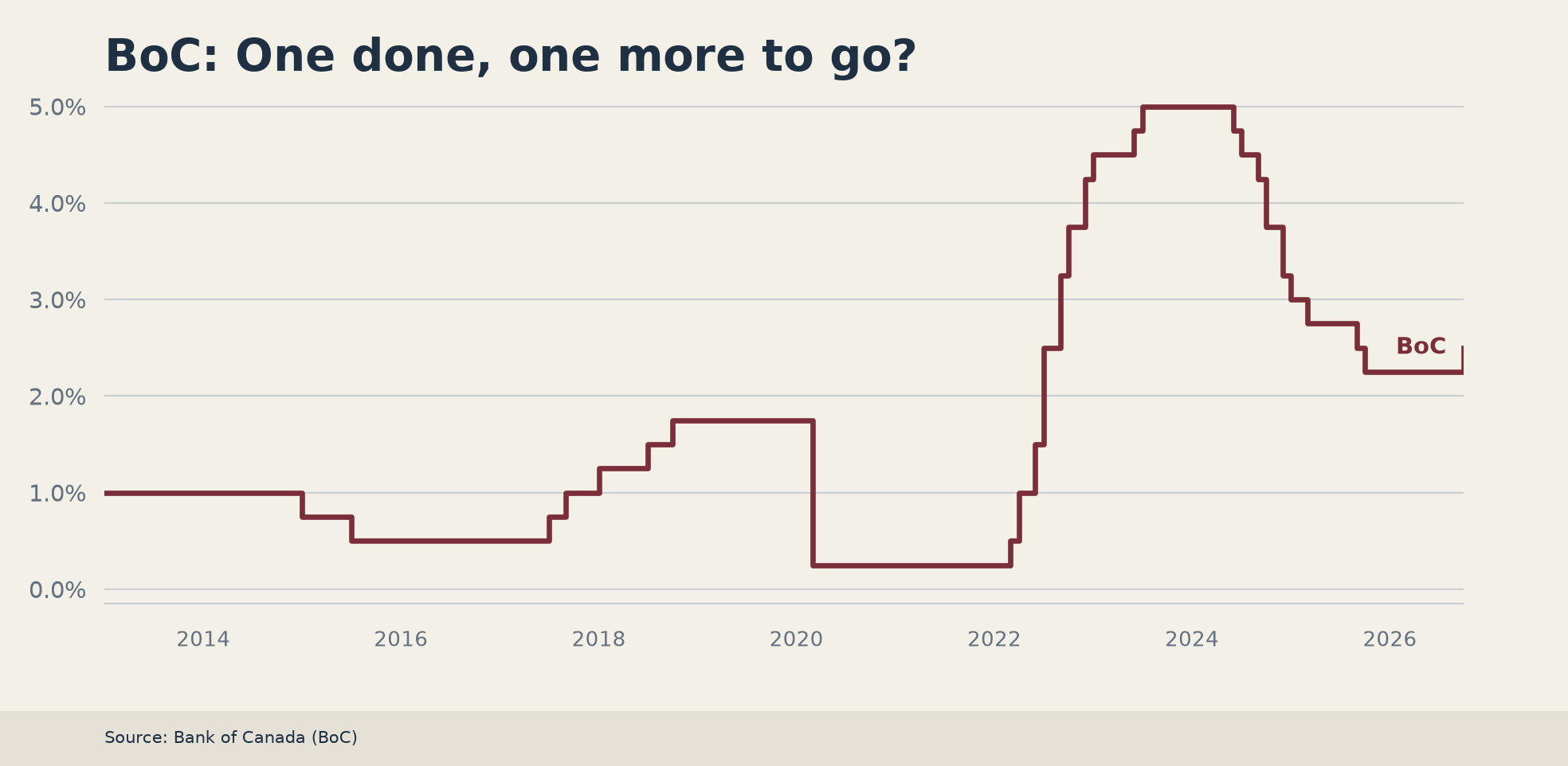
The overall message was hawkish but measured. Further tightening remains possible if energy-driven inflation becomes broader or more persistent, yet Macklem stressed that there is no predetermined rate path and that each decision will depend on the inflation outlook and incoming data.

Bank of Canada FAQs

The Bank of Canada (BoC), based in Ottawa, is the institution that sets interest rates and manages monetary policy for Canada. It does so at eight scheduled meetings a year and ad hoc emergency meetings that are held as required. The BoC primary mandate is to maintain price stability, which means keeping inflation at between 1-3%. Its main tool for achieving this is by raising or lowering interest rates. Relatively high interest rates will usually result in a stronger Canadian Dollar (CAD) and vice versa. Other tools used include quantitative easing and tightening.

In extreme situations, the Bank of Canada can enact a policy tool called Quantitative Easing. QE is the process by which the BoC prints Canadian Dollars for the purpose of buying assets – usually government or corporate bonds – from financial institutions. QE usually results in a weaker CAD. QE is a last resort when simply lowering interest rates is unlikely to achieve the objective of price stability. The Bank of Canada used the measure during the Great Financial Crisis of 2009-11 when credit froze after banks lost faith in each other’s ability to repay debts.

Quantitative tightening (QT) is the reverse of QE. It is undertaken after QE when an economic recovery is underway and inflation starts rising. Whilst in QE the Bank of Canada purchases government and corporate bonds from financial institutions to provide them with liquidity, in QT the BoC stops buying more assets, and stops reinvesting the principal maturing on the bonds it already holds. It is usually positive (or bullish) for the Canadian Dollar.

Disclaimer: For information purposes only. Past performance is not indicative of future results.
placeholder
US Sept. PCE Preview: Inflation May Heat Up Again, How Will US Stocks, the Dollar, and Gold React?This Thursday (October 29), the US will release the September Personal Consumption Expenditures (PCE) price index. However, since the PCE report will be released after the Federal Reserve
Author  TradingKey
7 hours ago
This Thursday (October 29), the US will release the September Personal Consumption Expenditures (PCE) price index. However, since the PCE report will be released after the Federal Reserve
placeholder
Brent's $115 front month sits $4.6 above January — the $14 spread to WTI is the supply-risk premiumDecember Brent trades at $115.29 while January is $110.71, a $4.58 backwardation. The December Brent-WTI spread is $14.2, versus a $3-5 normal. That gap, not the headline, is where the Middle East supply risk is priced. Here is what the curve says, why the December contract's expiry on October 30 will mechanically cut the headline by $4.6, and the 108.81 neckline that decides the next move.
Author  Irene Q.
11 hours ago
December Brent trades at $115.29 while January is $110.71, a $4.58 backwardation. The December Brent-WTI spread is $14.2, versus a $3-5 normal. That gap, not the headline, is where the Middle East supply risk is priced. Here is what the curve says, why the December contract's expiry on October 30 will mechanically cut the headline by $4.6, and the 108.81 neckline that decides the next move.
placeholder
Bitcoin is back above $80,000 — but 75% of the bounce was shorts, not buyersBitcoin trades at $80,669, back above the $80,000 line after touching $79,145 on October 24. But 75.4% of the last 24 hours of futures liquidations were shorts, CME open interest fell 36,545 BTC in October, and spot ETFs lost $773.5 million on October 22-23. Price is up; positioning is down. Here is why the bounce is a squeeze, and the four things that would make it real.
Author  Suzie
11 hours ago
Bitcoin trades at $80,669, back above the $80,000 line after touching $79,145 on October 24. But 75.4% of the last 24 hours of futures liquidations were shorts, CME open interest fell 36,545 BTC in October, and spot ETFs lost $773.5 million on October 22-23. Price is up; positioning is down. Here is why the bounce is a squeeze, and the four things that would make it real.
placeholder
Gold rises above $4,050 ahead of Fed rate decisionGold price (XAU/USD) jumps to around $4,065 during the early Asian session on Wednesday, bolstered by lower oil prices. Traders await the Federal Reserve's (Fed) policy meeting later on Wednesday for signals on ‌the future path of US interest rates.
Author  FXStreet
16 hours ago
Gold price (XAU/USD) jumps to around $4,065 during the early Asian session on Wednesday, bolstered by lower oil prices. Traders await the Federal Reserve's (Fed) policy meeting later on Wednesday for signals on ‌the future path of US interest rates.
placeholder
Fed October Rate Decision Preview: Rate Hike Pause Has Become Consensus, How Will US Stocks, Dollar, and Gold React?The Federal Reserve will announce its October interest rate decision at 14:00 Eastern Time on October 28, and Fed Chair Warsh will hold a press conference at 14:30. Markets currently wide
Author  TradingKey
Yesterday 10: 21
The Federal Reserve will announce its October interest rate decision at 14:00 Eastern Time on October 28, and Fed Chair Warsh will hold a press conference at 14:30. Markets currently wide
Related Instrument
goTop
quote