


Euro gives up early gains amid higher oil prices, French fiscal risks
- Euro surrenders early gains against the US Dollar due to multiple headwinds.
- Elevated oil prices and French fiscal risks continue to keep the Euro under pressure.
- Both the Fed and the ECB are expected to leave interest rates unchanged next week.
The Euro (EUR) gives back its early gains against the US Dollar (USD) and flattens at around 1.1234 during the European trade on Thursday. The major currency pair comes under pressure as the Euro faces multiple headwinds.
Euro sentiment pressured by energy costs and French debt concerns
Strategists at Danske Bank observe that the latest move lower in the Euro has been primarily a sentiment-driven story, stressing that “the decline in the pair is driven by the combination of high energy prices and EUR-pessimism on the back of French debt worries.” They note that these factors have reinforced existing caution toward the single currency, keeping investors wary of adding Euro exposure despite the absence of a clear directional catalyst from broader markets.
Higher oil prices bode poorly for the Euro, given that the continent relies heavily on its imports to meet its energy demands. As of writing, the WTI Oil price trades 2% higher to near $99.50.
Meanwhile, investors await the flash Eurozone-United States (US) PMI data for October, which is scheduled for Friday. In both the Eurozone and the US, overall business activity is expected to have expanded again, but at a moderate pace.
Going forward, key triggers for the Euro and US Dollar will be monetary policy announcements by the European Central Bank (ECB) and the Federal Reserve (Fed) next week, in which both are expected to leave interest rates unchanged.
EUR/USD Technical Analysis
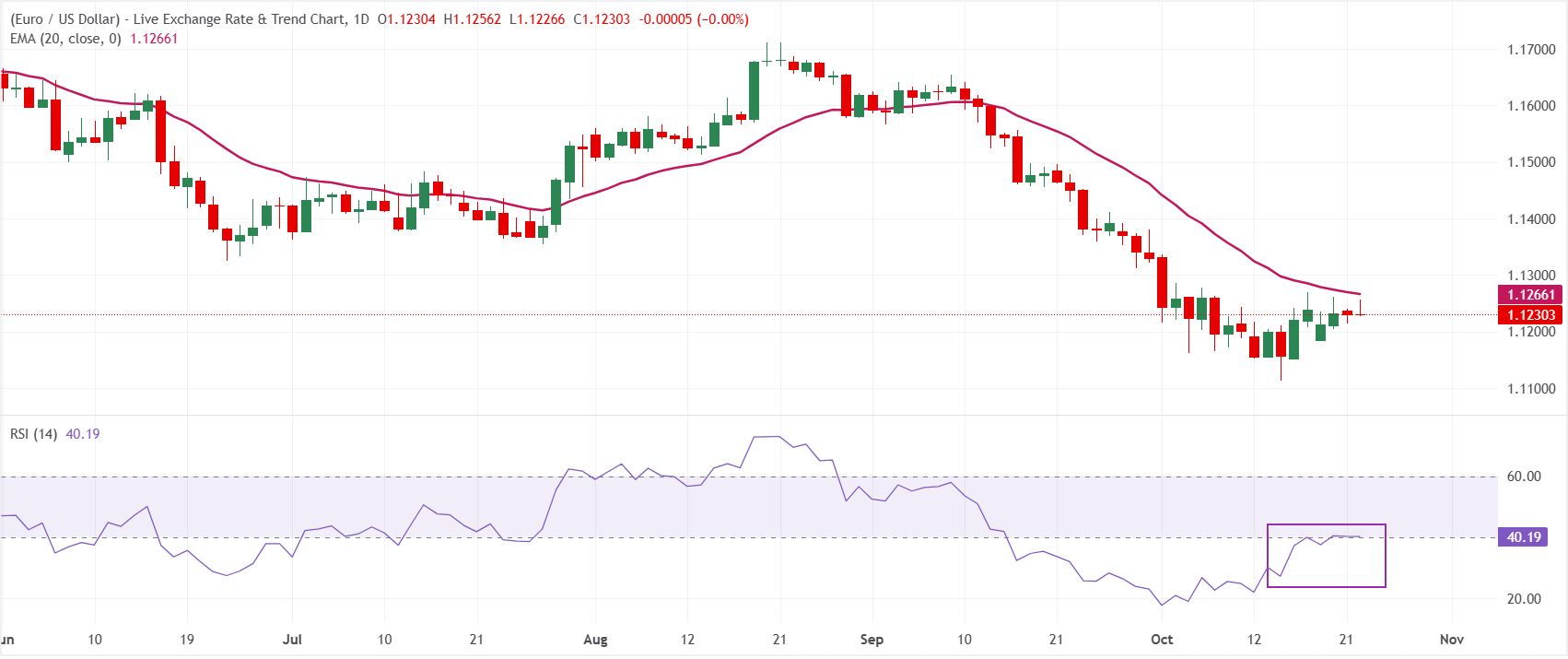
In the daily chart, EUR/USD trades at 1.1231, holding below the 20-day Exponential Moving Average (EMA) at 1.1266 and keeping a mild bearish bias in place. The pair remains capped by this short-term EMA, suggesting rallies are still being sold, while the Relative Strength Index (RSI) near 40 hints at weak but stabilizing downside momentum rather than outright oversold conditions.
On the topside, the 20-day EMA at 1.1266 is the immediate resistance that bulls need to reclaim to ease the current pressure and open the way for a more sustained recovery. On the downside, the absence of nearby measured supports in the data set leaves spot vulnerable to further slippage toward prior price lows, with sentiment likely to stay fragile while EUR/USD trades beneath the short-term EMA.
(The technical analysis of this story was written with the help of an AI tool. Know more.)
Euro FAQs
The Euro is the currency for the 20 European Union countries that belong to the Eurozone. It is the second most heavily traded currency in the world behind the US Dollar. In 2022, it accounted for 31% of all foreign exchange transactions, with an average daily turnover of over $2.2 trillion a day. EUR/USD is the most heavily traded currency pair in the world, accounting for an estimated 30% off all transactions, followed by EUR/JPY (4%), EUR/GBP (3%) and EUR/AUD (2%).
The European Central Bank (ECB) in Frankfurt, Germany, is the reserve bank for the Eurozone. The ECB sets interest rates and manages monetary policy. The ECB’s primary mandate is to maintain price stability, which means either controlling inflation or stimulating growth. Its primary tool is the raising or lowering of interest rates. Relatively high interest rates – or the expectation of higher rates – will usually benefit the Euro and vice versa. The ECB Governing Council makes monetary policy decisions at meetings held eight times a year. Decisions are made by heads of the Eurozone national banks and six permanent members, including the President of the ECB, Christine Lagarde.
Eurozone inflation data, measured by the Harmonized Index of Consumer Prices (HICP), is an important econometric for the Euro. If inflation rises more than expected, especially if above the ECB’s 2% target, it obliges the ECB to raise interest rates to bring it back under control. Relatively high interest rates compared to its counterparts will usually benefit the Euro, as it makes the region more attractive as a place for global investors to park their money.
Data releases gauge the health of the economy and can impact on the Euro. Indicators such as GDP, Manufacturing and Services PMIs, employment, and consumer sentiment surveys can all influence the direction of the single currency. A strong economy is good for the Euro. Not only does it attract more foreign investment but it may encourage the ECB to put up interest rates, which will directly strengthen the Euro. Otherwise, if economic data is weak, the Euro is likely to fall. Economic data for the four largest economies in the euro area (Germany, France, Italy and Spain) are especially significant, as they account for 75% of the Eurozone’s economy.
Another significant data release for the Euro is the Trade Balance. This indicator measures the difference between what a country earns from its exports and what it spends on imports over a given period. If a country produces highly sought after exports then its currency will gain in value purely from the extra demand created from foreign buyers seeking to purchase these goods. Therefore, a positive net Trade Balance strengthens a currency and vice versa for a negative balance.
Recommended Articles


