


Indian Rupee trades calm ahead of US NFP data release
- The Indian Rupee opens steady at around 95.27 against the US Dollar as the US NFP takes center stage.
- Weak US ADP Employment Change data has set a negative tone for the US NFP.
- Oil prices bounce back amid fears of escalation in internal Middle East war.
The Indian Rupee (INR) opens flat against the US Dollar (USD) on Friday in the countdown to the United States (US) Nonfarm Payrolls (NFP) data for July at 06:00 PM IST or 12:30 GMT. The USD/INR pair wobbles near Thursday’s high at 95.27, awaiting the US NFP to get cues regarding the current status of the labor market.
Ahead of the US NFP, weak ADP Employment Change data for July has established a cautious backdrop for the official employment data.
ADP slowdown reinforces expectations for softer US payrolls
According to TD Securities, July ADP employment data “surprised to the downside, moderating to 44k (TD: 50k, cons: 65k).” While the bank stresses that it does “not put much weight on ADP when it comes to m/m moves in NFP,” it notes that “the trend in the data is in line with what we are expecting.” TD highlights that “both the monthly and weekly ADP data have moderated this summer after a strong start to the year,” and suggests that “a similar trend is likely to occur with NFP job gains.”
According to NFP estimates, the US economy created 80K fresh jobs, higher than 57K in June. The Unemployment Rate is seen as steady at 4.2%. Average Hourly Earnings, a key measure of wage growth, is expected to have grown at a steady pace of 0.3% and 3.5% on a monthly and yearly basis, respectively.
The wage growth measure, which provides cues about the inflation outlook, could prove to be a major driver for the US Dollar’s next move, compared to the job data, as policymakers signaled in July’s Fed monetary policy statement that they are increasingly concerned about inflation remaining well above the 2% target. Also, Chairman Kevin Warsh said that the central bank “won’t hesitate to act” if needed to tame elevated price pressures.
Currently, the CME FedWatch tool shows a 54.5% chance that the Fed will raise interest rates in the September policy meeting.
Oil prices bounce back as Middle East conflicts widen
Oil prices have regained ground after a significant plunge in the last two weeks. Rising friction between Iran-aligned Houthis and Saudi Arabia has increased risks of internal war in the Middle East at a time when Iran and the US have just reached a temporary ceasefire, and has promoted fears of a prolonged energy supply disruption.
According to a report from The Guardian, Saudi Arabia is stepping up its attacks on Houthis in retaliation for striking Yemeni government troops and Najran province.
At press time, the MCX Crude Oil contract expiring on August 19 trades 1.13% higher at around Rs. 7,460.
Currencies from economies, such as India, which rely heavily on oil imports to meet their energy needs, tend to underperform in a high-oil-price environment.
Technical Analysis: USD/INR strives for mean-reversion to 20-day EMA
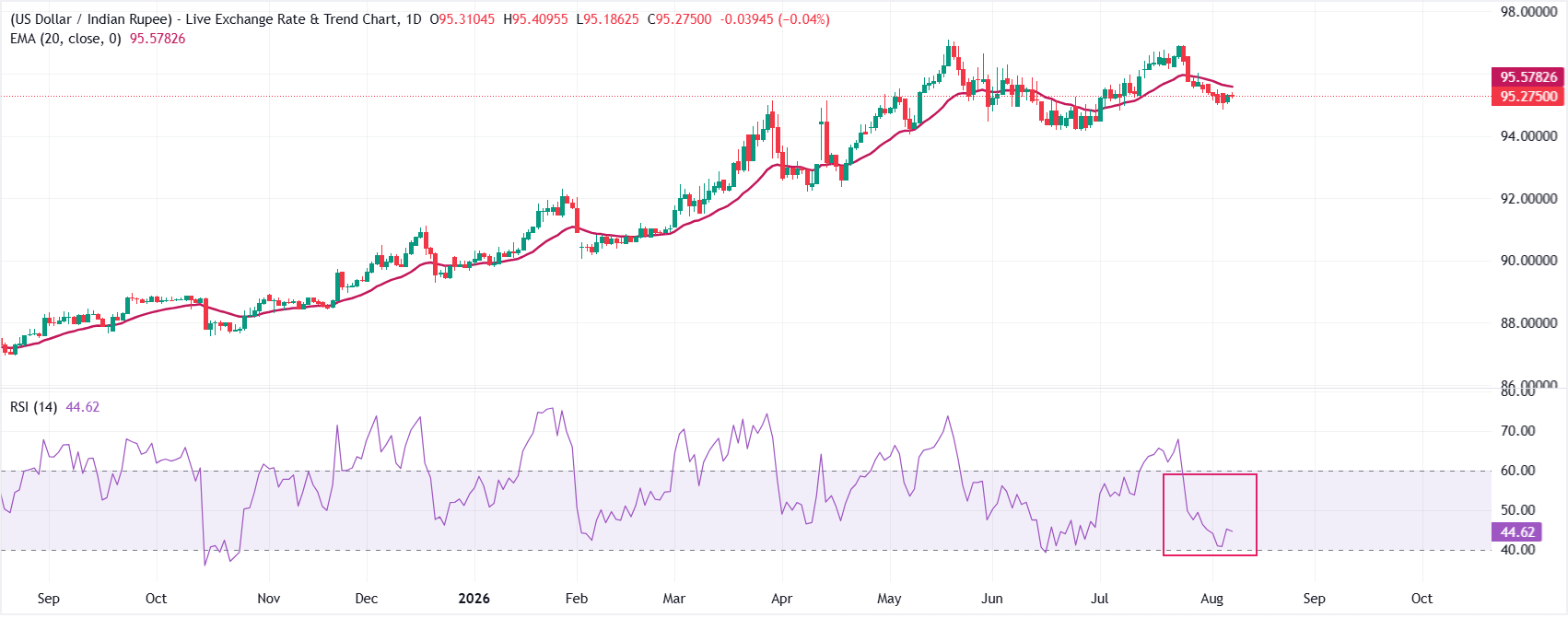
USD/INR trades at around 95.27, retaining a mildly bearish near-term bias as spot holds below the 20-day exponential moving average (EMA) at 95.57.
The pair’s failure to reclaim this dynamic resistance hints at continued downside risk, while the Relative Strength Index (RSI) at 44.6 sits in neutral territory, suggesting selling pressure is present but not yet stretched into oversold conditions.
On the topside, the 20-day EMA at 95.57 is the first barrier that bulls would need to clear to ease the current downward tone and open the way for a more sustained recovery. Looking down, the Wednesday low at 94.83 is the key support level, followed by the June low at 94.15.
(The technical analysis of this story was written with the help of an AI tool. Know more.)
Indian Rupee FAQs
The Indian Rupee (INR) is one of the most sensitive currencies to external factors. The price of Crude Oil (the country is highly dependent on imported Oil), the value of the US Dollar – most trade is conducted in USD – and the level of foreign investment, are all influential. Direct intervention by the Reserve Bank of India (RBI) in FX markets to keep the exchange rate stable, as well as the level of interest rates set by the RBI, are further major influencing factors on the Rupee.
The Reserve Bank of India (RBI) actively intervenes in forex markets to maintain a stable exchange rate, to help facilitate trade. In addition, the RBI tries to maintain the inflation rate at its 4% target by adjusting interest rates. Higher interest rates usually strengthen the Rupee. This is due to the role of the ‘carry trade’ in which investors borrow in countries with lower interest rates so as to place their money in countries’ offering relatively higher interest rates and profit from the difference.
Macroeconomic factors that influence the value of the Rupee include inflation, interest rates, the economic growth rate (GDP), the balance of trade, and inflows from foreign investment. A higher growth rate can lead to more overseas investment, pushing up demand for the Rupee. A less negative balance of trade will eventually lead to a stronger Rupee. Higher interest rates, especially real rates (interest rates less inflation) are also positive for the Rupee. A risk-on environment can lead to greater inflows of Foreign Direct and Indirect Investment (FDI and FII), which also benefit the Rupee.
Higher inflation, particularly, if it is comparatively higher than India’s peers, is generally negative for the currency as it reflects devaluation through oversupply. Inflation also increases the cost of exports, leading to more Rupees being sold to purchase foreign imports, which is Rupee-negative. At the same time, higher inflation usually leads to the Reserve Bank of India (RBI) raising interest rates and this can be positive for the Rupee, due to increased demand from international investors. The opposite effect is true of lower inflation.
Recommended Articles


