


A cooler inflation print buys British Pound Sterling nothing but a slower decline
- GBP/USD holds just above the 1.3350 area and is on track for a fifth consecutive daily decline, the shallowest of the run.
- UK inflation cooled to 2.6% in June, undercutting consensus and deflating Bank of England hike pricing eight days before the July decision.
- Friday's retail sales and flash PMIs close the week's data slate ahead of next week's Federal Reserve and Bank of England double bill.
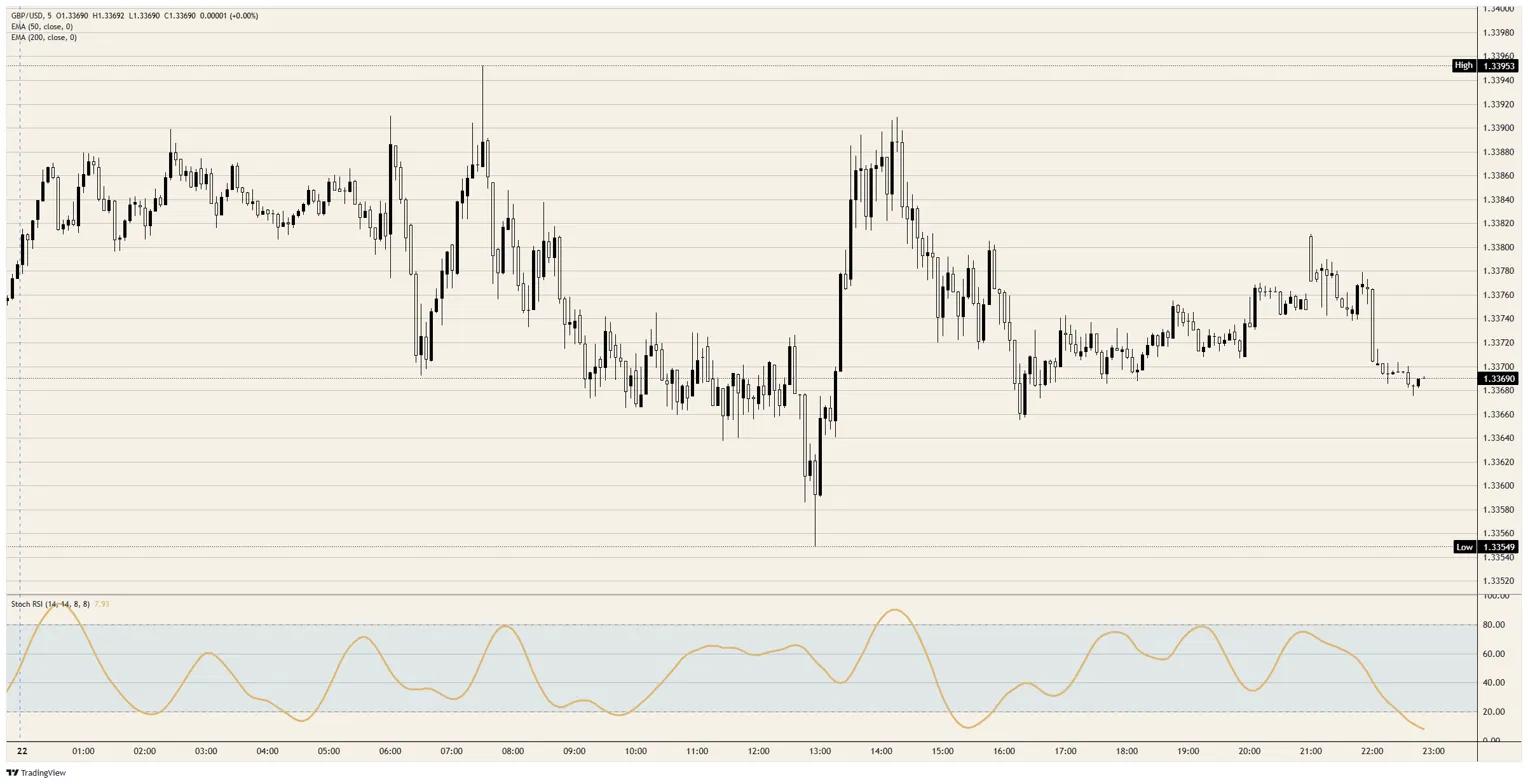
The Pound's week-long slide slowed to a crawl on Wednesday, and it picked an odd session to do so, because the June inflation report handed sellers their cleanest argument yet. GBP/USD tagged the 1.3350 area in early New York trade, its weakest level in over a week, and now sits between that floor and the converged moving-average band just below 1.3400, on track for a fifth straight daily decline measured in single-digit pips.
The hike case cools with the price data
The Office for National Statistics put headline Consumer Price Index (CPI) inflation at 2.6% YoY for June, under the 2.7% consensus, down from 2.8% in May and the lowest annual rate since March 2025. Services inflation eased to 3.6% from 3.7%, the monthly gain ran at just 0.1%, and transport and food did most of the downward work, precisely the categories a war-supply shock was supposed to keep hot.
A downside miss landing eight days before the Bank of England (BoE) decision on 30 July strips the near-term hike case down to its studs. Markets went into the release pricing roughly one more move to 4.00% over the coming months, the residue of a war-panic peak that briefly priced three, and the June print pushes that residue further out the curve. Core inflation is the lone complication, holding at 2.6% against a 2.5% consensus and refusing to sign off on the all-clear.
A slower fall is not a floor
Price action told a stranger story than the data, because the session's only meaningful rally arrived after the soft print, a squeeze that stalled just short of the 1.3400 handle before sellers reloaded through the London morning. The shape fits a market that front-ran the release: the Pound fell hardest on Tuesday, once the cooling pay numbers previewed the theme, and found little fresh to sell when the confirmation landed.
The slowdown therefore reads as exhaustion beneath resistance rather than the start of a base. Wednesday's entire range spans roughly 40 pips, wedged between a support shelf the market has already tested and an average band it cannot reclaim, while the daily candle prints a pause exactly where bulls needed a reversal.
The Dollar side of the ledger keeps doing quiet work meanwhile. Washington ran an eleventh consecutive round of strikes on Iran, Trump attached a retaliation price of one Iranian bridge or power plant per tanker attacked in the Strait of Hormuz, and Crude Oil pressed one-month highs. A backdrop like that keeps a war bid under the greenback while risk currencies queue for their turn lower, and the Pound currently stands at the front of the queue.
Westminster supplied its own layer, with Andy Burnham's cabinet taking shape and John Healey installed at the Treasury, where his first inflation report as Chancellor arrived as welcome news he immediately qualified. The fiscal programme that will actually test gilt-market patience remains unwritten, so the political-credibility discount on the Pound stays intact rather than resolved.
Friday carries the rest of the week
Thursday runs light, with US jobless claims at 12:30 GMT seen near 212K and the GfK consumer confidence survey for July landing at 23:01 GMT, where consensus at -21 after -23 implies a household mood improving into a contracting economy. Friday then does the heavy lifting for the Pound. June retail sales print at 06:00 GMT with consensus at -0.3% MoM after May's 1.2% jump, the ex-fuel measure is seen giving back 0.4%, and the YoY pace is expected to cool to 2.3% from 3.2%.
The flash Purchasing Managers Index (PMI) round follows at 08:30 GMT from an uncomfortable base, since the composite entered the month at 49.3 with services at 48.8, both below the 50.0 boundary, and a further slip would carry the contraction story straight into the BoE's meeting week. The US answers with its own flash round at 13:45 GMT, expected near 54.5 on manufacturing, a reminder of the growth gap quietly working for the Dollar. The whole slate amounts to the final input batch before next week's double bill, the Federal Reserve on Wednesday and the BoE a day later.
The Pound's technical picture
Resistance: The converged 50-day and 200-day Exponential Moving Averages (EMA) sit just below the 1.3400 handle, and Wednesday's recovery attempt stalled just short of that band. Above it, the mid-July peak near 1.3550 is the next structure of consequence.
Support: The 1.3350 area, tagged on Wednesday and the first downside target from Tuesday's map, is the immediate floor. Beneath it sit 1.3300 and then the summer base at the 1.3150 area.
Bias: Bearish below the 1.3400 handle. A sustained break of the 1.3350 area opens 1.3300, with the daily Stochastic Relative Strength Index rolling over from overbought to confirm the turn, and a daily close back above 1.3400 invalidates the downside view.
GBP/USD daily chart
Pound Sterling FAQs
The Pound Sterling (GBP) is the oldest currency in the world (886 AD) and the official currency of the United Kingdom. It is the fourth most traded unit for foreign exchange (FX) in the world, accounting for 12% of all transactions, averaging $630 billion a day, according to 2022 data. Its key trading pairs are GBP/USD, also known as ‘Cable’, which accounts for 11% of FX, GBP/JPY, or the ‘Dragon’ as it is known by traders (3%), and EUR/GBP (2%). The Pound Sterling is issued by the Bank of England (BoE).
The single most important factor influencing the value of the Pound Sterling is monetary policy decided by the Bank of England. The BoE bases its decisions on whether it has achieved its primary goal of “price stability” – a steady inflation rate of around 2%. Its primary tool for achieving this is the adjustment of interest rates. When inflation is too high, the BoE will try to rein it in by raising interest rates, making it more expensive for people and businesses to access credit. This is generally positive for GBP, as higher interest rates make the UK a more attractive place for global investors to park their money. When inflation falls too low it is a sign economic growth is slowing. In this scenario, the BoE will consider lowering interest rates to cheapen credit so businesses will borrow more to invest in growth-generating projects.
Data releases gauge the health of the economy and can impact the value of the Pound Sterling. Indicators such as GDP, Manufacturing and Services PMIs, and employment can all influence the direction of the GBP. A strong economy is good for Sterling. Not only does it attract more foreign investment but it may encourage the BoE to put up interest rates, which will directly strengthen GBP. Otherwise, if economic data is weak, the Pound Sterling is likely to fall.
Another significant data release for the Pound Sterling is the Trade Balance. This indicator measures the difference between what a country earns from its exports and what it spends on imports over a given period. If a country produces highly sought-after exports, its currency will benefit purely from the extra demand created from foreign buyers seeking to purchase these goods. Therefore, a positive net Trade Balance strengthens a currency and vice versa for a negative balance.
Recommended Articles


