


USD/MXN (USDMXN) Is up 0.51% on Oct 22: Are Market Expectations Adjusting?
USD/MXN (USDMXN) is up 0.51% at Oct 22 00:15(ET), now at $18.76695, with a 7-day up of 2.08%.
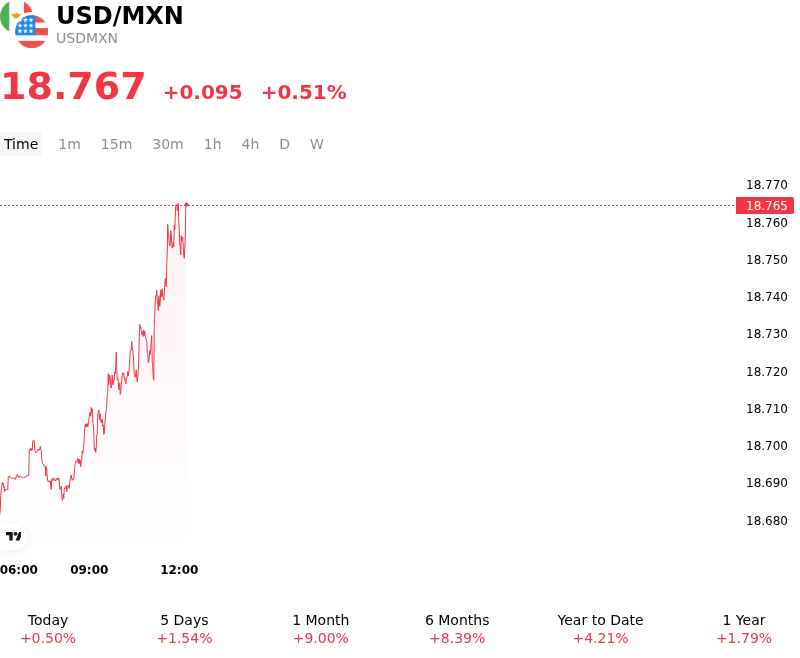
What is driving USD/MXN (USDMXN)’s stock price up today?
The upward momentum in USDMXN reflects a widening repricing of relative interest-rate expectations, with the US dollar outperforming emerging market peers as institutional investors recalibrate monetary policy trajectories for both central banks. Resilient US macroeconomic performance and firm Treasury yields have reinforced expectations that the Federal Reserve will adopt a cautious approach toward further policy easing. Elevated US yields have provided broad support to the greenback, weighing heavily on high-beta Latin American currencies.
Concurrently, the Mexican peso continues to experience margin pressure from a narrowing interest-rate differential. Banco de México has maintained a monetary easing path, supported by progressive moderation in domestic core inflation. As market participants price in additional benchmark rate reductions from Banxico, the prospective carry advantage of peso-denominated assets relative to US Treasuries has eroded. This diminishing yield spread has prompted institutional real-money and leveraged accounts to scale back long-peso carry positions.
From a macro strategy perspective, the movement appears driven by tactical portfolio reallocation and broader risk-off adjustments rather than a fundamental shift in Mexico's external balances. Heightened market sensitivity to global growth expectations and shifting risk appetite have favored liquid US dollar holdings over emerging market exposures. Institutional investors will remain focused on upcoming inflation metrics, fiscal policy developments, and upcoming central bank forward guidance to evaluate whether this upward trajectory signals an extended dollar firming cycle or a localized position-clearing event.
Technical Analysis of USD/MXN (USDMXN)
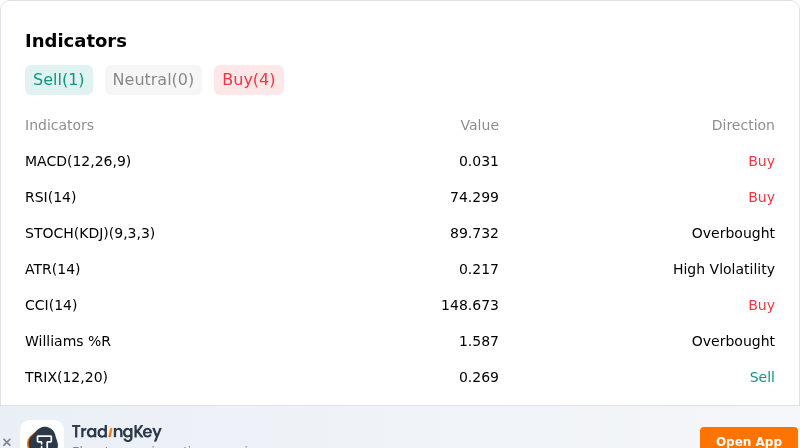
Technically, USD/MXN (USDMXN) shows a MACD (12,26,9) value of 0.032, indicating a buy signal. The RSI at 74.358 suggests buy condition and the Williams %R at 1.186 suggests overbought condition. Please monitor closely.
More details about USD/MXN (USDMXN)
Recent Events and Risks:
- Narrowing Rate Differentials and Carry Trade Unwind: Hawkish Federal Reserve rate expectations paired with elevated U.S. Treasury yields continue to compress the interest rate differential between Mexico's 6.50% reference rate and U.S. benchmark rates. This compression erodes the Mexican peso's carry-trade appeal and triggers intraday upside momentum in USD/MXN.
- Dovish Banxico Signals and Policy Divergence: Central bank minutes and institutional survey data indicate that key Banxico governing board members remain open to monetary easing. Softening interest rate support in Mexico contrasts with resilient U.S. yields, creating persistent downside pressure on the peso.
- Stalled U.S.-Mexico Trade and Tariff Negotiations: Bilateral trade negotiations have encountered resistance as U.S. officials oppose significant tariff relief on Mexican automobile, steel, and aluminum exports. The lack of immediate progress raises trade uncertainty ahead of upcoming USMCA review framework discussions.
- Institutional Investment Concerns: Persistent regulatory friction, ongoing debate surrounding judicial sector reforms, and external trade disputes continue to weigh on foreign direct investment expectations in Mexico. This leaves the Mexican peso vulnerable to sharp volatility spikes during broader risk-off market shifts.
Recommended Articles


