


NZD/USD (NZDUSD) Is up 0.52% on Oct 16: Why It Happened
NZD/USD (NZDUSD) is up 0.52% at Oct 16 23:50(ET), now at $0.56485, with a 7-day up of 0.68%.
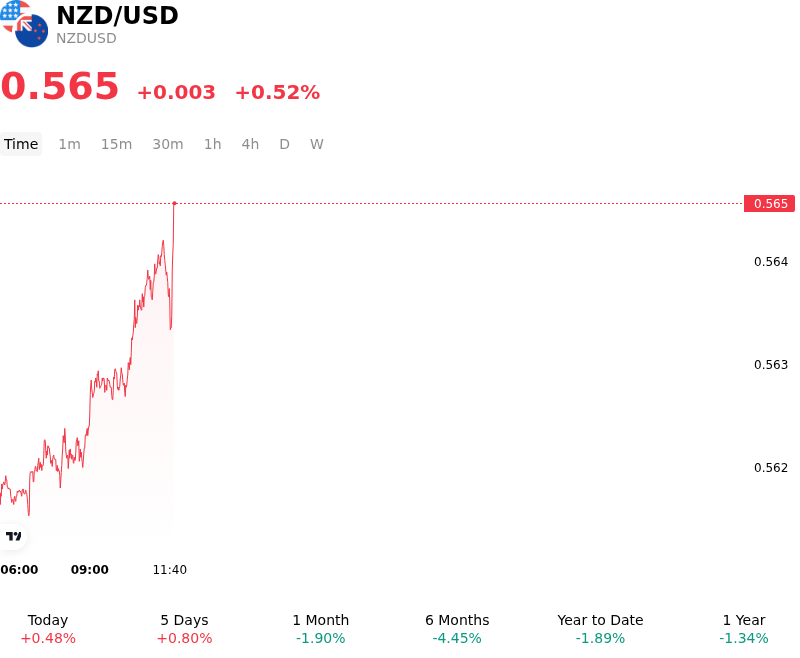
What is driving NZD/USD (NZDUSD)’s stock price up today?
The New Zealand dollar advanced against the US dollar during the session, driven primarily by a shift in relative interest rate expectations following hawkish communications from the Reserve Bank of New Zealand and a broader pullback in US Treasury yields. Market sentiment toward the Kiwi dollar was reinforced after senior central bank officials signaled that the upcoming Official Cash Rate decision remains open to further policy tightening. This hawkish stance reminded market participants that the RBNZ maintains an upward bias on short-term interest rates to combat persistent price pressures, encouraging investors to reprice domestic yield curves higher and widening interest rate differentials in favor of New Zealand assets.
Simultaneously, the US dollar experienced renewed downward pressure as US government bond yields retreated from recent multi-month peak levels. Investors engaged in profit-taking on long greenback positions following a strong rally triggered by earlier inflation data, which temporarily exhausted buying momentum for the US currency. As US yields eased, the short-term yield premium supporting the greenback narrowed, creating a more supportive environment for risk-sensitive, high-yielding currencies.
A modest stabilization in broader global risk appetite further amplified support for high-beta commodity currencies, allowing the New Zealand dollar to rebound off its recent technical lows. While the intraday advance represents a tactical recovery driven by central bank messaging and temporary yield adjustments, institutional investors will continue monitoring upcoming domestic inflation statistics and broader Federal Reserve policy expectations to determine whether the move can establish a durable trend.
Technical Analysis of NZD/USD (NZDUSD)
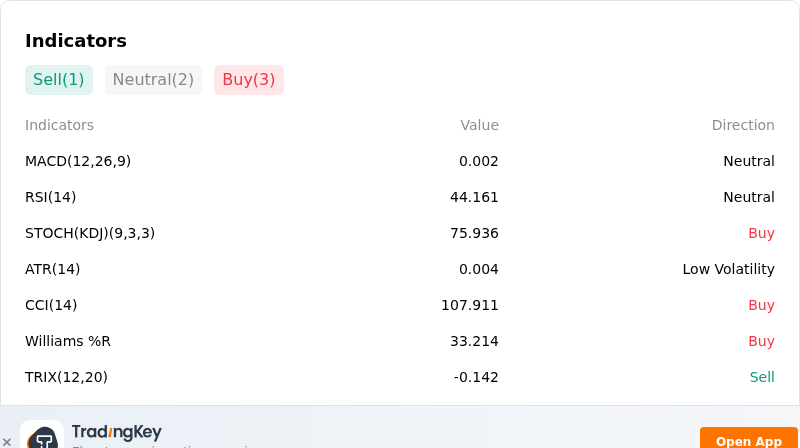
Technically, NZD/USD (NZDUSD) shows a MACD (12,26,9) value of 0.002, indicating a neutral signal. The RSI at 44.161 suggests neutral condition and the Williams %R at 33.214 suggests buy condition. Please monitor closely.
More details about NZD/USD (NZDUSD)
Recent Events and Risks:
- U.S. Inflation Acceleration and Fed Rate Expectations: Stronger-than-expected U.S. Consumer Price Index data showing headline inflation accelerating to 3.7% YoY has prompted hawkish Federal Reserve commentary and pushed U.S. Treasury yields higher, strengthening the U.S. Dollar at the expense of NZD/USD.
- Uncertain RBNZ Policy Outlook Amid Domestic Weakness: Statements from Reserve Bank of New Zealand Chief Economist Paul Conway noting the upcoming rate decision is completely open have injected monetary policy uncertainty, while lingering domestic economic sluggishness and soft labor conditions continue to weigh on Kiwi fundamentals.
- Geopolitical Risk Aversion and Energy Inflation Fears: Renewed Middle East geopolitical friction and rising energy prices have heightened global inflation concerns and reduced market risk appetite, triggering capital flows out of high-beta growth currencies like the New Zealand Dollar toward safe-haven greenback holdings.
- Technical Support Failure and Yield Spread Pressures: The breakdown below key support near 0.5580 toward multi-month lows has exacerbated selling momentum, reinforced by widening U.S.-NZ interest rate differentials and heavy long market positioning vulnerable to unwinding.
Recommended Articles


