


USD/JPY (USDJPY) Drops 1.02% on Aug 7: What Does the Market Value?
USD/JPY (USDJPY) is down 1.02% at Aug 7 08:35(ET), now at $156.793, with a 7-day down of 0.49%.
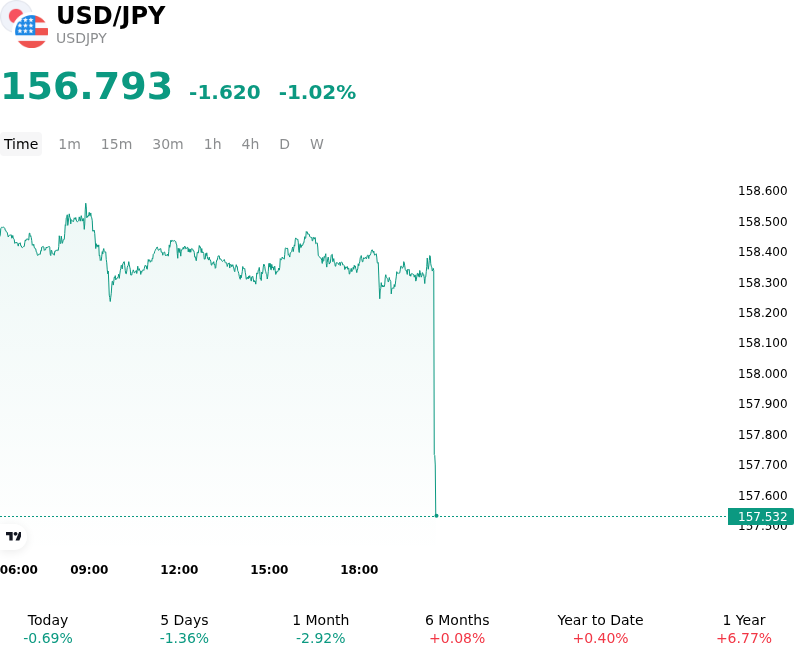
What is driving USD/JPY (USDJPY)’s stock price down today?
The sharp downside move in USDJPY is primarily driven by a significant repricing of Federal Reserve policy expectations following the release of the July U.S. employment report. The data showed a notable slowdown in non-farm payroll growth and an unexpected rise in the unemployment rate, signaling that the labor market is cooling faster than previously anticipated. This has led institutional investors to aggressively price in more substantial rate cuts for the remainder of the year, causing a broad-based retreat in the U.S. dollar as Treasury yields collapsed across the curve.
The compression of the U.S.-Japan interest rate differential is the core mechanical driver of the pair's decline. As the spread between 10-year U.S. Treasuries and Japanese Government Bonds narrows, the incentive for carry trade positions—where investors borrow yen to invest in higher-yielding dollar assets—diminishes rapidly. The resulting unwinding of these positions has created significant buying pressure for the yen, exacerbating the downward move in the exchange rate as market participants rush to hedge exposure.
On the Japanese side, the yen is benefiting from its traditional role as a safe-haven asset amid heightened concerns over a potential U.S. economic slowdown. While the Bank of Japan continues its path toward policy normalization, the market is focusing more on the narrowing policy gap between a Federal Reserve that is pivoting toward easing and a BoJ that remains committed to gradual rate hikes. Speculation that the Fed may need to front-load rate cuts to prevent a hard landing has shifted the momentum firmly in favor of the yen.
Furthermore, the technical breach of key psychological support levels has triggered automated selling programs and stop-loss orders, accelerating the intraday slide. Institutional capital flows are currently prioritizing liquidity and defensive positioning, as the narrative of U.S. economic exceptionalism faces its most significant challenge in recent months. Investors remain focused on upcoming inflation prints and further central bank commentary to determine if this move marks the beginning of a sustained structural trend lower for the pair.
Technical Analysis of USD/JPY (USDJPY)
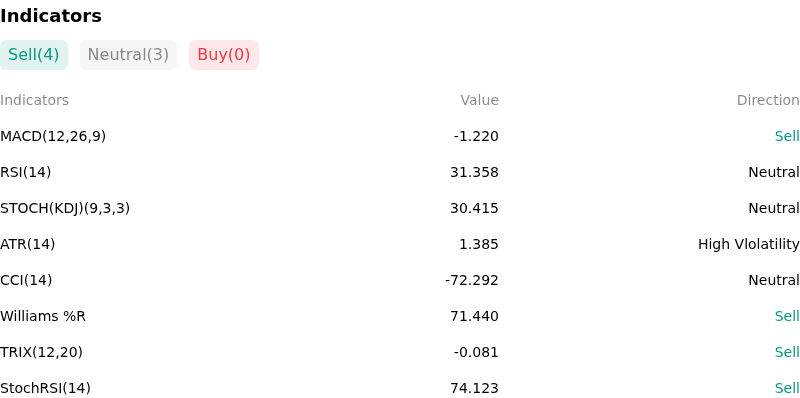
Technically, USD/JPY (USDJPY) shows a MACD (12,26,9) value of -1.220, indicating a sell signal. The RSI at 31.358 suggests neutral condition and the Williams %R at 71.440 suggests sell condition. Please monitor closely.
More details about USD/JPY (USDJPY)
Recent Events and Risks:
- Japanese Ministry of Finance Intervention Threat: Recent rhetoric from Japanese officials regarding "disorderly moves" has intensified as the pair tests the 157.00 level, creating a high-probability risk of direct yen-buying intervention that could trigger a multi-hundred pip downside move in USDJPY.
- Yield Spread Compression: Upward momentum in 10-year Japanese Government Bond (JGB) yields, which recently hit decade highs above 1.0%, is narrowing the interest rate differential with U.S. Treasuries, encouraging a tactical unwind of JPY-funded carry trades.
- Hawkish FOMC Minutes Backlash: While recent Fed minutes indicated a willingness to tighten further if inflation persists, any forthcoming U.S. economic data misses (such as cooling PCE or employment figures) pose a significant downside risk for the dollar as market positioning is currently heavily skewed toward "higher-for-longer" expectations.
- Safe-Haven Flow Reversal: Heightened geopolitical uncertainty or a sudden correction in overstretched global equity markets could trigger a rapid deleveraging event, driving safe-haven flows back into the yen and causing a sharp intraday spike in volatility.
Recommended Articles


