

Shopify Inc Stock (SHOP) Moved Up by 4.73% on Jul 1: Drivers Behind the Movement

Source Tradingkey

Shopify Inc (SHOP) moved up by 4.73%. The Software & IT Services sector is up by 3.05%. The company outperformed the industry. Top 3 stocks by turnover in the sector: Meta Platforms Inc (META) up 7.56%; Microsoft Corp (MSFT) up 1.45%; Alphabet Inc Class A (GOOGL) up 0.25%.
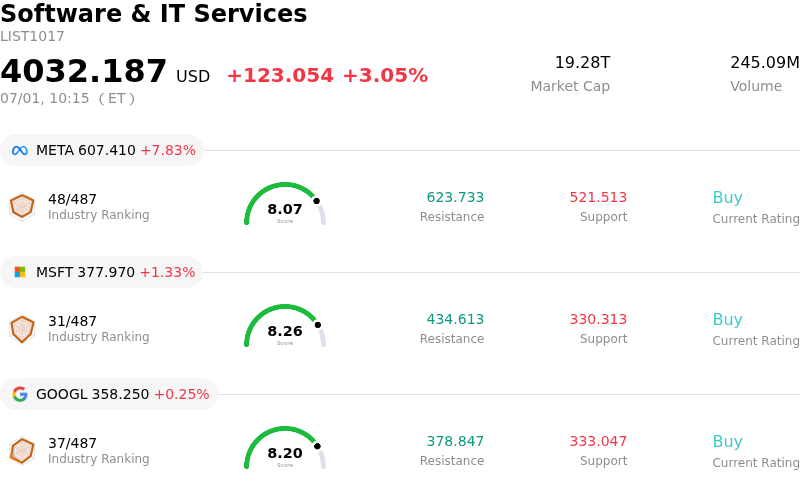
SummaryOverview

What is driving Shopify Inc (SHOP)’s stock price up today?

The upward movement and accompanying intraday volatility observed in Shopify shares can be attributed to a combination of strategic capital management, robust product updates, and high-profile enterprise customer acquisitions that have reinforced investor confidence.

A major driver of the positive sentiment is Shopify's aggressive capital allocation strategy. The board’s recent decision to add three billion dollars to its share repurchase program, expanding the total authorization to five billion dollars, has established a strong support level for the stock. With active buybacks underway, this move signals management's confidence in the company's long-term financial health and cash flow durability, providing reassurance to institutional investors. This buyback is particularly well-received as a stabilizing force following a period of broader software-sector weakness earlier in the year.

Additionally, the market is reacting to Shopify's product momentum and its positioning as a leader in AI-enabled e-commerce. The rollout of the Spring and Summer Editions, which highlighted upgrades to the Universal Commerce Protocol and the native integration of Agentic Storefronts, has gained traction. By allowing products to be seamlessly discovered by AI assistants across major consumer platforms, Shopify is successfully adapting to shifts in digital discovery. The strategic decision to open its proprietary checkout system, Shop Pay, to non-Shopify merchants has further expanded its addressable market and created a new, high-margin revenue stream that diversifies the business.

On the enterprise side, Shopify continues to win major global brands, illustrating the platform's scalability and enterprise-grade appeal. The high-profile announcement that fashion retail giant Benetton Group has successfully migrated its flagship e-commerce websites to Shopify's architecture serves as a strong validation of the platform's capabilities for large-scale operations. This migration, aimed at simplifying management processes and improving checkout conversion, underscores Shopify's competitive advantage in attracting premium global retailers.

While some market volatility persists due to technical adjustments following the scheduled deprecation of legacy platform features like Shopify Scripts, the overall trajectory remains highly supportive. The combination of a massive share buyback program, leading-edge AI product integrations, and continuous enterprise adoption has outweighed minor transition risks, driving the stock higher.

Technical Analysis of Shopify Inc (SHOP)

Technically, Shopify Inc (SHOP) shows a MACD (12,26,9) value of 1.258, indicating a neutral signal. The RSI at 53.145 suggests neutral condition and the Williams %R at 39.007 suggests buy condition. Please monitor closely.

Fundamental Analysis of Shopify Inc (SHOP)

Shopify Inc (SHOP) is in the Software & IT Services industry. Its latest annual revenue is $11.56B, ranking 32 in the industry. The net profit is $1.23B, ranking 39 in the industry. Company Profile

Over the past month, multiple analysts have rated the company as Buy, with an average price target of $149.71, a high of $200.00, and a low of $110.00.

More details about Shopify Inc (SHOP)

Company Specific Risks:

  • Stretched Valuation Premium: Despite falling approximately 25% to 33% year-to-date, Shopify continues to trade at a highly elevated forward price-to-earnings (P/E) ratio of over 62x, presenting a steep premium relative to the industry average of approximately 14x. This rich multiple leaves the stock exceptionally sensitive to macroeconomic headwinds and any perceived deceleration in its growth rate.
  • Rising Operating Expenses and Margin Pressure: Wall Street analysts remain cautious about the company’s operating expense leverage. Guidance forecasting elevated operating expenses of 35% to 36% of revenue for the second quarter has fueled investor concern that aggressive infrastructure and AI integrations are eroding operating margins, which could stall long-term net income margin expansion.
  • Slowdown in Projected Revenue Growth: Investors and institutional analysts have reacted negatively to management's near-term guidance indicating a slowdown. Following a period of consecutive 30%+ revenue expansions, the company’s forecast for second-quarter revenue growth to slip into the "high-twenties" percentage range has triggered a valuation compression.
  • Aggressive Institutional Distribution: Institutional investors—who collectively own roughly 70% of the company's outstanding shares—have engaged in active distribution, selling out of positions into market rallies at a rapid pace of nearly 3.5-to-1. This heavy institutional selling creates persistent overhead resistance and amplifies intraday stock price volatility.
Disclaimer: For information purposes only. Past performance is not indicative of future results.
placeholder
Bitcoin CME gaps at $35,000, $27,000 and $21,000, which one gets filled first?Prioritize filling the $27,000 gap and even try higher.
Author  FXStreet
Aug 22, 2023
Prioritize filling the $27,000 gap and even try higher.
placeholder
Pinduoduo Earnings Incoming: Morgan Stanley Sees Long-Term Profit Potential​Insights – On November 21, Chinese e-commerce giant Pinduoduo (PDD) will release its Q3 2024 earnings.
Author  Mitrade
Nov 20, 2024
​Insights – On November 21, Chinese e-commerce giant Pinduoduo (PDD) will release its Q3 2024 earnings.
placeholder
Bitcoin briefly loses 2025 gains as crypto plunges over the weekend.Bitcoin experienced a sharp decline this weekend, briefly erasing its 2025 gains and dipping below its year-opening value of $93,507. The cryptocurrency fell to a low of $93,029 on Sunday, representing a 25% drop from its all-time high in October. Although it has rebounded slightly to around $94,209, the pressures on the market remain significant. The downturn occurred despite the reopening of the U.S. government on Thursday, which many had hoped would provide essential support for crypto markets. This year initially appeared promising for cryptocurrencies, particularly after the inauguration of President Donald Trump, who has established the most pro-crypto administration thus far. However, ongoing political tensions—including Trump's tariff strategies and the recent government shutdown, lasting a historic 43 days—have contributed to several rapid price pullbacks for Bitcoin throughout the year. Market dynamics are also being influenced by Bitcoin whales—investors holding large amounts of Bitcoin—who have been offloading portions of their assets, consequently stalling price rallies even as positive regulatory developments emerge. Despite these sell-offs, analysts from Glassnode argue that this behavior aligns with typical patterns seen among long-term investors during the concluding stages of bull markets, suggesting it is not indicative of a mass exodus. Notably, Bitcoin is not alone in its struggles, as Ethereum and Solana have also recorded declines of 7.95% and 28.3%, respectively, since the start of the year, while numerous altcoins have faced even steeper losses. Looking ahead, questions linger regarding the viability of the four-year cycle thesis, particularly given the increasing institutional support and regulatory frameworks now in place in the crypto landscape. Matt Hougan, chief investment officer at Bitwise, remains optimistic, suggesting a potential Bitcoin resurgence in 2026 driven by the “debasement trade” thesis and a broader trend toward increased adoption of stablecoins, tokenization, and decentralized finance. Hougan emphasized the soundness of the underlying fundamentals, pointing to a positive outlook for the sector in the longer term.
Author  Mitrade
Nov 17, 2025
Bitcoin experienced a sharp decline this weekend, briefly erasing its 2025 gains and dipping below its year-opening value of $93,507. The cryptocurrency fell to a low of $93,029 on Sunday, representing a 25% drop from its all-time high in October. Although it has rebounded slightly to around $94,209, the pressures on the market remain significant. The downturn occurred despite the reopening of the U.S. government on Thursday, which many had hoped would provide essential support for crypto markets. This year initially appeared promising for cryptocurrencies, particularly after the inauguration of President Donald Trump, who has established the most pro-crypto administration thus far. However, ongoing political tensions—including Trump's tariff strategies and the recent government shutdown, lasting a historic 43 days—have contributed to several rapid price pullbacks for Bitcoin throughout the year. Market dynamics are also being influenced by Bitcoin whales—investors holding large amounts of Bitcoin—who have been offloading portions of their assets, consequently stalling price rallies even as positive regulatory developments emerge. Despite these sell-offs, analysts from Glassnode argue that this behavior aligns with typical patterns seen among long-term investors during the concluding stages of bull markets, suggesting it is not indicative of a mass exodus. Notably, Bitcoin is not alone in its struggles, as Ethereum and Solana have also recorded declines of 7.95% and 28.3%, respectively, since the start of the year, while numerous altcoins have faced even steeper losses. Looking ahead, questions linger regarding the viability of the four-year cycle thesis, particularly given the increasing institutional support and regulatory frameworks now in place in the crypto landscape. Matt Hougan, chief investment officer at Bitwise, remains optimistic, suggesting a potential Bitcoin resurgence in 2026 driven by the “debasement trade” thesis and a broader trend toward increased adoption of stablecoins, tokenization, and decentralized finance. Hougan emphasized the soundness of the underlying fundamentals, pointing to a positive outlook for the sector in the longer term.
placeholder
Markets in 2026: Will gold, Bitcoin, and the U.S. dollar make history again? — These are how leading institutions thinkAfter a turbulent 2025, what lies ahead for commodities, forex, and cryptocurrency markets in 2026?
Author  Insights
Dec 25, 2025
After a turbulent 2025, what lies ahead for commodities, forex, and cryptocurrency markets in 2026?
placeholder
Gold Price Forecast: Does Gold Falling Below $4,000 Mean the Bull Market Is Over? Will It Still Rise in the Second Half of 2026?Heading into the second half of 2026, the gold market has transitioned from a strong-performing asset at the start of the year into one pulling back from its highs. Recently, gold prices
Author  TradingKey
Jun 29, Mon
Heading into the second half of 2026, the gold market has transitioned from a strong-performing asset at the start of the year into one pulling back from its highs. Recently, gold prices
goTop
quote