

EUR/USD (EURUSD) Is down 0.52% on Jul 1: What Is Behind the Currency Move?

Source Tradingkey

EUR/USD (EURUSD) is down 0.52% at Jul 1 09:15(ET), now at $1.13616, with a 7-day up of 0.03%.
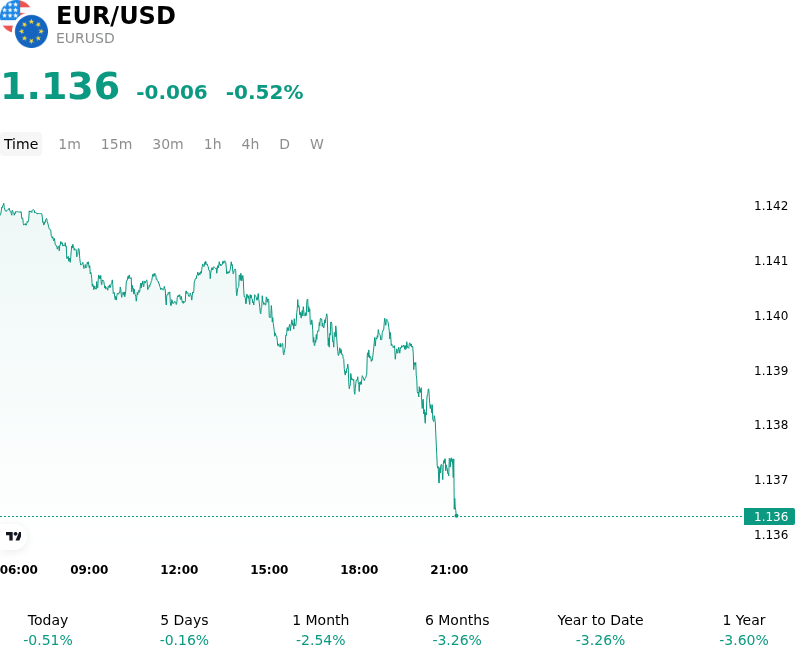
SummaryOverview

What is driving EUR/USD (EURUSD)’s stock price down today?

The primary catalyst driving the downward pressure on EURUSD was a sharper-than-expected cooling of Eurozone inflation, which significantly altered interest-rate expectations in favor of the US dollar. Preliminary inflation data released by Eurostat revealed that the Eurozone Harmonized Index of Consumer Prices fell more sharply than market consensus, matching a notable deceleration in its core component. This drop, fueled heavily by cooler German and French consumer price figures, suggested that regional inflationary pressures are moderating more rapidly than previously assumed. Consequently, foreign exchange markets quickly repriced European Central Bank policy expectations, scaling back the perceived necessity for the central bank to keep interest rates in highly restrictive territory for an extended period.

Conversely, the US dollar gathered fresh momentum from a resilient macroeconomic backdrop, highlighting the widening growth and policy divergence between the two economic blocs. Positive US economic data, including higher-than-expected job openings, underscored the ongoing tightness of the domestic labor market. This reinforced expectations that the Federal Reserve would maintain a restrictive monetary stance, with investors even pricing in increased odds of further rate hikes.

The contrasting macroeconomic signals directly impacted sovereign bond markets, driving yield differentials to move in favor of the greenback. While long-term Eurozone yields remained largely contained following the soft inflation prints, US Treasury yields rose sharply. This widening of the nominal interest-rate differential between US and European debt instruments reduced the relative appeal of euro-denominated assets, stimulating capital flows out of the single currency and toward the dollar.

Market participants also closely monitored policy guidance from central bankers during the European Central Bank’s Sintra Forum, where a panel featuring key central bank leaders highlighted the differing policy constraints. The broader, multi-week downtrend in EURUSD remains fundamentally supported by these diverging monetary policy paths, as the Fed's potential for maintaining higher terminal rates contrasts sharply with an ECB that is facing mounting domestic disinflationary pressures. Unless subsequent US data releases show a corresponding cooling of economic activity, the relative yield advantage is expected to continue supporting the greenback over the medium term.

Technical Analysis of EUR/USD (EURUSD)

Technically, EUR/USD (EURUSD) shows a MACD (12,26,9) value of -0.001, indicating a sell signal. The RSI at 32.761 suggests neutral condition and the Williams %R at 85.782 suggests oversold condition. Please monitor closely.
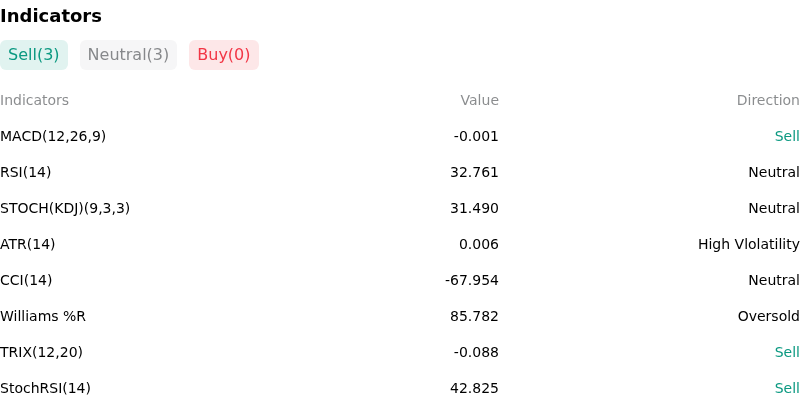
IndicatorAnalysis

More details about EUR/USD (EURUSD)

Recent Events and Risks:

  • Divergent Central Bank Policy Slant: While the European Central Bank (ECB) is expected to pause rate hikes following its 25-basis-point increase in June, the U.S. Federal Reserve under new Chair Kevin Warsh has adopted a more hawkish tone. Market expectations and interest rate futures are pricing in up to two additional Fed hikes by year-end, driving U.S. Treasury yields higher and exerting persistent downward pressure on the EURUSD pair.
  • Sintra Forum Event Volatility: The ongoing ECB Sintra Forum features highly anticipated panel discussions with ECB President Christine Lagarde and Fed Chair Kevin Warsh. Any hawkish rhetoric from Warsh regarding sticky U.S. inflation or dovish signaling from Lagarde concerning cooling Eurozone factory-gate pricing poses an immediate downside risk of triggering sharp intraday selling in the euro.
  • Cooling Eurozone Inflation Dampening Hike Bets: Recent economic indicators show Eurozone manufacturing cost inflation is easing to a multi-month low, primarily driven by a sharp drop in international energy prices. This easing inflation environment reduces the pressure on the ECB to pursue further aggressive rate increases, removing a key support pillar for the euro and allowing the bearish trendline to dominant.
  • Strong Technical Bearish Momentum: Despite brief technical recovery attempts, EURUSD is down over 2% over the past month and remains locked in a primary bearish trend below the pivotal 1.1500 resistance level and the 100-day moving average. Strategists warn that a failure to hold immediate support at the 1.1390/1.1410 zone exposes the pair to a quick drop toward the 1.1210 support level.
Disclaimer: For information purposes only. Past performance is not indicative of future results.
placeholder
Bitcoin CME gaps at $35,000, $27,000 and $21,000, which one gets filled first?Prioritize filling the $27,000 gap and even try higher.
Author  FXStreet
Aug 22, 2023
Prioritize filling the $27,000 gap and even try higher.
placeholder
Pinduoduo Earnings Incoming: Morgan Stanley Sees Long-Term Profit Potential​Insights – On November 21, Chinese e-commerce giant Pinduoduo (PDD) will release its Q3 2024 earnings.
Author  Mitrade
Nov 20, 2024
​Insights – On November 21, Chinese e-commerce giant Pinduoduo (PDD) will release its Q3 2024 earnings.
placeholder
Bitcoin briefly loses 2025 gains as crypto plunges over the weekend.Bitcoin experienced a sharp decline this weekend, briefly erasing its 2025 gains and dipping below its year-opening value of $93,507. The cryptocurrency fell to a low of $93,029 on Sunday, representing a 25% drop from its all-time high in October. Although it has rebounded slightly to around $94,209, the pressures on the market remain significant. The downturn occurred despite the reopening of the U.S. government on Thursday, which many had hoped would provide essential support for crypto markets. This year initially appeared promising for cryptocurrencies, particularly after the inauguration of President Donald Trump, who has established the most pro-crypto administration thus far. However, ongoing political tensions—including Trump's tariff strategies and the recent government shutdown, lasting a historic 43 days—have contributed to several rapid price pullbacks for Bitcoin throughout the year. Market dynamics are also being influenced by Bitcoin whales—investors holding large amounts of Bitcoin—who have been offloading portions of their assets, consequently stalling price rallies even as positive regulatory developments emerge. Despite these sell-offs, analysts from Glassnode argue that this behavior aligns with typical patterns seen among long-term investors during the concluding stages of bull markets, suggesting it is not indicative of a mass exodus. Notably, Bitcoin is not alone in its struggles, as Ethereum and Solana have also recorded declines of 7.95% and 28.3%, respectively, since the start of the year, while numerous altcoins have faced even steeper losses. Looking ahead, questions linger regarding the viability of the four-year cycle thesis, particularly given the increasing institutional support and regulatory frameworks now in place in the crypto landscape. Matt Hougan, chief investment officer at Bitwise, remains optimistic, suggesting a potential Bitcoin resurgence in 2026 driven by the “debasement trade” thesis and a broader trend toward increased adoption of stablecoins, tokenization, and decentralized finance. Hougan emphasized the soundness of the underlying fundamentals, pointing to a positive outlook for the sector in the longer term.
Author  Mitrade
Nov 17, 2025
Bitcoin experienced a sharp decline this weekend, briefly erasing its 2025 gains and dipping below its year-opening value of $93,507. The cryptocurrency fell to a low of $93,029 on Sunday, representing a 25% drop from its all-time high in October. Although it has rebounded slightly to around $94,209, the pressures on the market remain significant. The downturn occurred despite the reopening of the U.S. government on Thursday, which many had hoped would provide essential support for crypto markets. This year initially appeared promising for cryptocurrencies, particularly after the inauguration of President Donald Trump, who has established the most pro-crypto administration thus far. However, ongoing political tensions—including Trump's tariff strategies and the recent government shutdown, lasting a historic 43 days—have contributed to several rapid price pullbacks for Bitcoin throughout the year. Market dynamics are also being influenced by Bitcoin whales—investors holding large amounts of Bitcoin—who have been offloading portions of their assets, consequently stalling price rallies even as positive regulatory developments emerge. Despite these sell-offs, analysts from Glassnode argue that this behavior aligns with typical patterns seen among long-term investors during the concluding stages of bull markets, suggesting it is not indicative of a mass exodus. Notably, Bitcoin is not alone in its struggles, as Ethereum and Solana have also recorded declines of 7.95% and 28.3%, respectively, since the start of the year, while numerous altcoins have faced even steeper losses. Looking ahead, questions linger regarding the viability of the four-year cycle thesis, particularly given the increasing institutional support and regulatory frameworks now in place in the crypto landscape. Matt Hougan, chief investment officer at Bitwise, remains optimistic, suggesting a potential Bitcoin resurgence in 2026 driven by the “debasement trade” thesis and a broader trend toward increased adoption of stablecoins, tokenization, and decentralized finance. Hougan emphasized the soundness of the underlying fundamentals, pointing to a positive outlook for the sector in the longer term.
placeholder
Markets in 2026: Will gold, Bitcoin, and the U.S. dollar make history again? — These are how leading institutions thinkAfter a turbulent 2025, what lies ahead for commodities, forex, and cryptocurrency markets in 2026?
Author  Insights
Dec 25, 2025
After a turbulent 2025, what lies ahead for commodities, forex, and cryptocurrency markets in 2026?
placeholder
Gold Price Forecast: Does Gold Falling Below $4,000 Mean the Bull Market Is Over? Will It Still Rise in the Second Half of 2026?Heading into the second half of 2026, the gold market has transitioned from a strong-performing asset at the start of the year into one pulling back from its highs. Recently, gold prices
Author  TradingKey
Jun 29, Mon
Heading into the second half of 2026, the gold market has transitioned from a strong-performing asset at the start of the year into one pulling back from its highs. Recently, gold prices
goTop
quote