

Sugar (SUGAR) Is up 2.23% on Jul 1: What Changed in Supply and Demand?

Source Tradingkey

Sugar (SUGAR) is up 2.23% at Jul 1 04:00(ET), now at $0.1512, with a 7-day up of 9.25%.
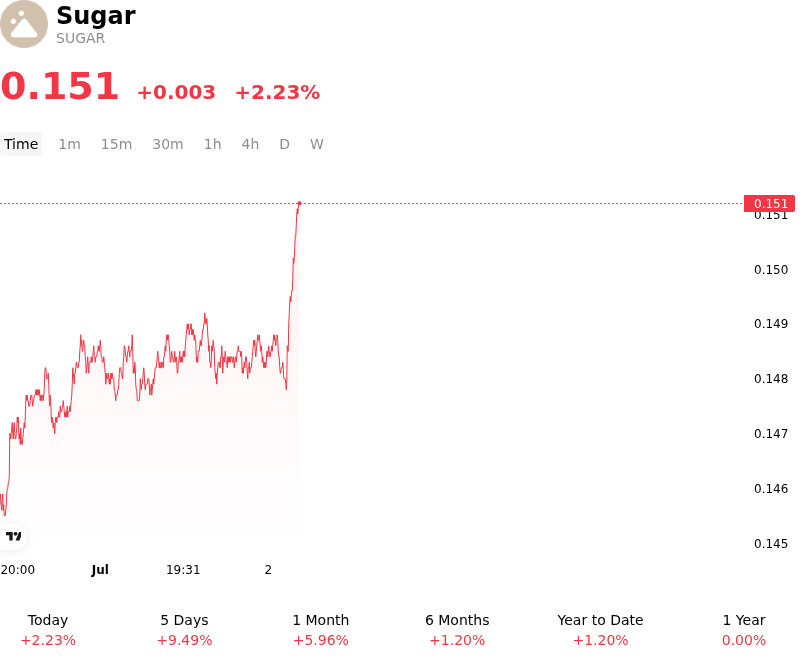
SummaryOverview

What is driving Sugar (SUGAR)’s stock price up today?

Sugar prices advanced significantly due to escalating supply-side concerns in major producing nations and shifting dynamics in agricultural weather patterns.

The primary catalyst for the upward price pressure is the worsening meteorological outlook in India, the world’s second-largest sugar producer. Cumulative monsoon rainfall has fallen nearly forty percent below normal historical levels. Forecasts suggesting the region's monsoon season could be one of the weakest in over a decade have stoked fears of severe water shortages, triggering sharp reductions in projected crop yields. Because India has extended its export restrictions to safeguard domestic food supplies, any severe drop in agricultural output threatens to completely remove Indian sugar from the international market. This has forced institutional investors to aggressively reprice global deficit expectations.

Compounding the supply anxieties in Asia are structural shifts in Brazil, the world’s leading sugar producer and exporter. Recent industry data from Unica indicates that sugarcane crushing in Brazil’s key center-south region has fallen year-over-year. Millers are increasingly diverting cane crushing away from sugar and toward ethanol production. Higher global energy and crude oil prices have incentivized this shift by enhancing domestic ethanol margins. Consequently, the percentage of cane allocated for sugar processing has dropped significantly compared to last year, exacerbating fears of a tightening global balance.

The convergence of below-average monsoons in South Asia and the reduced sugar-to-ethanol ratio in South America has prompted major commodity researchers to revise their global sugar balance estimates. Previous expectations of a comfortable surplus have been replaced with a projected global deficit.

While the physical market has faced near-term headwinds from high domestic inventories in regions like China, the international futures market is increasingly reflecting these longer-term structural deficits. Financial participants have reacted by reducing net-short exposure, and commercial buyers are aggressively locking in contracts to hedge against further agricultural disruptions. These factors have jointly driven a sharp repricing in global sugar benchmarks.

Technical Analysis of Sugar (SUGAR)

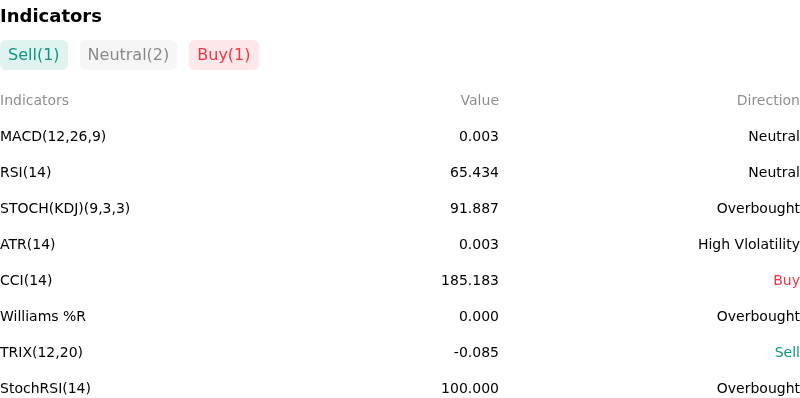
Technically, Sugar (SUGAR) shows a MACD (12,26,9) value of 0.003, indicating a neutral signal. The RSI at 65.434 suggests neutral condition and the Williams %R at 0.000 suggests overbought condition. Please monitor closely.
IndicatorAnalysis

More details about Sugar (SUGAR)

Recent Events and Risks:

  • Geopolitical Risk De-escalation and Lower Logistics Costs: The recent reopening of the critical Strait of Hormuz has dramatically reduced global maritime risk premiums, leading to lower ocean shipping rates and cheaper insurance costs for agricultural trade. This logistical stabilization removes immediate supply-disruption fears and puts downward pressure on global raw sugar futures.
  • Crude Oil Declines Reducing Ethanol Incentives: A slide in crude oil prices has weakened the economic incentive for Brazilian and international sugar mills to divert sugarcane crops into ethanol production. If energy prices remain soft, mills are highly likely to maximize their food-grade sugar allocation, exacerbating near-term global sugar oversupply.
  • Sluggish Global Demand and Consumption Slowdown: Weakness in physical demand continues to cap price recoveries, with the USDA's recent sweetener reports confirming significant multi-year declines in global sugar deliveries and overall food-consumption use. Physical spot market buyers remain well-stocked and are largely delaying purchases in anticipation of further price declines.
  • Comfortable Global Inventories and Rising Stocks-to-Use Ratio: Despite long-term crop concerns, physical inventories remain ample. The USDA's latest global projections highlight a rising global stocks-to-use ratio, climbing to 24.67% on the back of larger localized inventory builds in major importing countries like China and India.
Disclaimer: For information purposes only. Past performance is not indicative of future results.
placeholder
Bitcoin CME gaps at $35,000, $27,000 and $21,000, which one gets filled first?Prioritize filling the $27,000 gap and even try higher.
Author  FXStreet
Aug 22, 2023
Prioritize filling the $27,000 gap and even try higher.
placeholder
Pinduoduo Earnings Incoming: Morgan Stanley Sees Long-Term Profit Potential​Insights – On November 21, Chinese e-commerce giant Pinduoduo (PDD) will release its Q3 2024 earnings.
Author  Mitrade
Nov 20, 2024
​Insights – On November 21, Chinese e-commerce giant Pinduoduo (PDD) will release its Q3 2024 earnings.
placeholder
Bitcoin briefly loses 2025 gains as crypto plunges over the weekend.Bitcoin experienced a sharp decline this weekend, briefly erasing its 2025 gains and dipping below its year-opening value of $93,507. The cryptocurrency fell to a low of $93,029 on Sunday, representing a 25% drop from its all-time high in October. Although it has rebounded slightly to around $94,209, the pressures on the market remain significant. The downturn occurred despite the reopening of the U.S. government on Thursday, which many had hoped would provide essential support for crypto markets. This year initially appeared promising for cryptocurrencies, particularly after the inauguration of President Donald Trump, who has established the most pro-crypto administration thus far. However, ongoing political tensions—including Trump's tariff strategies and the recent government shutdown, lasting a historic 43 days—have contributed to several rapid price pullbacks for Bitcoin throughout the year. Market dynamics are also being influenced by Bitcoin whales—investors holding large amounts of Bitcoin—who have been offloading portions of their assets, consequently stalling price rallies even as positive regulatory developments emerge. Despite these sell-offs, analysts from Glassnode argue that this behavior aligns with typical patterns seen among long-term investors during the concluding stages of bull markets, suggesting it is not indicative of a mass exodus. Notably, Bitcoin is not alone in its struggles, as Ethereum and Solana have also recorded declines of 7.95% and 28.3%, respectively, since the start of the year, while numerous altcoins have faced even steeper losses. Looking ahead, questions linger regarding the viability of the four-year cycle thesis, particularly given the increasing institutional support and regulatory frameworks now in place in the crypto landscape. Matt Hougan, chief investment officer at Bitwise, remains optimistic, suggesting a potential Bitcoin resurgence in 2026 driven by the “debasement trade” thesis and a broader trend toward increased adoption of stablecoins, tokenization, and decentralized finance. Hougan emphasized the soundness of the underlying fundamentals, pointing to a positive outlook for the sector in the longer term.
Author  Mitrade
Nov 17, 2025
Bitcoin experienced a sharp decline this weekend, briefly erasing its 2025 gains and dipping below its year-opening value of $93,507. The cryptocurrency fell to a low of $93,029 on Sunday, representing a 25% drop from its all-time high in October. Although it has rebounded slightly to around $94,209, the pressures on the market remain significant. The downturn occurred despite the reopening of the U.S. government on Thursday, which many had hoped would provide essential support for crypto markets. This year initially appeared promising for cryptocurrencies, particularly after the inauguration of President Donald Trump, who has established the most pro-crypto administration thus far. However, ongoing political tensions—including Trump's tariff strategies and the recent government shutdown, lasting a historic 43 days—have contributed to several rapid price pullbacks for Bitcoin throughout the year. Market dynamics are also being influenced by Bitcoin whales—investors holding large amounts of Bitcoin—who have been offloading portions of their assets, consequently stalling price rallies even as positive regulatory developments emerge. Despite these sell-offs, analysts from Glassnode argue that this behavior aligns with typical patterns seen among long-term investors during the concluding stages of bull markets, suggesting it is not indicative of a mass exodus. Notably, Bitcoin is not alone in its struggles, as Ethereum and Solana have also recorded declines of 7.95% and 28.3%, respectively, since the start of the year, while numerous altcoins have faced even steeper losses. Looking ahead, questions linger regarding the viability of the four-year cycle thesis, particularly given the increasing institutional support and regulatory frameworks now in place in the crypto landscape. Matt Hougan, chief investment officer at Bitwise, remains optimistic, suggesting a potential Bitcoin resurgence in 2026 driven by the “debasement trade” thesis and a broader trend toward increased adoption of stablecoins, tokenization, and decentralized finance. Hougan emphasized the soundness of the underlying fundamentals, pointing to a positive outlook for the sector in the longer term.
placeholder
Markets in 2026: Will gold, Bitcoin, and the U.S. dollar make history again? — These are how leading institutions thinkAfter a turbulent 2025, what lies ahead for commodities, forex, and cryptocurrency markets in 2026?
Author  Insights
Dec 25, 2025
After a turbulent 2025, what lies ahead for commodities, forex, and cryptocurrency markets in 2026?
placeholder
Gold Price Forecast: Does Gold Falling Below $4,000 Mean the Bull Market Is Over? Will It Still Rise in the Second Half of 2026?Heading into the second half of 2026, the gold market has transitioned from a strong-performing asset at the start of the year into one pulling back from its highs. Recently, gold prices
Author  TradingKey
Jun 29, Mon
Heading into the second half of 2026, the gold market has transitioned from a strong-performing asset at the start of the year into one pulling back from its highs. Recently, gold prices
goTop
quote