

NZD/USD (NZDUSD) Is up 0.51% on Jun 30: Why It Happened

Source Tradingkey

NZD/USD (NZDUSD) is up 0.51% at Jun 30 10:25(ET), now at $0.56753, with a 7-day up of 0.19%.
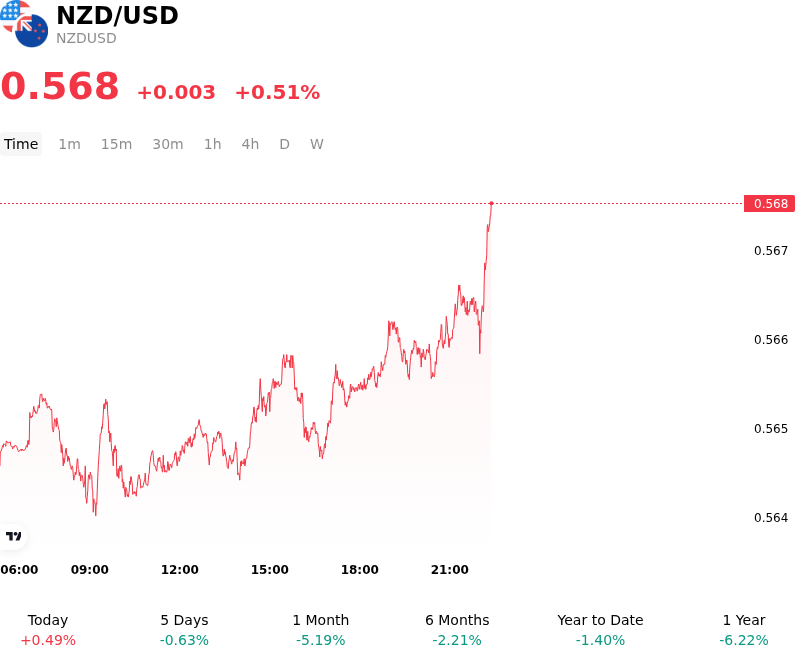
SummaryOverview

What is driving NZD/USD (NZDUSD)’s stock price up today?

The New Zealand Dollar advanced against the US Dollar during Tuesday’s session, driven by a combination of robust domestic business sentiment, stronger-than-expected economic indicators from China, and a softer US Dollar following underwhelming US consumer data.

A key domestic catalyst for the New Zealand Dollar was the release of the ANZ Business Outlook survey for June. The headline business confidence index surged to 36.6 from 10.0 in May, marking its highest level since February. Similarly, the Own Activity Outlook rose to 36.9. While various inflation and pricing gauges in the survey eased—partly aided by falling fuel costs—the sharp recovery in overall business optimism suggested that the domestic economic recovery is on firmer ground. This constructive backdrop reinforced market expectations that the Reserve Bank of New Zealand may still need to deliver gradual interest rate increases in the coming months, supporting the currency's yield appeal.

Additional support for the Kiwi came from New Zealand's largest trading partner, China. The official National Bureau of Statistics manufacturing purchasing managers' index rose to 50.3 in June, beating expectations of 50.1 and returning to expansion territory. The non-manufacturing PMI also defied contraction forecasts to print at 50.2. The improvement in Chinese industrial activity, led by high-tech manufacturing, lifted global risk sentiment and bolstered demand expectations for commodity-exporting economies, directly benefiting the risk-sensitive New Zealand Dollar.

Conversely, the US Dollar faced headwinds on the back of weaker-than-expected macroeconomic data. The Conference Board's Consumer Confidence Index rose only marginally to 91.2 in June, falling short of market forecasts. Beneath the headline number, the Present Situation Index declined to 116.4, and the labor market sub-indices showed notable softening. Consumers reporting that jobs were hard to get rose to 22.5%, the highest level since early 2021. This cooling signal in the US labor market, combined with easing geopolitical risks from ongoing US-Iran ceasefire negotiations, reduced safe-haven demand for the greenback and triggered profit-taking after its multi-month rally.

Ultimately, the combination of rising risk appetite, constructive New Zealand business conditions, positive trade-partner spillovers, and a pullback in the US Dollar on soft consumer metrics allowed the base currency to outperform the quote currency during the session.

Technical Analysis of NZD/USD (NZDUSD)

Technically, NZD/USD (NZDUSD) shows a MACD (12,26,9) value of -0.002, indicating a sell signal. The RSI at 35.301 suggests neutral condition and the Williams %R at 79.856 suggests sell condition. Please monitor closely.
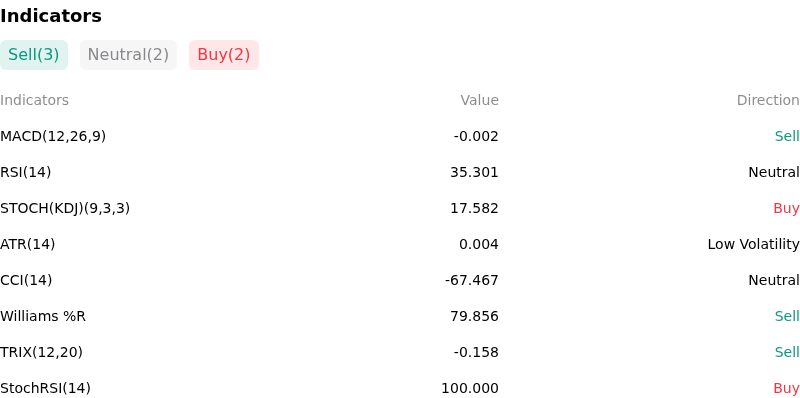
IndicatorAnalysis

More details about NZD/USD (NZDUSD)

Recent Events and Risks:

  • Dovish Recalibration of RBNZ Rate Track: Swaps markets have scaled back aggressive tightening expectations, now pricing in only two interest rate hikes from the Reserve Bank of New Zealand (RBNZ) instead of three for 2026. This cooling of central bank policy expectations is undermining the yield-spread support for the Kiwi.
  • Severe Stagflationary Domestic Growth Outlook: Structural damage from the Middle East energy shock, combined with a sharp downward GDP forecast revision to 0.6% by the NZIER and plunges in consumer confidence, is intensifying domestic recession fears. Sapped household sentiment threatens to trigger further downside pressure on the high-beta currency ahead of upcoming business and consumer confidence indicators.
  • Subdued Chinese Economic Recovery: Despite a marginal expansion in official Chinese PMI figures (Manufacturing at 50.3 and Non-Manufacturing at 50.2), the data highlighted sluggish domestic demand and weak consumer spending in China—New Zealand's largest trading partner. This tepid economic activity fails to provide momentum for commodity exports, keeping the growth-sensitive New Zealand Dollar depressed.
  • Resurgent Safe-Haven US Dollar Demand: Persistently hawkish Federal Reserve rate expectations—with traders pricing in a high probability of a Fed rate hike as soon as September—combined with lingering Middle East geopolitical uncertainties are fueling broad-based US Dollar demand, keeping the NZDUSD pair technically weak and highly vulnerable to short-term rallies being sold off.
Disclaimer: For information purposes only. Past performance is not indicative of future results.
placeholder
Bitcoin CME gaps at $35,000, $27,000 and $21,000, which one gets filled first?Prioritize filling the $27,000 gap and even try higher.
Author  FXStreet
Aug 22, 2023
Prioritize filling the $27,000 gap and even try higher.
placeholder
Pinduoduo Earnings Incoming: Morgan Stanley Sees Long-Term Profit Potential​Insights – On November 21, Chinese e-commerce giant Pinduoduo (PDD) will release its Q3 2024 earnings.
Author  Mitrade
Nov 20, 2024
​Insights – On November 21, Chinese e-commerce giant Pinduoduo (PDD) will release its Q3 2024 earnings.
placeholder
Elon Musk’s xAI and Neuralink Launch New Funding Rounds​Billionaire Elon Musk recently raised funds for his two high-profile tech companies, xAI and Neuralink.
Author  Insights
Jun 03, 2025
​Billionaire Elon Musk recently raised funds for his two high-profile tech companies, xAI and Neuralink.
placeholder
Bitcoin briefly loses 2025 gains as crypto plunges over the weekend.Bitcoin experienced a sharp decline this weekend, briefly erasing its 2025 gains and dipping below its year-opening value of $93,507. The cryptocurrency fell to a low of $93,029 on Sunday, representing a 25% drop from its all-time high in October. Although it has rebounded slightly to around $94,209, the pressures on the market remain significant. The downturn occurred despite the reopening of the U.S. government on Thursday, which many had hoped would provide essential support for crypto markets. This year initially appeared promising for cryptocurrencies, particularly after the inauguration of President Donald Trump, who has established the most pro-crypto administration thus far. However, ongoing political tensions—including Trump's tariff strategies and the recent government shutdown, lasting a historic 43 days—have contributed to several rapid price pullbacks for Bitcoin throughout the year. Market dynamics are also being influenced by Bitcoin whales—investors holding large amounts of Bitcoin—who have been offloading portions of their assets, consequently stalling price rallies even as positive regulatory developments emerge. Despite these sell-offs, analysts from Glassnode argue that this behavior aligns with typical patterns seen among long-term investors during the concluding stages of bull markets, suggesting it is not indicative of a mass exodus. Notably, Bitcoin is not alone in its struggles, as Ethereum and Solana have also recorded declines of 7.95% and 28.3%, respectively, since the start of the year, while numerous altcoins have faced even steeper losses. Looking ahead, questions linger regarding the viability of the four-year cycle thesis, particularly given the increasing institutional support and regulatory frameworks now in place in the crypto landscape. Matt Hougan, chief investment officer at Bitwise, remains optimistic, suggesting a potential Bitcoin resurgence in 2026 driven by the “debasement trade” thesis and a broader trend toward increased adoption of stablecoins, tokenization, and decentralized finance. Hougan emphasized the soundness of the underlying fundamentals, pointing to a positive outlook for the sector in the longer term.
Author  Mitrade
Nov 17, 2025
Bitcoin experienced a sharp decline this weekend, briefly erasing its 2025 gains and dipping below its year-opening value of $93,507. The cryptocurrency fell to a low of $93,029 on Sunday, representing a 25% drop from its all-time high in October. Although it has rebounded slightly to around $94,209, the pressures on the market remain significant. The downturn occurred despite the reopening of the U.S. government on Thursday, which many had hoped would provide essential support for crypto markets. This year initially appeared promising for cryptocurrencies, particularly after the inauguration of President Donald Trump, who has established the most pro-crypto administration thus far. However, ongoing political tensions—including Trump's tariff strategies and the recent government shutdown, lasting a historic 43 days—have contributed to several rapid price pullbacks for Bitcoin throughout the year. Market dynamics are also being influenced by Bitcoin whales—investors holding large amounts of Bitcoin—who have been offloading portions of their assets, consequently stalling price rallies even as positive regulatory developments emerge. Despite these sell-offs, analysts from Glassnode argue that this behavior aligns with typical patterns seen among long-term investors during the concluding stages of bull markets, suggesting it is not indicative of a mass exodus. Notably, Bitcoin is not alone in its struggles, as Ethereum and Solana have also recorded declines of 7.95% and 28.3%, respectively, since the start of the year, while numerous altcoins have faced even steeper losses. Looking ahead, questions linger regarding the viability of the four-year cycle thesis, particularly given the increasing institutional support and regulatory frameworks now in place in the crypto landscape. Matt Hougan, chief investment officer at Bitwise, remains optimistic, suggesting a potential Bitcoin resurgence in 2026 driven by the “debasement trade” thesis and a broader trend toward increased adoption of stablecoins, tokenization, and decentralized finance. Hougan emphasized the soundness of the underlying fundamentals, pointing to a positive outlook for the sector in the longer term.
placeholder
Ethereum smart contract deployments reach new 8.7M high in Q4Token Terminal data revealed that smart contracts deployed on the Ethereum network hit an all-time high of 8.7 million in the fourth quarter of 2025.
Author  Cryptopolitan
Dec 29, 2025
Token Terminal data revealed that smart contracts deployed on the Ethereum network hit an all-time high of 8.7 million in the fourth quarter of 2025.
goTop
quote