

Ethereum (ETHUSD) Is down 1.14% on Jun 23: What Are the Risk Factors?

Source Tradingkey

Ethereum (ETHUSD) is down 1.14% at Jun 23 01:20(ET), now at $1712.44, with a 7-day down of 4.62%.
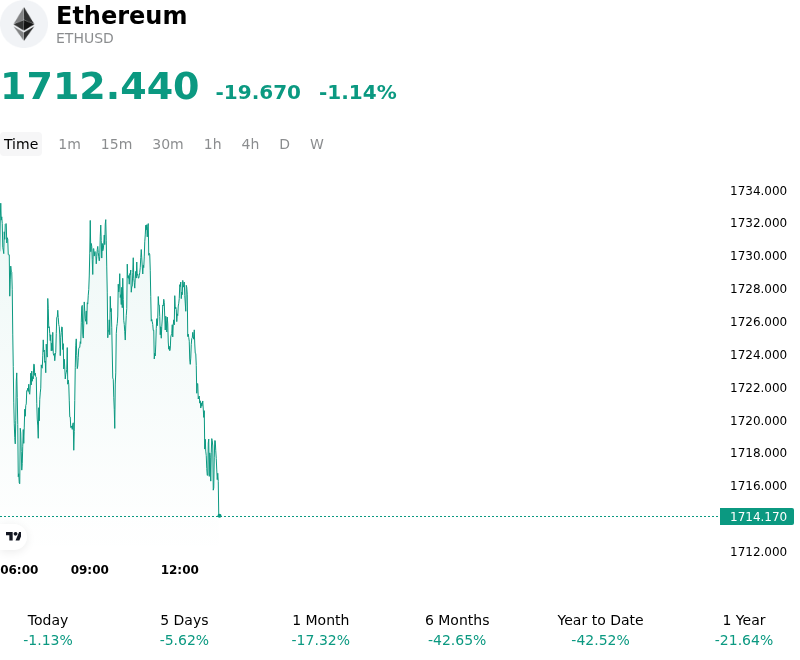
SummaryOverview

What is driving Ethereum (ETHUSD)’s stock price down today?

The recent downward pressure on Ethereum and heightened intraday volatility are primarily driven by tightening global liquidity conditions and shifting macroeconomic expectations. Investors are increasingly pricing in a hawkish Federal Reserve stance, as concerns mount that persistent inflation could delay anticipated rate cuts. This macroeconomic caution has pushed the two-year U.S. Treasury yield to its highest level in over a year, significantly increasing the opportunity cost of holding non-yielding digital assets. Furthermore, ahead of crucial Personal Consumption Expenditures inflation data and a massive projected quarter-end institutional portfolio rebalancing, market participants have adopted a defensive, risk-off posture, reducing exposure across the digital asset sector.

This risk aversion is starkly reflected in capital flows, with institutional investors steadily retreating from the market. The broader digital asset ecosystem has experienced substantial net outflows across stablecoins and exchange-traded products. For Ethereum specifically, spot ETF demand has remained sluggish following a series of heavy net outflows. Without a dovish policy pivot from global central banks or a decisive reversal in institutional capital flows, immediate buying pressure remains muted, forcing the asset to consolidate at lower levels.

On-chain developments and ecosystem-specific debates have further dampened investor sentiment. The Ethereum community is currently divided over a controversial proposal to redirect a portion of staking rewards toward ecosystem development. Opponents argue that this mechanism, characterized by some as an Ethereum tax, could diminish validator profitability, dilute staking yields, and complicate network governance. These concerns are exacerbated by leadership transitions within the Ethereum Foundation, including the departure of another key executive, which has raised fresh questions regarding long-term governance and coordination.

While structural initiatives like the launch of Ethlabs—an independent research and development organization designed to prepare the network for institutional and decentralized finance adoption—support the long-term settlement narrative, they have done little to offset immediate selling pressure. In the near term, Ethereum is likely to remain highly sensitive to global liquidity conditions, macroeconomic indicators, and the resolution of internal governance debates.

Technical Analysis of Ethereum (ETHUSD)

Technically, Ethereum (ETHUSD) shows a MACD (12,26,9) value of 41.040, indicating a neutral signal. The RSI at 41.459 suggests neutral condition and the Williams %R at 53.080 suggests neutral condition. Please monitor closely.
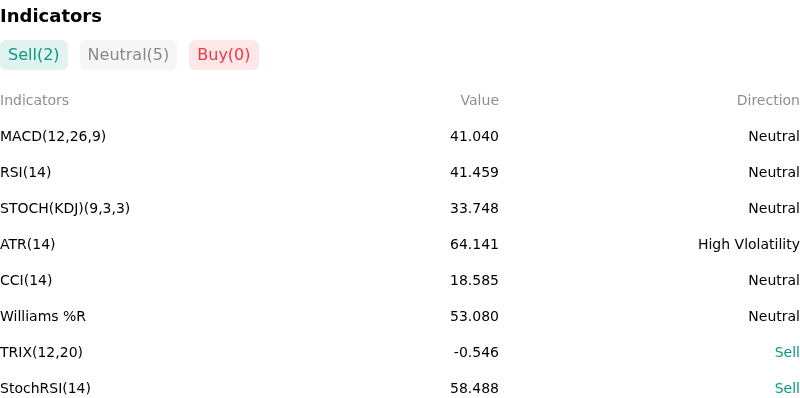
IndicatorAnalysis

More details about Ethereum (ETHUSD)

Recent Events and Risks:

  • Spot ETF Outflow Reversals: Following a brief recovery, U.S. spot Ethereum ETFs experienced a broad-based net outflow of $29.3 million on Monday, June 17, 2026, culminating in a net outflow of $10.05 million for the week. Led by withdrawals from Grayscale, BlackRock, and Fidelity, this sudden reversal underscores volatile institutional demand and renewed downward pressure on prices.
  • Concentrated Downside Liquidation Risks: As ETH struggles to find stable support below the $2,000 mark (trading near $1,734), leverage in the derivatives market remains highly vulnerable. Coinglass data indicates that a drop below the critical support level of $1,648 would trigger approximately $674 million in long liquidations across major centralized exchanges, risking a cascading price drop.
  • Core Development Funding Crisis: On June 18, 2026, former Ethereum Foundation coordinator Trent Van Epps warned that the network faces a "slow-burning funding crisis" within the next three to nine months. The expiration of the multi-year Client Incentive Program in April 2026, combined with the Foundation’s strategic transition to reduce spending to a 5% baseline, has created a projected $30 million annual funding deficit that threatens the stability of core development teams, network scaling, and security upgrades.
  • Weakening On-Chain Metrics: Data shows that 30-day Ethereum exchange withdrawals have fallen to 16.05 million ETH, reaching their lowest level since June 2024. This drop, combined with rising transaction failure rates and slight increases in exchange inflows, signals an overall slowdown in long-term accumulation and growing network friction.
Disclaimer: For information purposes only. Past performance is not indicative of future results.
placeholder
Bitcoin CME gaps at $35,000, $27,000 and $21,000, which one gets filled first?Prioritize filling the $27,000 gap and even try higher.
Author  FXStreet
Aug 22, 2023
Prioritize filling the $27,000 gap and even try higher.
placeholder
Pinduoduo Earnings Incoming: Morgan Stanley Sees Long-Term Profit Potential​Insights – On November 21, Chinese e-commerce giant Pinduoduo (PDD) will release its Q3 2024 earnings.
Author  Mitrade
Nov 20, 2024
​Insights – On November 21, Chinese e-commerce giant Pinduoduo (PDD) will release its Q3 2024 earnings.
placeholder
Elon Musk’s xAI and Neuralink Launch New Funding Rounds​Billionaire Elon Musk recently raised funds for his two high-profile tech companies, xAI and Neuralink.
Author  Insights
Jun 03, 2025
​Billionaire Elon Musk recently raised funds for his two high-profile tech companies, xAI and Neuralink.
placeholder
Bitcoin briefly loses 2025 gains as crypto plunges over the weekend.Bitcoin experienced a sharp decline this weekend, briefly erasing its 2025 gains and dipping below its year-opening value of $93,507. The cryptocurrency fell to a low of $93,029 on Sunday, representing a 25% drop from its all-time high in October. Although it has rebounded slightly to around $94,209, the pressures on the market remain significant. The downturn occurred despite the reopening of the U.S. government on Thursday, which many had hoped would provide essential support for crypto markets. This year initially appeared promising for cryptocurrencies, particularly after the inauguration of President Donald Trump, who has established the most pro-crypto administration thus far. However, ongoing political tensions—including Trump's tariff strategies and the recent government shutdown, lasting a historic 43 days—have contributed to several rapid price pullbacks for Bitcoin throughout the year. Market dynamics are also being influenced by Bitcoin whales—investors holding large amounts of Bitcoin—who have been offloading portions of their assets, consequently stalling price rallies even as positive regulatory developments emerge. Despite these sell-offs, analysts from Glassnode argue that this behavior aligns with typical patterns seen among long-term investors during the concluding stages of bull markets, suggesting it is not indicative of a mass exodus. Notably, Bitcoin is not alone in its struggles, as Ethereum and Solana have also recorded declines of 7.95% and 28.3%, respectively, since the start of the year, while numerous altcoins have faced even steeper losses. Looking ahead, questions linger regarding the viability of the four-year cycle thesis, particularly given the increasing institutional support and regulatory frameworks now in place in the crypto landscape. Matt Hougan, chief investment officer at Bitwise, remains optimistic, suggesting a potential Bitcoin resurgence in 2026 driven by the “debasement trade” thesis and a broader trend toward increased adoption of stablecoins, tokenization, and decentralized finance. Hougan emphasized the soundness of the underlying fundamentals, pointing to a positive outlook for the sector in the longer term.
Author  Mitrade
Nov 17, 2025
Bitcoin experienced a sharp decline this weekend, briefly erasing its 2025 gains and dipping below its year-opening value of $93,507. The cryptocurrency fell to a low of $93,029 on Sunday, representing a 25% drop from its all-time high in October. Although it has rebounded slightly to around $94,209, the pressures on the market remain significant. The downturn occurred despite the reopening of the U.S. government on Thursday, which many had hoped would provide essential support for crypto markets. This year initially appeared promising for cryptocurrencies, particularly after the inauguration of President Donald Trump, who has established the most pro-crypto administration thus far. However, ongoing political tensions—including Trump's tariff strategies and the recent government shutdown, lasting a historic 43 days—have contributed to several rapid price pullbacks for Bitcoin throughout the year. Market dynamics are also being influenced by Bitcoin whales—investors holding large amounts of Bitcoin—who have been offloading portions of their assets, consequently stalling price rallies even as positive regulatory developments emerge. Despite these sell-offs, analysts from Glassnode argue that this behavior aligns with typical patterns seen among long-term investors during the concluding stages of bull markets, suggesting it is not indicative of a mass exodus. Notably, Bitcoin is not alone in its struggles, as Ethereum and Solana have also recorded declines of 7.95% and 28.3%, respectively, since the start of the year, while numerous altcoins have faced even steeper losses. Looking ahead, questions linger regarding the viability of the four-year cycle thesis, particularly given the increasing institutional support and regulatory frameworks now in place in the crypto landscape. Matt Hougan, chief investment officer at Bitwise, remains optimistic, suggesting a potential Bitcoin resurgence in 2026 driven by the “debasement trade” thesis and a broader trend toward increased adoption of stablecoins, tokenization, and decentralized finance. Hougan emphasized the soundness of the underlying fundamentals, pointing to a positive outlook for the sector in the longer term.
placeholder
Gold declines below $4,500 on stalled US-Iran ceasefire talks, US NFP data loomsGold price (XAU/USD) edges lower to near $4,470 during the early Asian session on Friday. The precious metal remains volatile amid ongoing geopolitical turmoil. Traders will closely monitor the developments surrounding the US-Iran peace deal and the US May employment report later on Friday. 
Author  FXStreet
Jun 05, Fri
Gold price (XAU/USD) edges lower to near $4,470 during the early Asian session on Friday. The precious metal remains volatile amid ongoing geopolitical turmoil. Traders will closely monitor the developments surrounding the US-Iran peace deal and the US May employment report later on Friday. 
goTop
quote