

AUD/USD (AUDUSD) Drops on Jun 23: What Are the Key Reasons?

Source Tradingkey

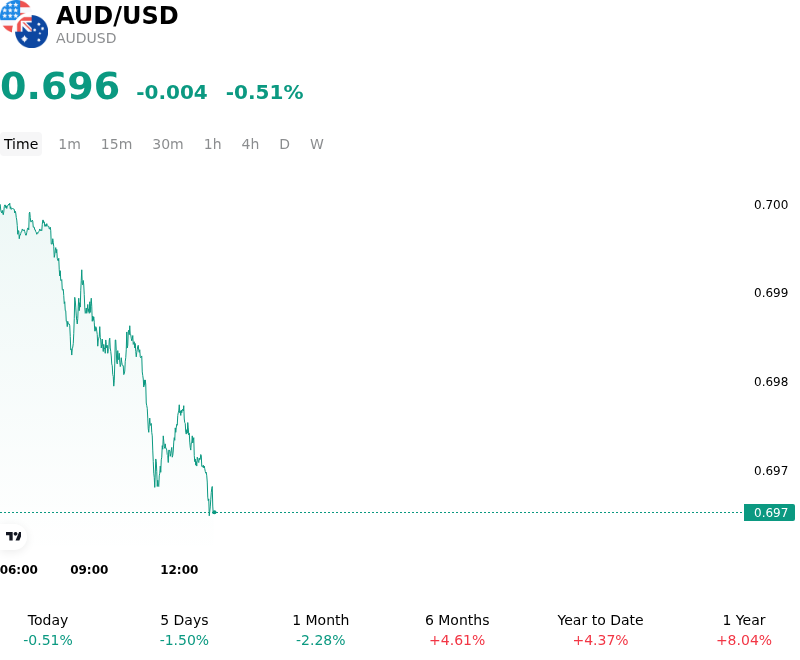
AUD/USD (AUDUSD) is down 0.51% at Jun 23 01:10(ET), now at $0.69638, with a 7-day down of 1.43%.
SummaryOverview

What is driving AUD/USD (AUDUSD)’s stock price down today?

The downtrend in the AUDUSD currency pair, which recently pushed the exchange rate to an eleven-week low below the key psychological level of 0.70, reflects a widening divergence in monetary policy expectations between the Reserve Bank of Australia and the Federal Reserve. This policy contrast has compressed interest rate differentials, shifting capital flows in favor of the US dollar. On one hand, the Reserve Bank of Australia elected to pause its tightening cycle, keeping the cash rate steady at 4.35 percent following three consecutive rate hikes earlier in the year. Although the central bank retained its long-term hawkish bias, Governor Michele Bullock struck a more balanced tone during her press conference, emphasizing that future tightening would only occur if required, rather than being actively debated. This wait-and-see stance has curbed expectations for an imminent rate hike.

In contrast, the US dollar continues to find robust support from a hawkish shift in Federal Reserve policy expectations. Under the leadership of the new Chair, Kevin Warsh, the Federal Open Market Committee recently delivered a hawkish surprise to market participants. The central bank removed its prior policy-easing language and revealed that a significant portion of the committee now projects at least one additional rate hike before the end of the year. This divergent outlook has reinforced US Treasury yields and intensified the downward pressure on the Australian dollar, as yield-seeking institutional investors favor the higher-yielding US fixed-income assets.

Adding to the Australian dollar's underperformance is the recent shift in the commodity complex. The easing of geopolitical tensions and potential resolution of oil supply disruptions in the Middle East have pushed global energy prices lower. While lower oil prices provide relief to global inflation expectations, they also strip away a key driver of domestic inflation in Australia, further justifying the Reserve Bank of Australia's decision to pause. Because the Australian dollar operates as a highly sensitive commodity currency, the retreat in energy and raw material prices has removed a critical pillar of support for the currency.

Furthermore, market participants are displaying heightened caution ahead of critical Australian macroeconomic data releases, specifically the monthly consumer price index and labor market reports. Investors are reluctant to build long positions in the Australian dollar until there is clearer evidence of persistent domestic inflationary pressures that would force the Reserve Bank of Australia back into a tightening stance. From a technical perspective, the breach of the critical 0.7000 support level has triggered stop-loss orders and fueled momentum-driven selling, cementing the dominant short-term bearish structure of the currency pair as it continues to trace lower along a descending trend line.

Technical Analysis of AUD/USD (AUDUSD)

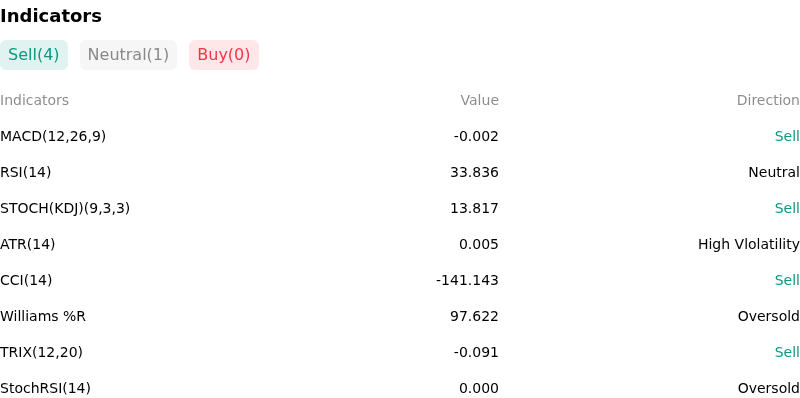
Technically, AUD/USD (AUDUSD) shows a MACD (12,26,9) value of -0.002, indicating a sell signal. The RSI at 33.836 suggests neutral condition and the Williams %R at 97.622 suggests oversold condition. Please monitor closely.
IndicatorAnalysis

More details about AUD/USD (AUDUSD)

Recent Events and Risks:

  • Divergent Central Bank Trajectories: While the Reserve Bank of Australia (RBA) recently left its cash rate unchanged at 4.35%, the Federal Reserve's hawkish surprise under its new leadership has signaled a potential rate hike in late 2026. This policy divergence has compressed the Aussie-US two-year yield spread in favor of the greenback, driving persistent downward pressure on the AUDUSD pair.
  • Impending May CPI Volatility: Ahead of Australia's May Monthly CPI indicator release on June 24, the currency faces significant downside risk. Any cooler-than-expected print in underlying core inflation (trimmed mean)—which is forecast to edge up to 3.5%–3.6%—would weaken the RBA’s hawkish stance and accelerate AUD liquidations.
  • Labor Market Softness and Economic Slowdown: With key Australian employment data scheduled for release on June 25, the pair remains highly vulnerable to signs of a domestic slowdown. Following the previous month’s surprise decline of 18,600 jobs and an unemployment spike to 4.5%, another soft labor print would underscore broader GDP per capita contraction and limit RBA rate expectations.
  • Bearish Technical Topping Pattern: From a technical perspective, AUDUSD continues to struggle beneath an active head-and-shoulders topping pattern. Remaining capped below the critical neckline resistance band of 0.7000–0.7080 keeps near-term momentum skewed to the downside, with a clear breach of the 0.7000 psychological handle exposing the 200-day EMA near 0.6852.
Disclaimer: For information purposes only. Past performance is not indicative of future results.
placeholder
Bitcoin CME gaps at $35,000, $27,000 and $21,000, which one gets filled first?Prioritize filling the $27,000 gap and even try higher.
Author  FXStreet
Aug 22, 2023
Prioritize filling the $27,000 gap and even try higher.
placeholder
Pinduoduo Earnings Incoming: Morgan Stanley Sees Long-Term Profit Potential​Insights – On November 21, Chinese e-commerce giant Pinduoduo (PDD) will release its Q3 2024 earnings.
Author  Mitrade
Nov 20, 2024
​Insights – On November 21, Chinese e-commerce giant Pinduoduo (PDD) will release its Q3 2024 earnings.
placeholder
Elon Musk’s xAI and Neuralink Launch New Funding Rounds​Billionaire Elon Musk recently raised funds for his two high-profile tech companies, xAI and Neuralink.
Author  Insights
Jun 03, 2025
​Billionaire Elon Musk recently raised funds for his two high-profile tech companies, xAI and Neuralink.
placeholder
Bitcoin briefly loses 2025 gains as crypto plunges over the weekend.Bitcoin experienced a sharp decline this weekend, briefly erasing its 2025 gains and dipping below its year-opening value of $93,507. The cryptocurrency fell to a low of $93,029 on Sunday, representing a 25% drop from its all-time high in October. Although it has rebounded slightly to around $94,209, the pressures on the market remain significant. The downturn occurred despite the reopening of the U.S. government on Thursday, which many had hoped would provide essential support for crypto markets. This year initially appeared promising for cryptocurrencies, particularly after the inauguration of President Donald Trump, who has established the most pro-crypto administration thus far. However, ongoing political tensions—including Trump's tariff strategies and the recent government shutdown, lasting a historic 43 days—have contributed to several rapid price pullbacks for Bitcoin throughout the year. Market dynamics are also being influenced by Bitcoin whales—investors holding large amounts of Bitcoin—who have been offloading portions of their assets, consequently stalling price rallies even as positive regulatory developments emerge. Despite these sell-offs, analysts from Glassnode argue that this behavior aligns with typical patterns seen among long-term investors during the concluding stages of bull markets, suggesting it is not indicative of a mass exodus. Notably, Bitcoin is not alone in its struggles, as Ethereum and Solana have also recorded declines of 7.95% and 28.3%, respectively, since the start of the year, while numerous altcoins have faced even steeper losses. Looking ahead, questions linger regarding the viability of the four-year cycle thesis, particularly given the increasing institutional support and regulatory frameworks now in place in the crypto landscape. Matt Hougan, chief investment officer at Bitwise, remains optimistic, suggesting a potential Bitcoin resurgence in 2026 driven by the “debasement trade” thesis and a broader trend toward increased adoption of stablecoins, tokenization, and decentralized finance. Hougan emphasized the soundness of the underlying fundamentals, pointing to a positive outlook for the sector in the longer term.
Author  Mitrade
Nov 17, 2025
Bitcoin experienced a sharp decline this weekend, briefly erasing its 2025 gains and dipping below its year-opening value of $93,507. The cryptocurrency fell to a low of $93,029 on Sunday, representing a 25% drop from its all-time high in October. Although it has rebounded slightly to around $94,209, the pressures on the market remain significant. The downturn occurred despite the reopening of the U.S. government on Thursday, which many had hoped would provide essential support for crypto markets. This year initially appeared promising for cryptocurrencies, particularly after the inauguration of President Donald Trump, who has established the most pro-crypto administration thus far. However, ongoing political tensions—including Trump's tariff strategies and the recent government shutdown, lasting a historic 43 days—have contributed to several rapid price pullbacks for Bitcoin throughout the year. Market dynamics are also being influenced by Bitcoin whales—investors holding large amounts of Bitcoin—who have been offloading portions of their assets, consequently stalling price rallies even as positive regulatory developments emerge. Despite these sell-offs, analysts from Glassnode argue that this behavior aligns with typical patterns seen among long-term investors during the concluding stages of bull markets, suggesting it is not indicative of a mass exodus. Notably, Bitcoin is not alone in its struggles, as Ethereum and Solana have also recorded declines of 7.95% and 28.3%, respectively, since the start of the year, while numerous altcoins have faced even steeper losses. Looking ahead, questions linger regarding the viability of the four-year cycle thesis, particularly given the increasing institutional support and regulatory frameworks now in place in the crypto landscape. Matt Hougan, chief investment officer at Bitwise, remains optimistic, suggesting a potential Bitcoin resurgence in 2026 driven by the “debasement trade” thesis and a broader trend toward increased adoption of stablecoins, tokenization, and decentralized finance. Hougan emphasized the soundness of the underlying fundamentals, pointing to a positive outlook for the sector in the longer term.
placeholder
Gold declines below $4,500 on stalled US-Iran ceasefire talks, US NFP data loomsGold price (XAU/USD) edges lower to near $4,470 during the early Asian session on Friday. The precious metal remains volatile amid ongoing geopolitical turmoil. Traders will closely monitor the developments surrounding the US-Iran peace deal and the US May employment report later on Friday. 
Author  FXStreet
Jun 05, Fri
Gold price (XAU/USD) edges lower to near $4,470 during the early Asian session on Friday. The precious metal remains volatile amid ongoing geopolitical turmoil. Traders will closely monitor the developments surrounding the US-Iran peace deal and the US May employment report later on Friday. 
goTop
quote