

Platinum (XPTUSD) Drops on Jun 23: Key Factors to Watch

Source Tradingkey

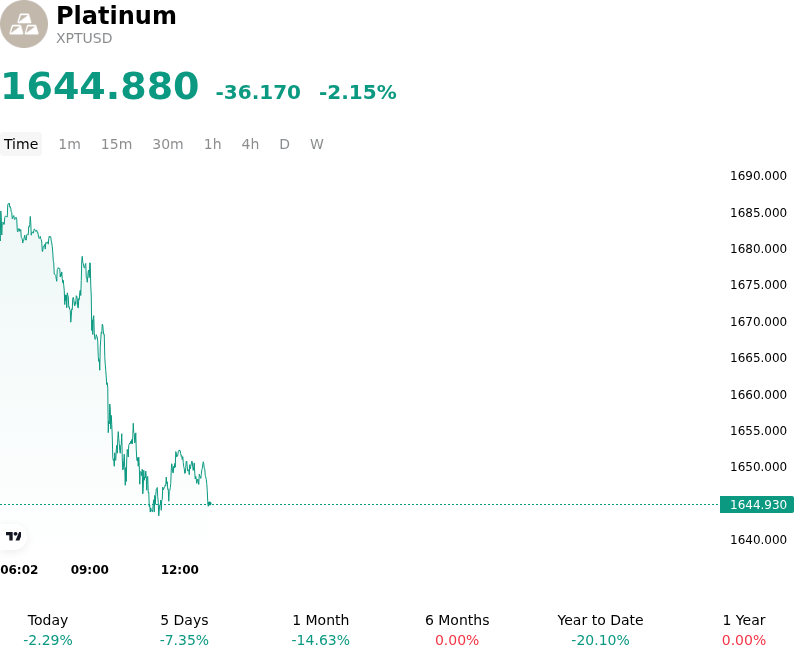
Platinum (XPTUSD) is down 2.15% at Jun 23 01:00(ET), now at $1644.88, with a 7-day down of 8.99%.
SummaryOverview

What is driving Platinum (XPTUSD)’s stock price down today?

The recent downward pressure on platinum is primarily driven by a significant hawkish shift in monetary policy expectations and a rallying US dollar. Following the Federal Reserve's June policy updates under the leadership of Chairman Kevin Warsh, the central bank signaled an unexpectedly aggressive stance, with several policymakers projecting potential rate increases before the end of the year. This higher-for-longer interest rate outlook has pushed real US Treasury yields higher and propelled the dollar to multi-month highs. As a non-yielding asset, platinum’s investment appeal has severely diminished in this environment, triggering broader liquidations across the precious metals complex.

Simultaneously, a notable cooling of geopolitical risks in the Middle East has eroded the safe-haven and inflation-hedging premiums that had previously supported prices. Progress toward a formal peace agreement between the United States and Iran has led to an easing of energy-related anxieties and a subsequent decline in crude oil prices. The prospective normalization of global energy flows has dampened near-term inflation expectations, prompting institutional investors to unwind their defensive positions and accelerate profit-taking in the futures and spot markets.

On the demand side, near-term fundamental indicators have softened considerably. Updated market projections for the year forecast a contraction in global platinum demand. This weakness is driven by declining consumption in the automotive and jewelry sectors, alongside a sharp deceleration in retail investment inflows and substantial liquidations of exchange-traded fund holdings. Reduced demand for catalytic converters, amid slower global automotive fabrication and economic headwinds, has further weighed on the metal's near-term outlook.

This softening of demand has significantly narrowed the projected global platinum market deficit. Although long-term structural supply deficits remain a concern due to constrained output from primary producers in South Africa and Russia, these tight supply dynamics are currently being overshadowed by cyclical demand headwinds. The contraction of the market deficit has undermined the aggressive supply-squeeze narrative that underpinned platinum's historic peaks earlier in the year, leaving the metal highly vulnerable to macro-driven capital outflows and technical selling pressure.

Technical Analysis of Platinum (XPTUSD)

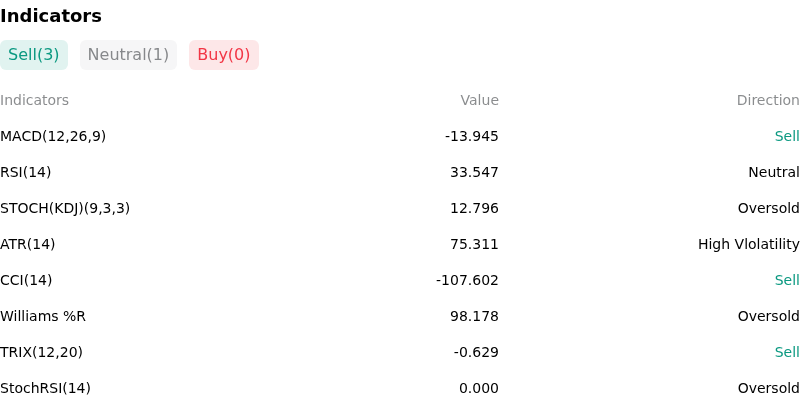
Technically, Platinum (XPTUSD) shows a MACD (12,26,9) value of -13.945, indicating a sell signal. The RSI at 33.547 suggests neutral condition and the Williams %R at 98.178 suggests oversold condition. Please monitor closely.
IndicatorAnalysis

More details about Platinum (XPTUSD)

Recent Events and Risks:

  • Hawkish Federal Reserve Monetary Outlook: The Federal Reserve’s hawkish "higher-for-longer" monetary policy signals—emphasizing persistent inflation and indicating support for elevated interest rates through late 2026—have pushed real yields and the US Dollar Index higher. This macroeconomic headwind has increased the opportunity cost of holding non-yielding precious metals, driving spot platinum (XPTUSD) down toward six-month lows near $1,634/oz.
  • Erosion of Geopolitical Premium and Speculative Liquidation: Recent diplomatic progress and hopes for an interim US-Iran agreement have substantially cooled the global inflation and energy-shock premiums that previously supported precious metals. This has triggered aggressive long-liquidation by algorithmic and speculative funds, driving physical metal outflows of over 200,000 ounces from NYMEX warehouses and severely pressuring spot prices.
  • Contracting Global Investment and Automotive Demand: Updated market projections forecast global platinum demand to contract by up to 9% year-on-year. This slump is driven by a massive projected drop in investment demand—marked by heavy ETF and exchange stock outflows—coupled with a 12% decline in jewelry demand and softening automotive consumption due to ICE vehicle light-duty production cuts, narrowing the global supply deficit to its lowest level in four years.
  • Sluggish Downstream Physical Spot Market Activity: Downstream industrial and manufacturing buyers are maintaining comfortable stockpiles and adopting a strict "wait-and-see" stance. This lack of physical buying interest has caused spot trading to remain highly sluggish, preventing physical demand from stepping in to support prices and leaving XPTUSD vulnerable to further technical selling below the key $1,635/oz support level.
Disclaimer: For information purposes only. Past performance is not indicative of future results.
placeholder
Bitcoin CME gaps at $35,000, $27,000 and $21,000, which one gets filled first?Prioritize filling the $27,000 gap and even try higher.
Author  FXStreet
Aug 22, 2023
Prioritize filling the $27,000 gap and even try higher.
placeholder
Pinduoduo Earnings Incoming: Morgan Stanley Sees Long-Term Profit Potential​Insights – On November 21, Chinese e-commerce giant Pinduoduo (PDD) will release its Q3 2024 earnings.
Author  Mitrade
Nov 20, 2024
​Insights – On November 21, Chinese e-commerce giant Pinduoduo (PDD) will release its Q3 2024 earnings.
placeholder
Elon Musk’s xAI and Neuralink Launch New Funding Rounds​Billionaire Elon Musk recently raised funds for his two high-profile tech companies, xAI and Neuralink.
Author  Insights
Jun 03, 2025
​Billionaire Elon Musk recently raised funds for his two high-profile tech companies, xAI and Neuralink.
placeholder
Bitcoin briefly loses 2025 gains as crypto plunges over the weekend.Bitcoin experienced a sharp decline this weekend, briefly erasing its 2025 gains and dipping below its year-opening value of $93,507. The cryptocurrency fell to a low of $93,029 on Sunday, representing a 25% drop from its all-time high in October. Although it has rebounded slightly to around $94,209, the pressures on the market remain significant. The downturn occurred despite the reopening of the U.S. government on Thursday, which many had hoped would provide essential support for crypto markets. This year initially appeared promising for cryptocurrencies, particularly after the inauguration of President Donald Trump, who has established the most pro-crypto administration thus far. However, ongoing political tensions—including Trump's tariff strategies and the recent government shutdown, lasting a historic 43 days—have contributed to several rapid price pullbacks for Bitcoin throughout the year. Market dynamics are also being influenced by Bitcoin whales—investors holding large amounts of Bitcoin—who have been offloading portions of their assets, consequently stalling price rallies even as positive regulatory developments emerge. Despite these sell-offs, analysts from Glassnode argue that this behavior aligns with typical patterns seen among long-term investors during the concluding stages of bull markets, suggesting it is not indicative of a mass exodus. Notably, Bitcoin is not alone in its struggles, as Ethereum and Solana have also recorded declines of 7.95% and 28.3%, respectively, since the start of the year, while numerous altcoins have faced even steeper losses. Looking ahead, questions linger regarding the viability of the four-year cycle thesis, particularly given the increasing institutional support and regulatory frameworks now in place in the crypto landscape. Matt Hougan, chief investment officer at Bitwise, remains optimistic, suggesting a potential Bitcoin resurgence in 2026 driven by the “debasement trade” thesis and a broader trend toward increased adoption of stablecoins, tokenization, and decentralized finance. Hougan emphasized the soundness of the underlying fundamentals, pointing to a positive outlook for the sector in the longer term.
Author  Mitrade
Nov 17, 2025
Bitcoin experienced a sharp decline this weekend, briefly erasing its 2025 gains and dipping below its year-opening value of $93,507. The cryptocurrency fell to a low of $93,029 on Sunday, representing a 25% drop from its all-time high in October. Although it has rebounded slightly to around $94,209, the pressures on the market remain significant. The downturn occurred despite the reopening of the U.S. government on Thursday, which many had hoped would provide essential support for crypto markets. This year initially appeared promising for cryptocurrencies, particularly after the inauguration of President Donald Trump, who has established the most pro-crypto administration thus far. However, ongoing political tensions—including Trump's tariff strategies and the recent government shutdown, lasting a historic 43 days—have contributed to several rapid price pullbacks for Bitcoin throughout the year. Market dynamics are also being influenced by Bitcoin whales—investors holding large amounts of Bitcoin—who have been offloading portions of their assets, consequently stalling price rallies even as positive regulatory developments emerge. Despite these sell-offs, analysts from Glassnode argue that this behavior aligns with typical patterns seen among long-term investors during the concluding stages of bull markets, suggesting it is not indicative of a mass exodus. Notably, Bitcoin is not alone in its struggles, as Ethereum and Solana have also recorded declines of 7.95% and 28.3%, respectively, since the start of the year, while numerous altcoins have faced even steeper losses. Looking ahead, questions linger regarding the viability of the four-year cycle thesis, particularly given the increasing institutional support and regulatory frameworks now in place in the crypto landscape. Matt Hougan, chief investment officer at Bitwise, remains optimistic, suggesting a potential Bitcoin resurgence in 2026 driven by the “debasement trade” thesis and a broader trend toward increased adoption of stablecoins, tokenization, and decentralized finance. Hougan emphasized the soundness of the underlying fundamentals, pointing to a positive outlook for the sector in the longer term.
placeholder
Gold declines below $4,500 on stalled US-Iran ceasefire talks, US NFP data loomsGold price (XAU/USD) edges lower to near $4,470 during the early Asian session on Friday. The precious metal remains volatile amid ongoing geopolitical turmoil. Traders will closely monitor the developments surrounding the US-Iran peace deal and the US May employment report later on Friday. 
Author  FXStreet
Jun 05, Fri
Gold price (XAU/USD) edges lower to near $4,470 during the early Asian session on Friday. The precious metal remains volatile amid ongoing geopolitical turmoil. Traders will closely monitor the developments surrounding the US-Iran peace deal and the US May employment report later on Friday. 
goTop
quote