




10 Best Shares to Buy Today in Australia (April 2026 Guide)

The ASX fell 6.2% in March 2026, its worst monthly drop since January 2022.
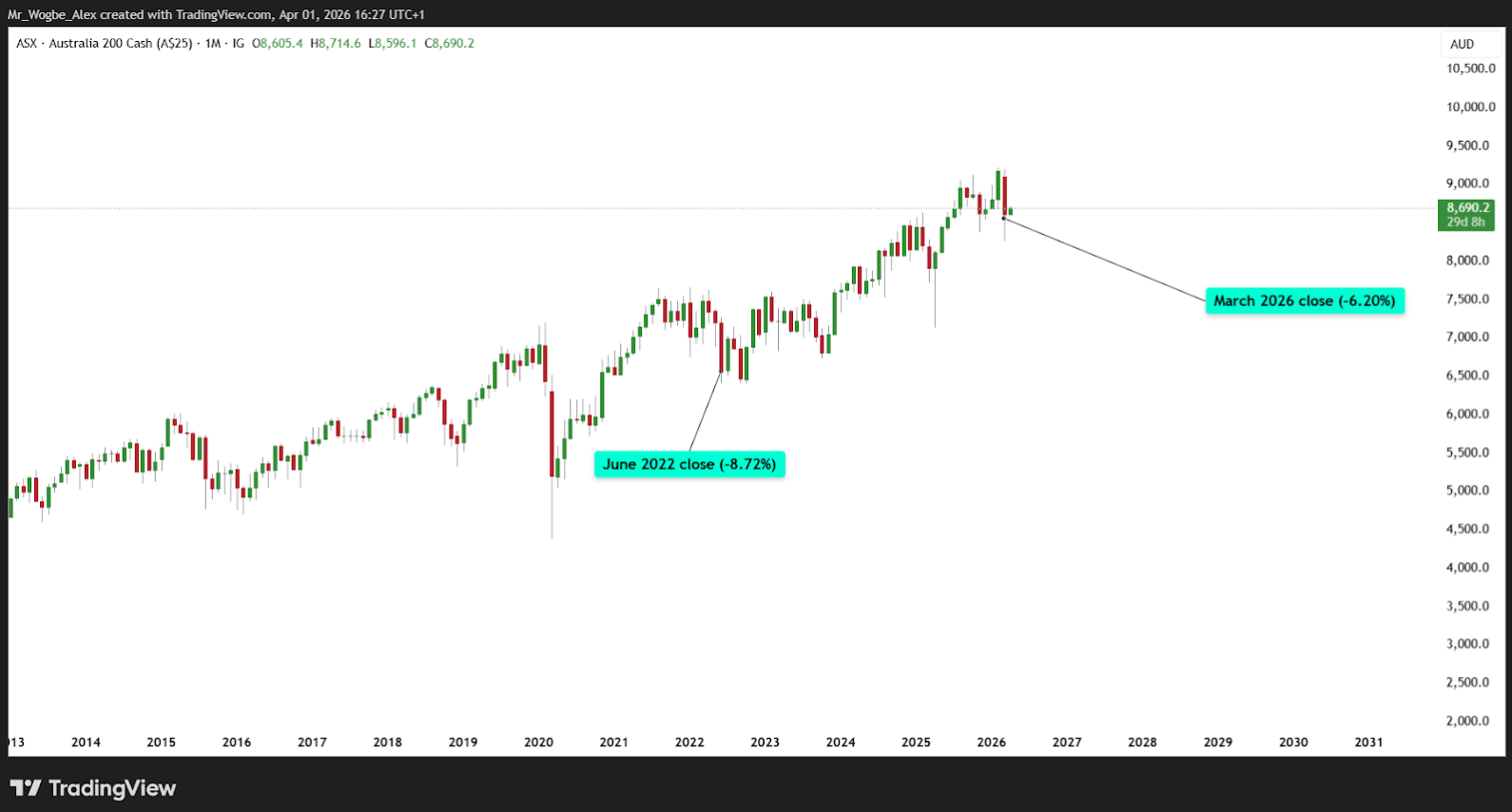
Image via TradingView: ASX Monthly Chart
Middle East tensions and rising inflation fears drove the sell-off. But for investors looking for the best shares to buy today that Australia has to offer, that kind of pullback often creates opportunity.
This guide covers the 10 best shares to buy right now across both the ASX and the US, five picks from each market.
You'll also get a straight comparison of both markets and a look at how to trade these shares using CFDs. Every pick here is grounded in fundamentals and current analyst views.
How We Selected the Best Shares
Not every stock that looks cheap is worth buying. And not every stock trading near its highs is overpriced. The picks in this guide were chosen based on a consistent set of criteria that apply to both ASX and US shares. These include:
Earnings growth: Each company has a clear track record of growing revenue or profit, with analysts expecting that trend to continue through 2026 and beyond.
Competitive advantage: Every pick holds a strong position in its market. This could be a dominant brand, proprietary technology, or infrastructure that competitors can't easily replicate.
Reasonable valuation: A good business bought at the wrong price still carries risk. Each pick was assessed against its growth potential, not just its current share price.
Sector relevance: The picks reflect where capital is flowing in 2026, including AI infrastructure, healthcare, commodities, and cloud technology.
Resilience: Each company has shown it can hold up when markets get choppy, which matters in the current environment.
This list spans both the ASX and US markets, giving you options across two of the world's most accessible exchanges.
“Trade Stocks with an ASIC-regulated broker. Fast AUD funding via PayID. ”
5 Best Australian Shares to Buy Today
If you're looking for the best shares to buy today that Australia has on offer, the ASX is a good place to start. Despite the rough March, several strong companies are now trading at better prices than they were a few months ago.
1. CSL Ltd (ASX: CSL)
CSL makes plasma-derived therapies and vaccines sold in over 100 countries. The share price has been weak since 2025, but the business itself is holding up well.
According to CSL's official FY2025 results announcement, underlying profit grew by 14% to US$3.3 billion. The healthcare industry is also considered one of the cheapest sectors on the ASX by price-to-fair-value.
Risk profile: The key risk is that margin recovery at its CSL Behring division remains slower than expected.
2. BHP Group (ASX: BHP)
BHP is Australia's largest mining company, with operations across copper, iron ore, and coal. According to BHP's half-year results for December 2025, copper contributed 51% of the group's underlying EBITDA, a first for the company.
That puts it directly in the path of two major 2026 spending trends, including the energy transition and AI data center construction. Both of these trends are heavily copper-dependent.
Risk profile: The key risk is commodity price volatility, which can shift quickly on changes in global demand.
3. Wesfarmers Ltd (ASX: WES)
Wesfarmers owns some of Australia's most recognized retail brands, including Bunnings, Kmart, and Officeworks.
According to the company's FY2025 full-year results, statutory net profit after tax rose 14.4% to $2.93 billion, with Bunnings and Kmart both growing earnings despite a tough consumer environment.
That's the kind of resilience that holds up well when markets get rough.
Risk profile: The key risk is a prolonged consumer spending slowdown, which could put pressure on its retail divisions.
4. Goodman Group (ASX: GMG)
Goodman is an industrial property group that is shifting its focus toward data center development. Its pipeline is increasingly tied to digital infrastructure, and the demand for AI and cloud computing facilities continues to grow.
Very few ASX stocks offer this kind of direct exposure to the global data center boom.
Risk profile: The key risk is its premium valuation, which makes it sensitive to rate movements and shifts in sentiment toward growth stocks.
5. Macquarie Group (ASX: MQG)
Macquarie is Australia's largest investment bank, with businesses spanning asset management, banking, commodities, and infrastructure.
According to Macquarie's official FY2025 results, net profit rose 5% to A$3.71 billion, with asset management profit surging 43% in the first half of FY2026.
The business manages assets across four long-term structural themes, including demographics, decarbonization, digitalization, and deglobalization. Those are four tailwinds that aren't going away any time soon.
Risk profile: The key risk is that its Commodities and Global Markets division is sensitive to energy price volatility, which has been elevated in 2026.
This list spans both the ASX and US markets, giving you options across two of the world's most accessible exchanges.
“Trade Stocks with an ASIC-regulated broker. Fast AUD funding via PayID. ”
5 Best US Shares to Buy Today
If you're scanning the global market for the best shares to buy right now, the US has some strong options in 2026. But, one thing to note is that Australian investors buying US stocks are exposed to AUD/USD movements. This can affect returns in either direction.
1. Nvidia (NASDAQ: NVDA)
Nvidia makes the chips that power most of the world's AI computing.
According to Nvidia's fiscal year 2026 results, full-year revenue hit $215.9 billion, up 65% from the year before. Data center revenue alone came in at $193.7 billion.
As of the start of April, the stock is down roughly 8% year-to-date in 2026. Some analysts see that as a better entry point than earlier in the cycle.
Risk profile: The key risk is heavy dependence on continued AI spending from large cloud providers.
2. Microsoft (NASDAQ: MSFT)
Microsoft builds cloud infrastructure, productivity software, and AI tools for businesses. Its Q2 FY2026 results showed revenue of $81.3 billion, up 17% year over year. Azure grew 39% in the quarter. And Microsoft Cloud revenue crossed $51.5 billion.
CEO Satya Nadella said the company is still in the early phases of AI adoption.
Risk profile: The key risk is the cost of building out AI infrastructure, which is putting pressure on gross margins.
3. Alphabet (NASDAQ: GOOG)
Alphabet owns Google, YouTube, and Google Cloud. Its Q4 2025 earnings release showed full-year revenue passing $400 billion for the first time.
Google Cloud grew 48% in the quarter to $17.7 billion. Search revenue grew 17%, despite fears about AI disrupting its core business.
Risk profile: The key risk is rising competition from AI-native search tools and ongoing antitrust pressure in multiple markets.
4. Taiwan Semiconductor Manufacturing (NYSE: TSM)
TSMC makes advanced chips for Nvidia, AMD, Apple, and Broadcom. Its Q4 2025 results showed quarterly revenue of $33.7 billion, up 25.5% year over year. Full-year 2025 revenue reached $122.4 billion.
TSMC benefits regardless of which chipmaker gains market share. Its Wall Street analyst consensus is a “Strong Buy,” with an average price target implying around 29% upside from current levels of around $326.
Risk profile: The key risk is geopolitical tension between the US, China, and Taiwan.
5. Palo Alto Networks (NASDAQ: PANW)
Palo Alto Networks is one of the world's largest cybersecurity companies. It protects enterprise networks, cloud environments, and endpoints.
Its Q2 FY2026 results showed revenue of $2.6 billion, up 15% year over year. Next-generation security annual recurring revenue grew 33% to $6.3 billion. Full-year revenue guidance was raised to $11.28 to $11.31 billion.
Risk profile: The key risk is near-term margin pressure from integrating recent acquisitions.
This list spans both the ASX and US markets, giving you options across two of the world's most accessible exchanges.
“Trade Stocks with an ASIC-regulated broker. Fast AUD funding via PayID. ”
Australian vs US Shares: Which Is Better?
The honest answer is that neither market is better. They serve different goals.
The ASX is built for income. Australian companies pay generous dividends, and the franking credit system makes those payouts even more tax-efficient for local investors.
The ASX currently yields around 3.3% in dividends, compared to roughly 1.5% for global shares.
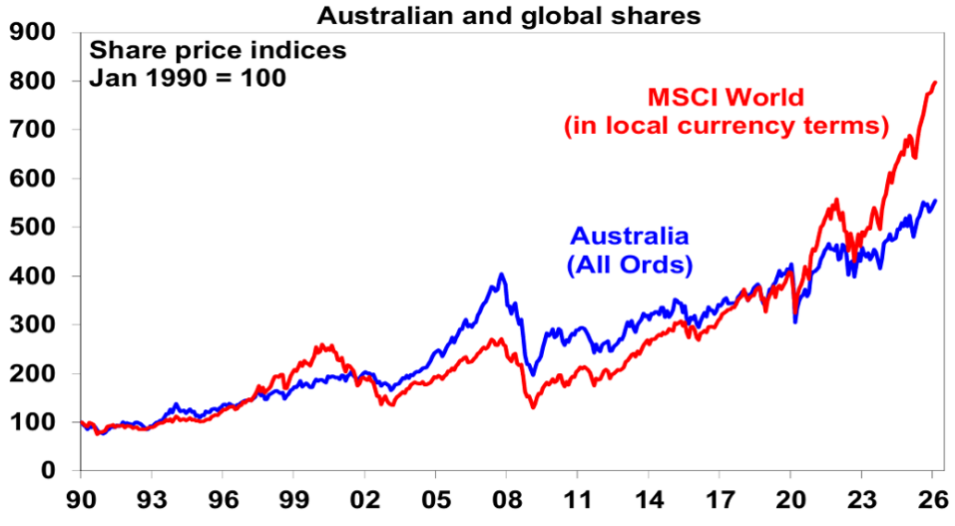
Image via AMP
US companies tend to reinvest earnings instead, which drives share price growth over time rather than income.
Sector exposure differs too. The ASX leans heavily on mining, banking, and healthcare. According to VanEck data, the top 10 stocks in the ASX 200 now make up around 49% of the entire index.
The US is far less concentrated and gives you access to global tech, AI infrastructure, and consumer brands that simply don't exist on the ASX.
On long-term returns, both markets have delivered. Since 1900, the ASX has returned around 11.6% per annum, including dividends, compared to 10.1% for US shares.
There are also practical points to note. US stocks trade overnight for Australian investors. You will also need a W-8BEN form to avoid being taxed in both countries.
For most investors, a mix of both markets makes the most sense.
How to Trade These Shares with CFDs
Buying shares directly is one way to get exposure to the stocks covered in this guide. Another option is trading them as contracts for difference, or CFDs.
With a CFD, you don't own the underlying stock. Instead, you and the broker simply exchange the difference between the price when you open the trade and the price when you close it.
There are two features that make CFDs useful in a market.
The first is leverage. Under ASIC rules, share CFDs are capped at 5x leverage for Australian retail traders. This means you can control a larger position with a smaller upfront deposit, known as margin.
The second is flexibility. You can go long if you think a stock will rise or go short if you think it will fall. That's not possible with direct share ownership.
Mitrade is an ASIC-regulated platform that lets you trade both ASX and US share CFDs from a single account.
It uses spread-only pricing, which makes costs straightforward to understand before you enter a trade. But unlike owning shares directly, CFDs don't give you voting rights or dividends.


Conclusion
Finding the 10 best shares to buy today that Australia has to offer takes more than just picking names from a list. It takes an understanding of what drives each business.
The ASX pullback in March 2026 has created some interesting entry points. So has the broader volatility in US markets. But a lower price only matters if the underlying business is sound.
Focus on fundamentals first. From there, the best shares to buy right now are the ones that fit your risk tolerance and time horizon.
Mitrade gives you a simple, ASIC-regulated way to start trading both ASX and US shares from one account.
*CFD trading involves significant risk of loss. Past performance does not guarantee future results. This article serves informational purposes only and does not constitute financial advice. Consider your risk tolerance before trading.
1. What are the best shares to buy right now in Australia?
The ASX picks covered in this guide are CSL, BHP, Wesfarmers, Goodman Group, and Macquarie. These are among the best shares to buy right now based on fundamentals and analyst consensus.
2. How do I choose which shares to buy?
Start with the basics:
Earnings growth
Competitive position
Valuation
Sector outlook
Do your own research before committing capital, and consider speaking with a licensed financial adviser.
3. Can I trade Australian and US shares from one account?
Yes. Platforms like Mitrade let you access both ASX and US share CFDs from a single account, without switching between brokers.
4. What is the difference between buying shares and trading CFDs?
Buying shares gives you ownership, potential dividends, and voting rights. CFDs give you no ownership but let you go long or short with leverage. CFDs carry higher risk.
5. Is it a good time to invest during market volatility?
Volatility can create entry points, but it also increases risk. Having a clear strategy and a plan for managing losses is essential before entering any position.
Disclaimer: The content presented above, whether from a third party or not, is considered as general advice only. CFD trading involves significant risk of loss. Past performance does not guarantee future results. This article serves informational purposes only and does not constitute financial advice. Consider your risk tolerance before trading.


