




Day Trading the ASX 200 (2026 Guide)

For Australian traders, the local market offers a practical edge that overseas markets simply can’t match: timing. Instead of staying awake through the night to follow US or European sessions, the ASX allows traders to react to news, price movement, and economic updates in real time during normal business hours.
Day trading in Australia involves opening and closing positions within the same session to capture short-term price movement rather than holding positions for weeks or months. For many local traders, that focus naturally turns to the ASX 200 - the 200 largest companies listed on the ASX.
Rather than buying individual shares, many active traders use ASX 200 CFDs to speculate on short-term market movement without owning the underlying assets.
In this guide, traders can learn what drives daily movement in the ASX 200, how index CFDs are used in practice, and what it takes to build a structured ASX index trading strategy.
CFDs vs. Traditional Share Investing
To understand why many traders focus on index CFDs, it helps first to compare how they operate alongside traditional share investing.
Why Many Traders Focus on ASX 200 CFDs
For many active traders, the appeal of the ASX 200 goes beyond simply following the local market. Index CFDs allow traders to react quickly to short-term price movements without the complexity of tracking dozens of individual shares.
Rather than analysing company earnings reports or sector announcements one stock at a time, trading the ASX 200 provides exposure to the broader direction of the Australian market. Because the index tracks the largest listed companies, daily price action often reflects shifts in banking performance, commodity prices, and overall investor sentiment.
Several practical advantages explain why many traders focus on index CFDs instead of individual stocks:
Market-wide exposure: A single position reflects movement across Australia’s largest listed companies, reducing reliance on individual stock performance.
Ability to trade in both directions: Traders can take long positions during market strength or short positions when the index weakens.
Fast execution: Positions can be opened and closed quickly within the same session without waiting for share settlement cycles.
Capital efficiency: Margin-based trading allows traders to control larger index positions with smaller upfront capital compared with buying multiple shares individually.
Speed matters in day trading Australia because sentiment can shift quickly once the Sydney session gets underway. A sharp move in iron ore, a surprise currency swing, or weak overnight leads from Wall Street can all push the ASX 200 higher or lower within minutes.
While flexibility is one reason traders use CFDs, it also demands discipline. Because leverage magnifies both gains and losses, position sizing and risk control become central to any ASX index trading strategy.
“Trade ASX 200 with an ASIC-regulated broker. Fast AUD funding via PayID. ”
What Drives Daily Movement in the ASX 200
At first glance, short-term movement in the ASX 200 can seem unpredictable. In practice, most daily swings trace back to a small group of familiar drivers that traders watch closely.
Although the ASX 200 spans many industries, its direction is heavily shaped by financial stocks and major mining companies, which carry significant weight in the index.
Daily movement in the ASX 200 is most often influenced by:
Major banks and financial stocks, which react to interest rate expectations
Mining and materials companies, closely tied to iron ore and commodity demand
Overnight global markets, particularly major US indices
Domestic economic releases, including RBA decisions and inflation data
Currency movement, especially shifts in the Australian dollar (AUD)
Because these areas represent a large share of the index, even moderate changes in outlook can create noticeable price movement during the Sydney session.
External developments also play an important role. Many traders begin each day by reviewing overnight global market activity and scheduled economic releases before the ASX opens.
Recognising these patterns helps traders anticipate when volatility is likely to build, rather than reacting after price movement is already underway. This is a useful foundation when developing an ASX index trading strategy.
Formulating an ASX Index Trading Strategy
Once traders understand what moves the ASX 200, the next step is structuring the trading day around predictable periods of activity. Successful day trading in Australia rarely involves constant execution. Instead, many traders focus on specific windows when liquidity and volatility are strongest.
The Sydney session typically shows the most movement during:
Market open (10:00–11:00 AM AEST/AEDT), when overnight global news is absorbed
Scheduled economic releases, particularly domestic inflation or employment data
The final hour of trading, when positions are adjusted before the daily close
These time periods often provide clearer price direction than quieter parts of the session.
One widely observed approach involves monitoring the early price range established after the market opens. Rather than reacting immediately, some traders wait to see whether the price holds within this range or breaks beyond it.
Common preparation steps include:
Reviewing overnight market performance before the open
Checking the economic calendar for scheduled announcements
Identifying key support and resistance levels
Defining acceptable risk before placing any trades
The objective is not to predict every movement, but to trade selectively during periods when volatility is more likely. Many experienced traders prioritise consistency over complexity, relying on repeatable routines rather than constantly changing strategies.
“Trade ASX 200 with an ASIC-regulated broker. Fast AUD funding via PayID. ”
The Realities of Day Trading in Australia
Day trading demands far more discipline than many new traders expect.
Unlike long-term investing, intraday trading leaves little room for hesitation. Decisions must be made quickly, and once a position is open, price movement can shift within seconds. Without structure, it becomes easy to chase losses or enter trades based on emotion rather than planning.
One of the biggest challenges is managing risk consistently. Because index CFDs allow leveraged exposure, even small market movements can have a noticeable impact on an account balance.
For this reason, experienced traders tend to prioritise risk control above everything else:
Setting stop-loss orders before entering any position
Limiting risk per trade, rather than committing large amounts of capital to a single idea
Avoiding overtrading, especially during quiet market periods
Accepting losses as part of the process, rather than attempting to immediately recover them
Understanding these realities should help traders approach day trading in Australia with realistic expectations by reinforcing the importance of preparation, patience, and disciplined execution.
Executing Local Trades with Mitrade
Once a trading routine is in place, execution becomes the next priority. Day trading the ASX 200 relies on timing and clarity, so the platform used to place trades can influence how efficiently positions are managed throughout the session.
Traders want tools that minimise friction, not just in placing orders, but in monitoring risk while positions are active. Delays caused by slow-loading charts, confusing order tickets, or fragmented tools can make fast-moving markets harder to manage.
For those focused on ASX index trading, practical platform features should include:
Clear charting tools, allowing traders to monitor short-term price movement across multiple timeframes
Built-in risk controls, including stop-loss and take-profit functions that are easy to adjust during live trades
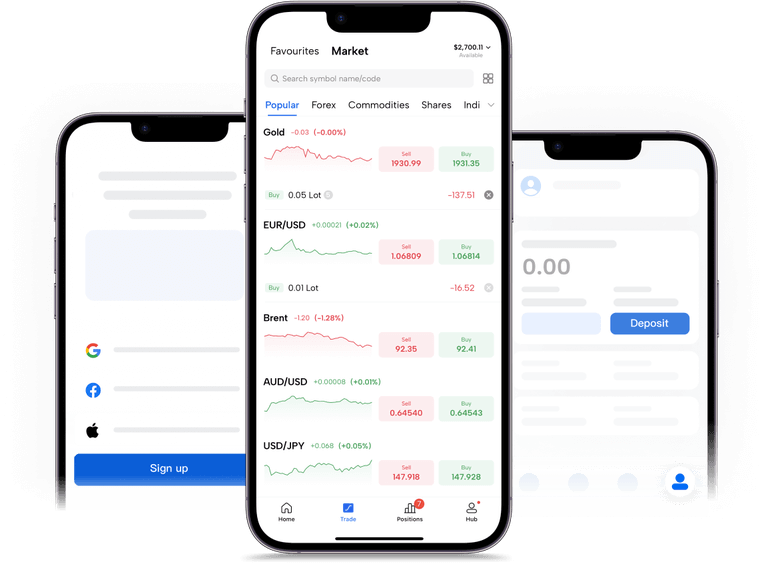
Mobile accessibility, enabling traders to monitor positions away from a desktop environment
Integrated market tools, such as economic calendars and price alerts
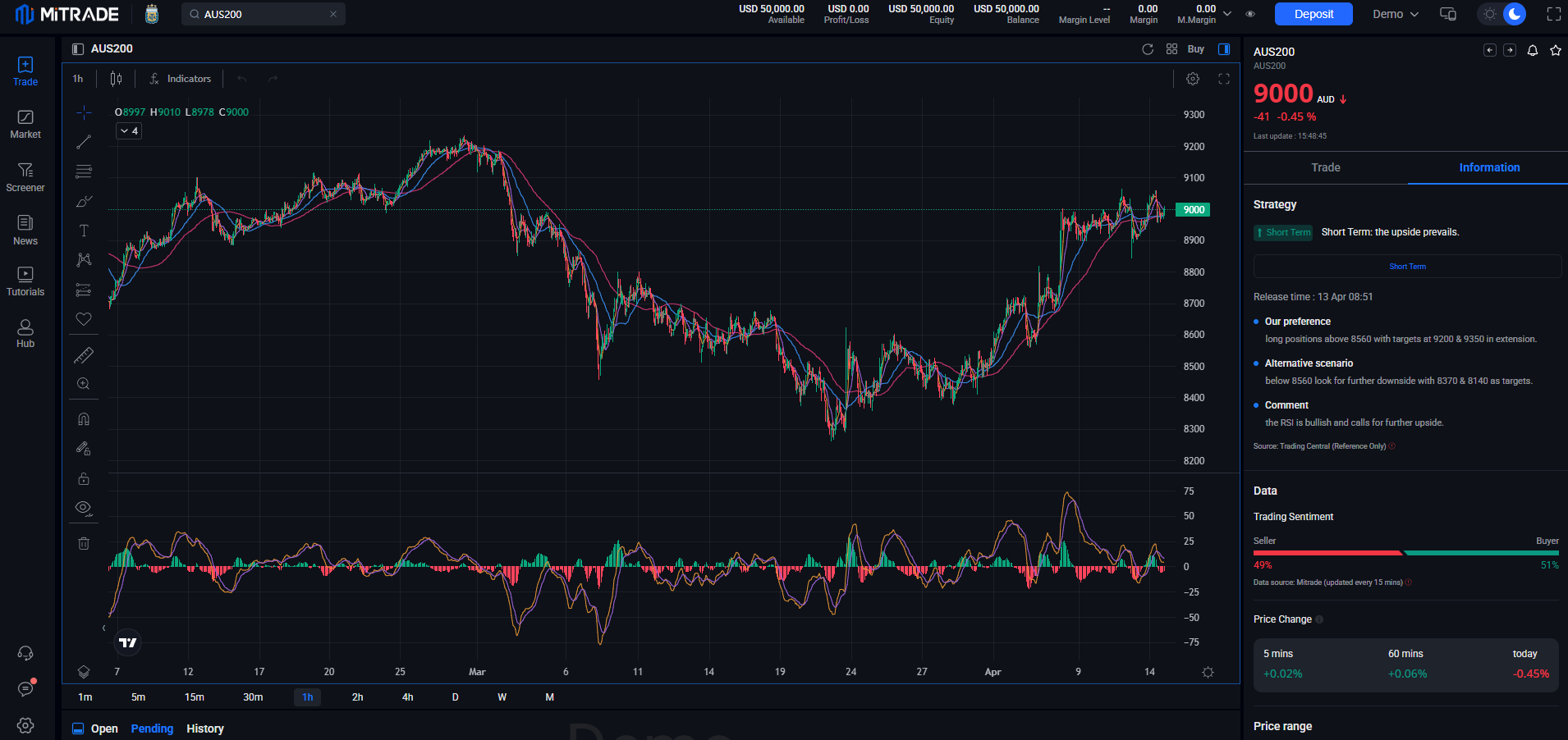
Mitrade provides these tools within a streamlined web and mobile platform, operating under ASIC regulation with client funds held in segregated trust accounts. While trading costs are incorporated into spreads rather than charged as separate commissions.
Ultimately, these features support efficient execution, particularly for traders managing multiple short-term positions during the Australian session.
Ready to put your strategies to the test? Open your account today and start trading the ASX 200 with confidence.


Bringing Structure to Day Trading the ASX 200
Day trading the ASX 200 offers Australian traders the advantage of operating within familiar market hours while responding to real-time economic and global developments. By focusing on broader market movement rather than individual companies, index trading provides a structured way to engage with short-term shifts in the Australian market.
Success in day trading rarely comes from reacting to every market move. It comes from understanding what drives volatility, consistently managing risk, and working within a defined routine. While short-term trading always carries risk, preparation and discipline often matter more than complexity.
With the right structure in place, day trading in Australia becomes less about reacting to noise and more about making measured decisions within repeatable conditions.
1. Is day trading the ASX 200 legal in Australia?
Yes. Day trading the ASX 200 through regulated CFD providers is legal in Australia. Traders should ensure their broker is regulated by the Australian Securities and Investments Commission (ASIC), which requires strict compliance standards, including client fund protection.
2. What time is best to trade the ASX 200 in Australia?
The most active trading periods typically occur during the first hour after the market opens (around 10:00 AM AEST/AEDT) and during major economic announcements. The final hour of trading can also produce increased volatility as positions are adjusted before market close.
3. How much capital is required to trade ASX 200 CFDs?
The capital required depends on the margin requirements set by the trading platform. Because CFDs use leverage, traders can open positions with smaller upfront capital compared with purchasing shares outright. However, leverage increases both potential gains and losses, making risk management essential.
4. Can beginners trade the ASX 200, or is it better suited to experienced traders?
The ASX 200 is often considered more manageable for beginners than individual stock trading because it reflects broad market movement rather than company-specific risk. However, day trading still requires discipline, risk management, and a clear routine. Many new traders begin by practising on demo accounts to understand how the index behaves before committing real capital.
Disclaimer: The content presented above, whether from a third party or not, is considered as general advice only. CFD trading involves significant risk of loss. Past performance does not guarantee future results. This article serves informational purposes only and does not constitute financial advice. Consider your risk tolerance before trading.


