




Forex Trading Australia: What It Is & How It Works (2026 Guide)

Forex trading pulls in trillions of dollars every single day. In Australia alone, the market averaged $201 billion in daily turnover in April 2025. This was a 34% jump from just three years prior. And retail traders are a growing slice of that.
For most beginners, though, the mechanics can feel unclear. What you're buying, how leverage works, and where to even start are all fair questions without obvious answers.
This guide walks you through all of it. You'll learn what forex trading is, how CFD trading works through platforms like Mitrade, what the real risks look like, and how to take your first steps as an Australian trader.
What Is Forex Trading? Major Currency Pairs Explained
So, what is forex trading?
Forex trading is the act of buying one currency and selling another at the same time. You're speculating on whether one currency will rise or fall against another, and the price difference is where your profit or loss comes from.
Currencies are always traded in pairs. Take AUD/USD as an example. The Australian dollar is the base currency and the US dollar is the quote currency.
If you believe the Australian dollar will strengthen against the US dollar, you buy AUD/USD. If the exchange rate moves in your favour, you close the trade at a profit. If it moves against you, you take a loss.
The most traded pairs in the world are known as the majors. They include:
EUR/USD: The euro against the US dollar, the most traded pair globally
USD/JPY: The US dollar against the Japanese yen, popular for its liquidity
GBP/USD: The British pound against the US dollar, known for its volatility
USD/CAD: The US dollar against the Canadian dollar, closely tied to oil prices
AUD/USD: The Australian dollar against the US dollar, the pair most relevant to Australian traders
USD/CHF: The US dollar against the Swiss franc, often seen as a safe-haven pair
The scale of this market is hard to overstate. For context, global forex turnover averaged $9.6 trillion per day in April 2025. And as we saw, Australia contributed $201 billion of that daily.
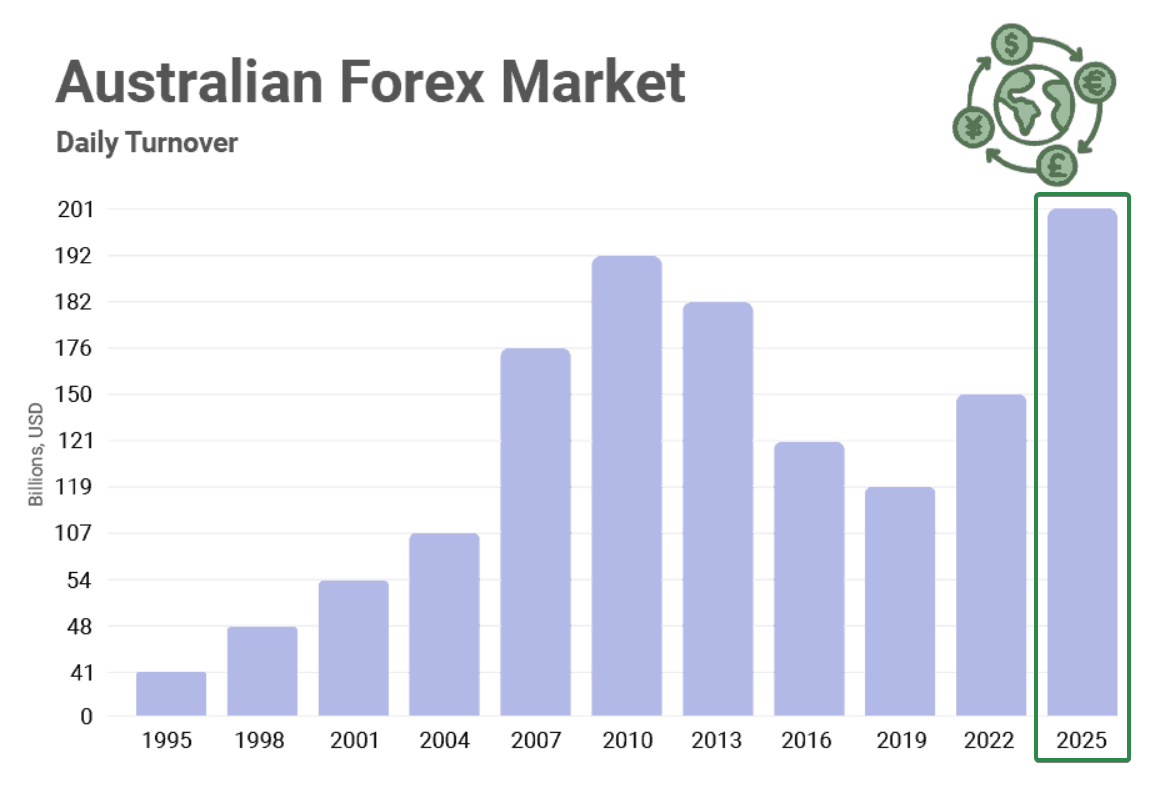
Image via Compare Forex Brokers
Also, the Australian dollar ranking 7th most traded globally at 6% of total forex turnover.
How Does Forex CFD Trading Work?
Understanding how forex trading works starts with knowing what a CFD is.
CFD stands for contract for difference. It's a contract between you and a broker where you agree to exchange the difference in an asset's price from when you open a trade to when you close it.
On platforms like Mitrade, you never own the underlying currency. You're simply taking a position on where its price is going.
Leverage is what makes CFD trading different from most other markets.
With 30:1 leverage (the maximum ASIC allows on major currency pairs), a $1,000 deposit gives you exposure to a $30,000 position. A 1% move in your favor returns $300 on that $1,000 outlay. But a 1% move against you costs $300 too.
To be clear, this is a hypothetical example, but it shows exactly how quickly leverage can work for or against you.
Additionally, here are the key terms worth knowing before you place your first trade:
Leverage: Borrowed exposure that lets you control a larger position with a smaller deposit
Margin: The deposit you put up to open a leveraged position
Pip: The smallest standard price movement in a currency pair, usually the fourth decimal place. EUR/USD moving from 1.0850 to 1.0851 is one pip.
Long: Buying a currency pair because you expect its price to rise
Short: Selling a currency pair because you expect its price to fall
To see how this plays out in practice, consider this hypothetical trade. You think AUD/USD will rise, so you open a long position at 0.6500. The price moves to 0.6550, a 50-pip gain. On a $10,000 position, that's a $50 profit.
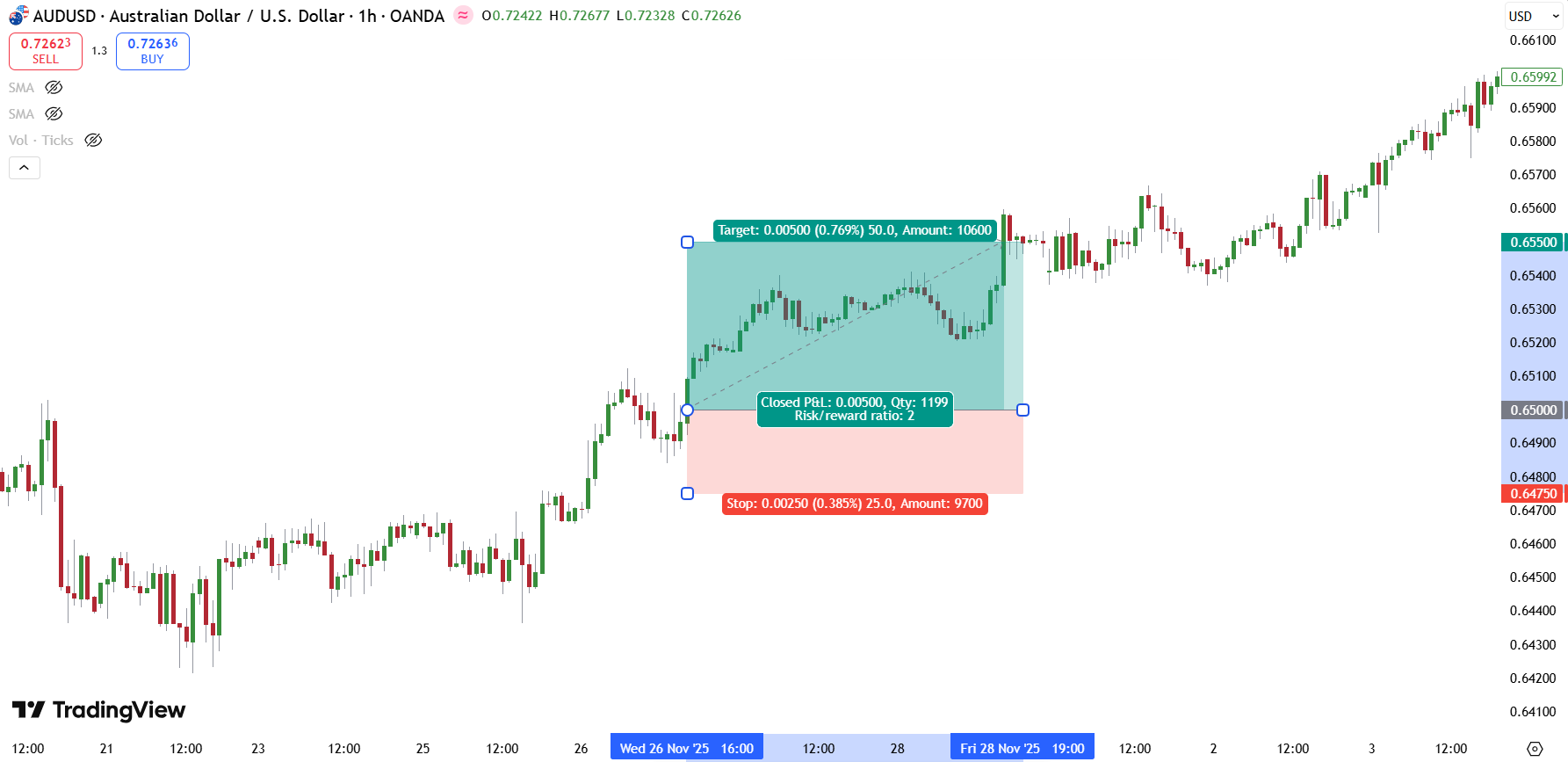
Image via TradingView: AUD/USD Hourly Chart
But if the price had dropped to 0.6450 instead, that's a $50 loss.
CFD trading gives you access to the forex market without needing large amounts of upfront capital. But your risk scales with your position size, not just your deposit.
“Trade Forex with an ASIC-regulated broker. Fast AUD funding via PayID. ”
Pros and Cons of Forex Trading
Like any financial market, forex trading has real advantages and real drawbacks. Here's an honest look at both.
Pros
24-hour market access: Forex runs five days a week, around the clock. Australian traders can trade during the Sydney session from 7am AEST, which overlaps with both Asian and later US trading hours.
Ability to go short: Unlike buying shares, CFD forex trading lets you profit from falling prices. If you think a currency will drop, you can act on that view.
Lower capital requirements: Leverage means you don't need large sums to get meaningful market exposure. A small deposit can open a position worth significantly more.
High liquidity: With trillions changing hands daily, major pairs like EUR/USD and AUD/USD execute quickly and with tight spreads.
Cons
Leverage amplifies losses: This is the most important risk to understand. ASIC, the Australian Securities and Investments Commission, requires brokers to disclose that 70-80% of retail CFD accounts lose money. Leverage is the main reason why.
Sudden volatility: Central bank decisions, economic data releases, and geopolitical events can move currency pairs by hundreds of pips in minutes.
Overnight financing costs: Holding a leveraged position overnight incurs a daily swap fee. These costs compound over time and can quietly erode profits on longer trades.
Emotional discipline: Many new traders close winning trades too early and hold losing ones too long. Managing your psychology is just as important as managing your position.
Forex CFD trading is a high-risk, high-access market. It rewards traders who have a clear plan, understand how leverage works, and treat risk management as non-negotiable.
Best Forex Trading Strategies for Beginners
No strategy works every time, but some are more beginner-friendly than others. These three are the forex trading strategies worth starting with.
Trend Following
The idea is to trade in the direction the market is already moving. If a currency pair is making higher highs and higher lows on a daily or 4-hour chart, the trend is up.
What you can do is wait for a slight pullback, then enter when the price resumes moving in the trend direction.
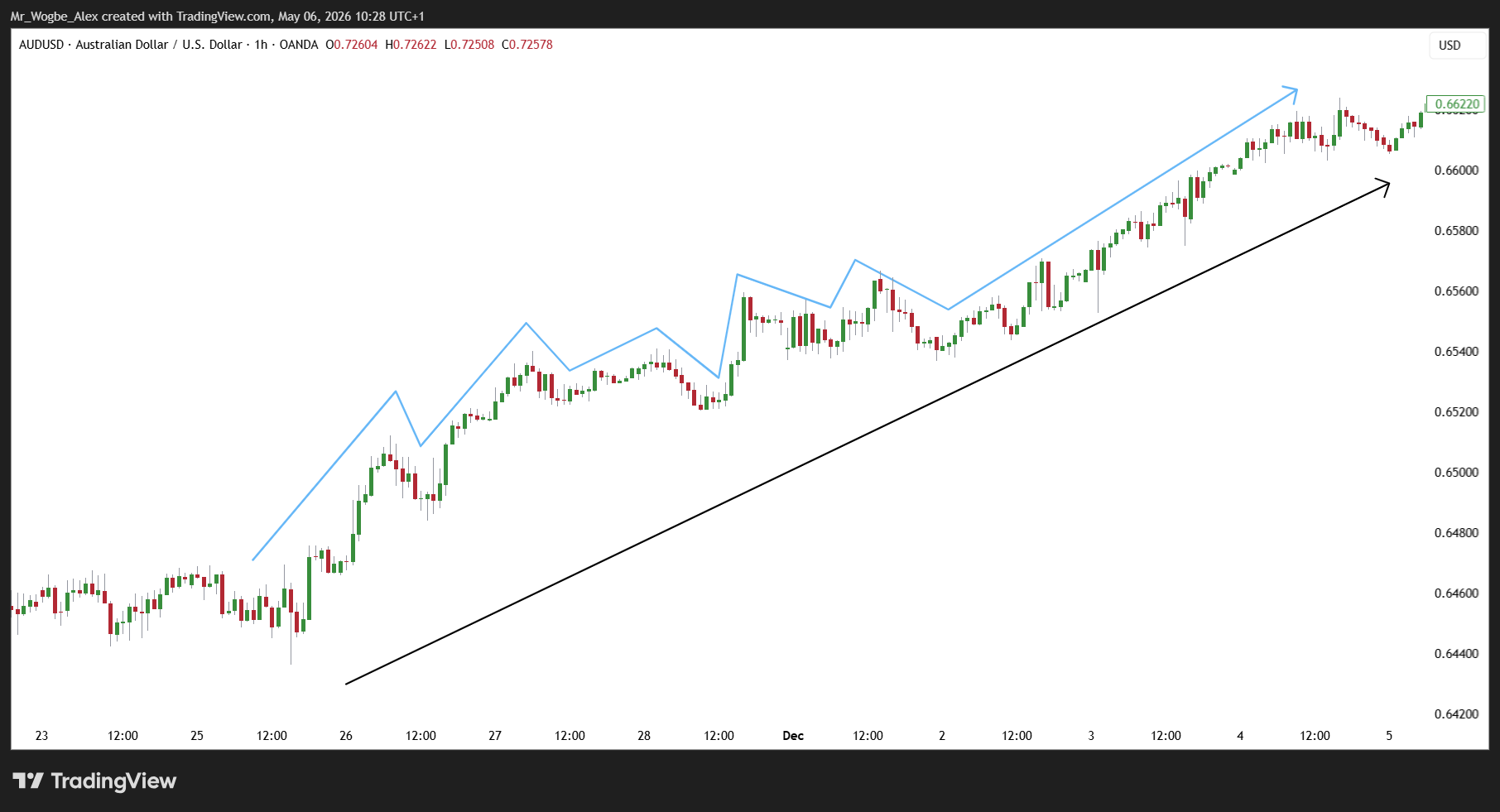
Image via TradingView: AUD/USD Hourly Chart
This suits beginners because it removes some of the guesswork. You're working with the market, not against it. This strategy won't catch every move, but it keeps you on the right side of momentum more often than not.
Range Trading
Range trading works when a currency pair moves between a clear ceiling (resistance) and a clear floor (support). The approach is to buy near the bottom of the range and sell near the top.
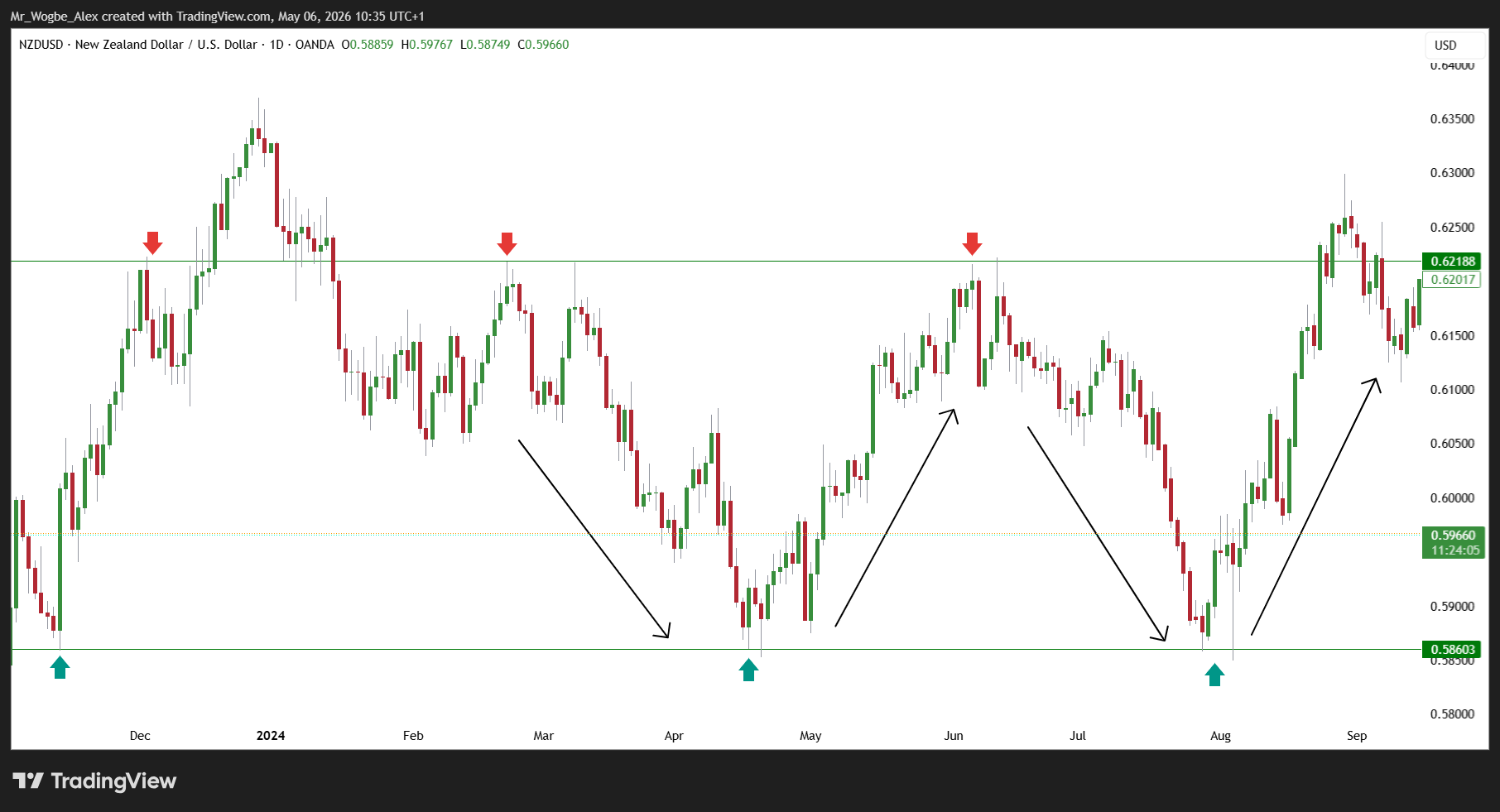
Image via TradingView: NZD/USD Hourly Chart
To time your entries, use the RSI (relative strength index) indicator, a tool that measures whether a pair is overbought or oversold. A reading above 70 suggests overbought conditions. Below 30 suggests oversold. These levels help you enter with more confidence within the range.
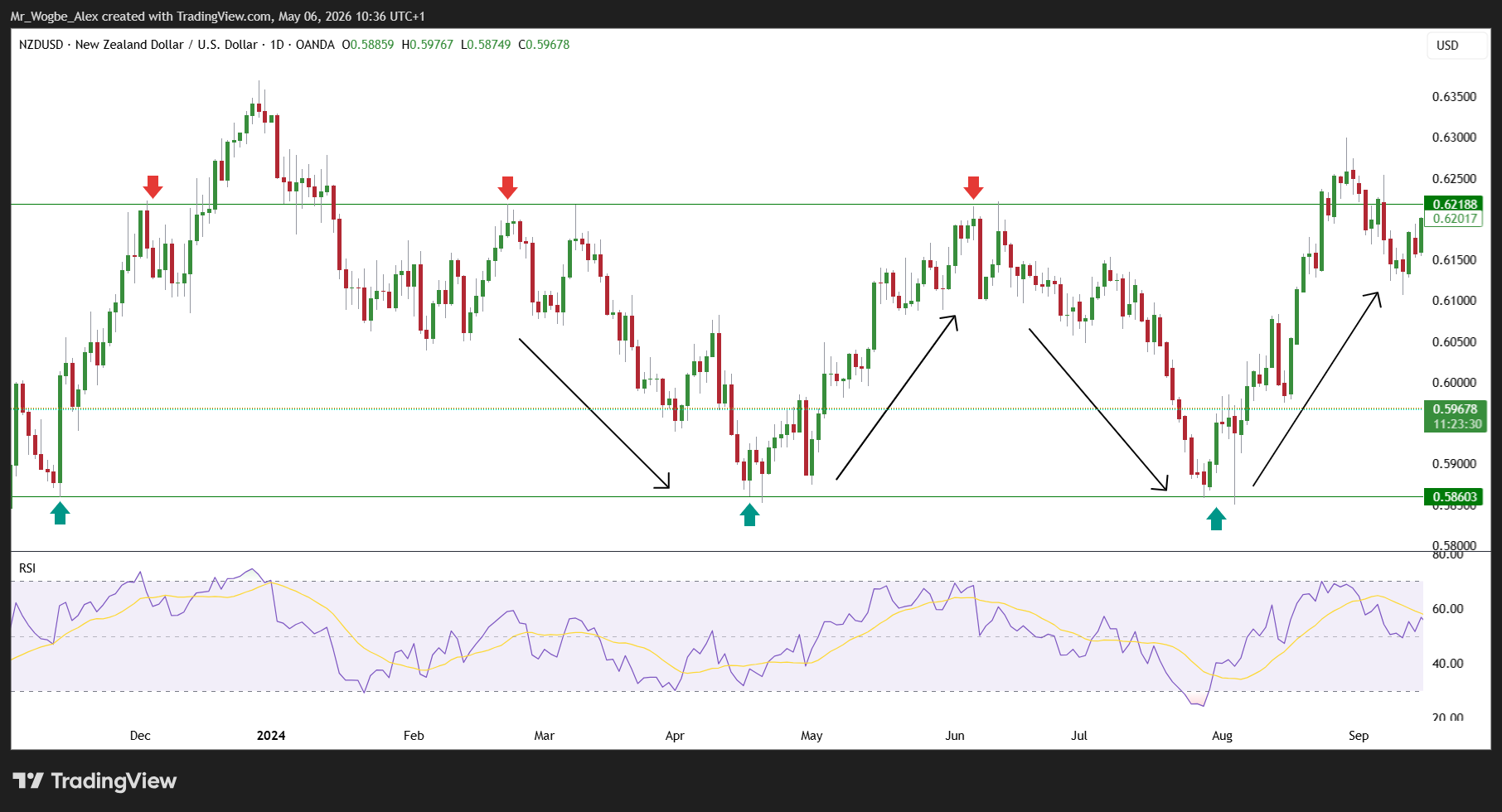
Image via TradingView: NZD/USD Hourly Chart
News Trading
Major economic announcements move currency markets fast. RBA interest rate decisions, US Non-Farm Payrolls, and CPI data releases can send pairs surging or dropping within seconds.
Check an economic calendar like Investing.com or Trading Economics at the start of each week so you know what's coming. If you're new to forex trading, be cautious about holding positions into high-impact events.
Moves can reverse sharply and without warning. Tight stop-losses are essential here.
Whichever strategy you start with, practise it on a demo account before putting real money on the line.
“Trade Forex with an ASIC-regulated broker. Fast AUD funding via PayID. ”
Why Do People Trade Forex CFDs?
Forex CFDs attract a wide range of people, from first-time traders to experienced investors. The reasons vary, but a few consistently stand out. These are:
Access to global markets from one account: Traders can access AUD/USD, EUR/USD, GBP/JPY and more from a single platform. There's no need for multiple brokerage accounts across different markets.
Trade in both directions: You can profit whether a currency rises or falls. This gives you more flexibility than traditional investing, where you only benefit from price increases.
Low barrier to entry: Many ASIC-regulated brokers allow you to open an account with a modest initial deposit. Fore example, Mitrade requires a minimum deposit of just $50, making it accessible for traders who are just starting out.
A market that never sleeps: For Australian traders, the Sydney session opens at 7am AEST and overlaps with both Asian and later US trading hours. You can fit trading around work or other commitments.
Hedging: Some traders and businesses use forex CFDs to offset currency risk elsewhere in their portfolio. If you hold international assets, a forex position can help balance your exposure.
How to Start Forex Trading in Australia
Getting started with forex trading in Australia is a lot more straightforward than you’d expect. But doing it right means understanding the rules of the market before you put any real money on the line.
Step 1: Understand the Regulatory Environment
In Australia, forex and CFD trading is regulated by ASIC, the Australian Securities and Investments Commission. Any broker offering CFDs to retail clients must hold an Australian Financial Services Licence (AFSL).
As a retail trader, you're entitled to key protections, including:
Leverage capped at 30:1 on major currency pairs
Negative balance protection
Mandatory margin close-out at 50% of required margin
Step 2: Choose an ASIC-Regulated Broker
Look for a broker that holds a current AFSL and keeps client funds in segregated accounts. The broker should also be a member of the AFCA (Australian Financial Complaints Authority), which gives you access to free, independent dispute resolution.
Mitrade is an ASIC-regulated broker that meets these requirements and offers access to a wide range of forex CFD markets.
Step 3: Open a Demo Account First
Before risking real money, open a demo account. It lets you practice with virtual funds, test your strategies, and get comfortable with how the platform works. Most brokers, including Mitrade, offer demo accounts with no time pressure to go live.
Step 4: Start Small With Real Funds
Once you're comfortable on the demo, start with a small deposit. Risk no more than 1-2% of your account on any single trade, and have a clear trading plan before you open any live position.
Trading is a skill that takes time to develop. Starting slow, keeping your risk tight, and learning consistently are what separate traders who last from those who don't.


1. What is forex trading?
Forex trading is the act of buying one currency and selling another at the same time. You're speculating on whether one currency will rise or fall in value against another. The difference in price between when you open and close your trade determines your profit or loss.
2. How does forex trading work for beginners?
Most beginners access the forex market through a CFD broker. You pick a currency pair, decide whether you think it'll go up or down, and open a position. You set a stop-loss to limit your downside and close the trade when the price hits your target.
3. Is forex trading legal in Australia?
Yes. Forex trading is legal in Australia and regulated by ASIC. Any broker offering forex CFDs to retail clients must hold an AFSL. Retail traders also benefit from leverage caps and negative balance protection.
4. Can you trade forex in Australia with a small amount?
Yes. Many ASIC-regulated brokers have low minimum deposit requirements. Mitrade, for example, allows you to get started with as little as $50. That said, keep your position sizes small while you're still learning.
Disclaimer: The content presented above, whether from a third party or not, is considered as general advice only. CFD trading involves significant risk of loss. Past performance does not guarantee future results. This article serves informational purposes only and does not constitute financial advice. Consider your risk tolerance before trading.


