




What Is the Dow Jones Industrial Average (DJIA)? How to Trade It in Australia

Across the financial markets, everyone seems to be talking about “the Dow.” Even financial news platforms aren’t left behind. If you’ve spent any time around them, you’ve likely heard the saying, “the Dow is up” or “the Dow dropped by 100 points.”
However, like everything related to investing, knowledge isn’t automatic, so not everyone understands these expressions. If you are a beginner investor or someone who’s yet to grasp what “the Dow” means, this guide is for you. We’ll be answering the question: what is the Dow Jones Industrial Average (DJIA), and how to trade Dow Jones in Australia. Let’s get into it.
What Is the Dow Jones?
The Dow Jones Industrial Average (DJIA) is a stock market index that tracks 30 large, publicly traded US companies. While it is deeply connected with the US, the Dow Jones is one of the most quoted financial indicators in the world.
The Dow index was designed to reflect the health of major American businesses on the stock market. It was originally designed to track blue-chip companies like Apple, Microsoft, JPMorgan Chase, Coca-Cola, Goldman Sachs, etc. These are not early-stage startups but established, globally recognised firms with long operating histories and strong balance sheets. They influence global supply chains, consumer behaviour, and policy discussions.
The idea was for the Dow Jones to sit at the centre of the global economy. Over time, its scope expanded, and it is now considered a “quick view” of the overall market sentiment. That’s part of what gives the Dow its weight compared to the S&P 500, which tracks the top 500 companies in the US.
What happens to the Dow often influences how the global markets open. In Australia, it can even impact movements in the ASX 200. So, despite being an old metric to evaluate the financial markets since 1896, the Dow Jones still works as a signal today, and the global capital markets continue to respect it.
How Does Dow Jones Work?
When speaking of the Dow, one aspect that is often overlooked is how the index is calculated. Unlike more modern indices, the DJIA is price-weighted. That means a company with a higher share price has more influence on the index’s movement, regardless of its market capitalisation.
Because the Dow is price-weighted, a small number of high-priced stocks can have a significant impact on the index. For example, a company’s stock trading at $400 per share will have more impact than one trading at $50, even if the $50 company has a bigger market value from its capitalisation.
When those small-company stocks move, the index tends to respond more sharply. This creates short periods of volatility that the Dow Jones is known for.
Other Factors Influencing the Dow Jones
1. US Economic Data
Unlike individual stocks, which can move based on internal company events, the Dow responds to broader forces, especially US economic data. The Dow Jones’ price movement reacts to reports on inflation, employment, and growth, which shape its market direction and expectations across financial markets.
For instance, if the US Bureau of Labour Statistics gives a stronger job report than anticipated, investors may read it as a sign of economic resilience, and it’ll push the Dow higher.
2. Interest Rates
On the other hand, rising inflation or increased interest rates from the Federal Reserve (Fed) can trigger concerns and lead to a decline in the Dow Jones price.
That’s because when interest rates rise, borrowing becomes more expensive, which can slow business activity and reduce stock valuations. When rates fall, liquidity increases, often supporting higher asset prices.
3. Corporate Earnings
Corporate earnings also play a role, particularly given the structure of the index. Since the DJIA includes just 30 companies, strong or weak performance from a few major components can shift the entire index.
4. Global Events
And then there are external shocks like geopolitical events, energy price movements, and global conflicts. These are harder to predict, but their impact can be immediate and significant on the DJIA price. For traders, all of this means the Dow is not a static index. It’s constantly reacting, adjusting, and repricing based on new information.
“Trade Indices with an ASIC-regulated broker. Fast AUD funding via PayID. ”
Why Trade the Dow Jones?
Since the DJIA is a US index focusing on the country’s top 30 companies, you may wonder why trading it in Australia makes sense. In practice, it doesn’t matter only to US traders and investors. The Dow plays a role in shaping global market direction, and Australia is part of the global economy.
The Australian markets typically react to overnight US market performance. If the Dow rallies strongly, the ASX often opens higher the next morning. If it drops, a low opening happens in Australia, as the sentiment tends to spread across. This shows how interconnected capital flows and investor psychology are from the nights in the US to the mornings in Australia.
For traders, that connection creates an opportunity. These include:
Exposure to the US economy, which is the largest globally. You can capitalise on the price performance of US companies on the stock market that you may not directly have access to in Australia. The Dow also gives you insight into their strengths to make informed decisions.
Diversification across underrepresented sectors in Australia. The Australian market doesn’t always offer diversification across some sectors locally, as the ASX leans heavily toward mining and financials. However, the Dow includes a broader mix of firms across industrials, technology, healthcare and consumer goods.
Liquidity is another advantage. Since the DJIA is one of the most actively traded indices in the world, it offers fast execution and efficient order matching when trading. That level of activity also results in tighter spreads and consistent price movement that prevents slippage. These factors are important to active traders.
In short, the Dow isn’t exactly outside your market because of its American roots. Instead, it has the power to move yours, and you can capitalise on these movements.
How to Trade the DJIA in Australia
You can’t buy the Dow Jones Industrial Average directly in Australia since it’s not listed on the ASX. It’s also a benchmark index, not a stock. Still, Australian traders can gain exposure to its movements, based on their goals and experience levels.
Trade the Dow Jones Using CFDs
The most common way to trade the Dow Jones in Australia is through Contracts for Difference (CFDs). CFDs allow you to trade on the price movement of the index without owning the shares of the companies the index reports directly. This means you can take positions in both directions and buy if you expect the Dow to increase in price or sell if you anticipate a market downturn.
Buy and Sell Through ETFs
Another option is through exchange-traded funds (ETFs), such as the SPDR Dow Jones Industrial Average ETF Trust. These are designed to track the performance of the Dow and are typically used by longer-term investors rather than active traders.
Purchase Through Futures
Futures contracts are also available, though they tend to be more complex and are generally used by institutional or highly experienced traders.
For most Aussie traders, CFDs are the most accessible way to trade the Dow due to their flexibility and relatively low capital requirements
“Trade Indices with an ASIC-regulated broker. Fast AUD funding via PayID. ”
How to Trade the Dow Jones
Trading the Dow is straightforward using CFDs. However, it requires structure. The first step is choosing a platform that offers access to global indices. Most platforms list the Dow as “US30” or simply “Wall Street.”
Beyond access, execution quality matters, particularly speed and pricing, since the index can move quickly during active periods. Once your account is set up and verified, the next step is analysis. Some traders use technical indicators, such as trend lines, moving averages, support and resistance levels to guide their entries and exits. Others focus more on macroeconomic news and market sentiment. Using both offers better outcomes.
When placing a trade, the key decisions revolve around direction, position size, and risk management. This is where discipline is crucial. Setting a stop-loss is not optional but a basic requirement for managing risk. After you enter a position, monitor market shifts and adjust your positions quickly. Knowing when to exit, whether in profit or loss.
A Step-by-Step Guide on How to Trade Dow Jones in Australia
In Australia, Mitrade is the best platform to trade the DJIA due to its low fees, fast execution speed, asset flexibility, and high leverage. Here’s how to trade the Dow Jones index CFD on Mitrade:
Sign up on Mitrade and verify your identity
Fund your account using available payment methods.
Search for US30 (the Dow Jones index) on the platform.
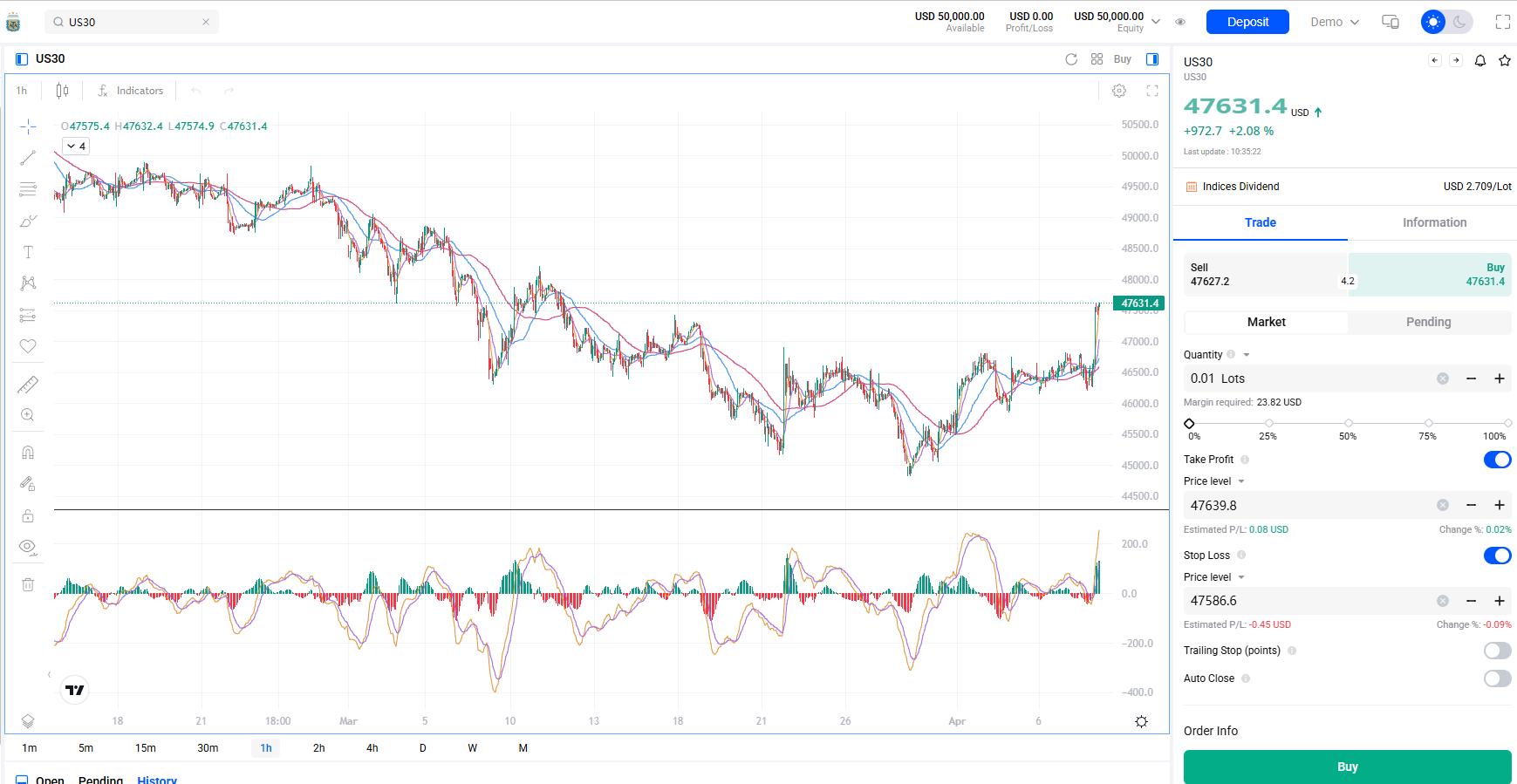
Use charts, indicators, and news to analyse the market.
Open a short or long trade, set position size, and apply risk controls.
Track your trade and close when you hit your target.

Trade Indices with Flexible CFDs
Trade indices and commodity CFDs to respond to AUD swings and global market shifts with greater precision.
* CFDs are complex instruments and come with a high risk of losing money.


Dow Jones vs S&P 500
The Dow is often compared with the S&P 500 because they do the same thing on the surface. However, while both indices gauge the US market, they are different in usage.
In terms of scale, the Dow tracks 30 top US companies, while the S&P 500 tracks 500 firms. That alone makes the S&P a broader representation of the market. Beyond the number of entities they track, the Dow’s price-weighted structure makes it more sensitive to movements in individual stocks, particularly those with higher share prices. This can lead to higher volatility compared to the S&P 500, which is market-cap weighted.
Since the S&P 500 spreads across a larger number of companies, it experiences smoother and more stable trends. For traders, the choice between the two depends on your preference and risk appetite.
The Dow usually reacts quickly to news and external factors, making it more ideal for short-term strategies. The S&P 500 provides a more balanced view of the market, making it relatively less volatile and more ideal for longer-term investing. However, you can also combine both for a more balanced context.
Risks of Trading the Dow Jones
Like every other financial asset, the Dow Jones comes with volatility risks. The value can change sharply, particularly around major economic announcements. While this creates opportunity for gains, it also increases the potential for loss.
Leverage adds another layer of complexity. While platforms like Mitrade offer up to 200:1 leverage for index CFDs to increase traders’ potential gains, the margin can equally magnify losses in a CFD market where positions are often leveraged by default.
There’s also the issue of overnight exposure. Holding positions while markets are closed, or during periods of low liquidity, can lead to price gaps and additional fees when trading resumes.
Emotional trading is another risk. When trading index CFDs, factors like emotional decision-making, overtrading, and lack of discipline are common pitfalls with a real impact on your trading outcomes.
Overall, the Dow is accessible and can be easily traded on CFD platforms like Mitrade, but it requires solid structure and good risk management.
Final Thoughts
The Dow Jones Industrial Average (DJIA) remains one of the most relevant market indicators for traders navigating the capital markets. For Australian traders, this is a valuable index that spans beyond the US market evaluation. It offers a way to access the global economy, trade in high-liquidity markets, and invest in some of the most widely followed economic signals worldwide.
However, while Dow Jones trading has its perks, a strict balance between risk and reward is essential, especially when using leverage on an index CFD trading platform like Mitrade.
1. Is the Dow Jones available to trade in Australia?
While you can’t directly trade the Dow Jones on the ASX, many trading platforms, including Mitrade, offer it as the US30 CFD index. You can also trade it via ETFs on supported platforms in Australia.
2. Can beginners trade the DJIA?
Yes, beginners can trade the Dow Jones. However, it requires a good structure and strong risk management due to its volatility.
3. Do I need a lot of money to trade the Dow Jones?
No. With a minimum deposit of USD 100, you can start trading index CFDs like the DJIA on Mitrade and many other platforms in Australia.
Disclaimer: The content presented above, whether from a third party or not, is considered as general advice only. CFD trading involves significant risk of loss. Past performance does not guarantee future results. This article serves informational purposes only and does not constitute financial advice. Consider your risk tolerance before trading.


