




Index Trading Hours in Australian Time: When to Trade NAS100, US30, GER40, JPN225 and More

Australians can trade the world's biggest stock indices from home, but almost none of them follow Sydney's clock. The NAS100 moves most while Australia sleeps, while the Nikkei moves during the Australian working day.
Knowing the index trading hours in Australian time helps you pick a market that fits your day. It also shows you when spreads, volatility and overnight costs change.
This guide lists the trading hours for eight major index CFDs in Sydney time. It also shows when each one is busiest and how daylight saving moves the times.
What Are Index Trading Hours?
Index trading hours are the times when you can open and close CFD positions on a stock index, which are often much longer than the opening hours of the stock exchange behind it.
A share market such as the New York Stock Exchange runs for six and a half hours a day. An index CFD that tracks it can trade for almost 23 hours.
That is because index CFDs are usually priced from futures markets, which trade around the clock on weekdays. So you can trade the Dow in the Australian afternoon, even though New York is asleep.
The catch is that liquidity is not even across those hours. Most of the real movement happens when the home exchange is open.
Index Trading Hours in Australian Time at a Glance
On the platform, all of these index CFDs trade almost around the clock. Most run from 10am to 9am the next day Sydney time, with a one hour break from 9am to 10am.
AUS200 is the exception, trading from 10am to 8am the next day. What really differs is when each index's home market is open, because that is when most of the movement happens.
All times are Sydney time from November to mid March. During daylight saving, Brisbane is one hour behind Sydney, Adelaide is 30 minutes behind and Perth is three hours behind. The daylight saving section below shows how the times change during the rest of the year.
Friday sessions can end earlier. At the time of writing, the Friday sessions for GER40, UK100 and EU50 were set to close at 8am on Saturday Sydney time.
How to check the hours yourself
Every index on the platform shows its own trading session. Open the market, choose the Information tab and scroll to Trading Session.
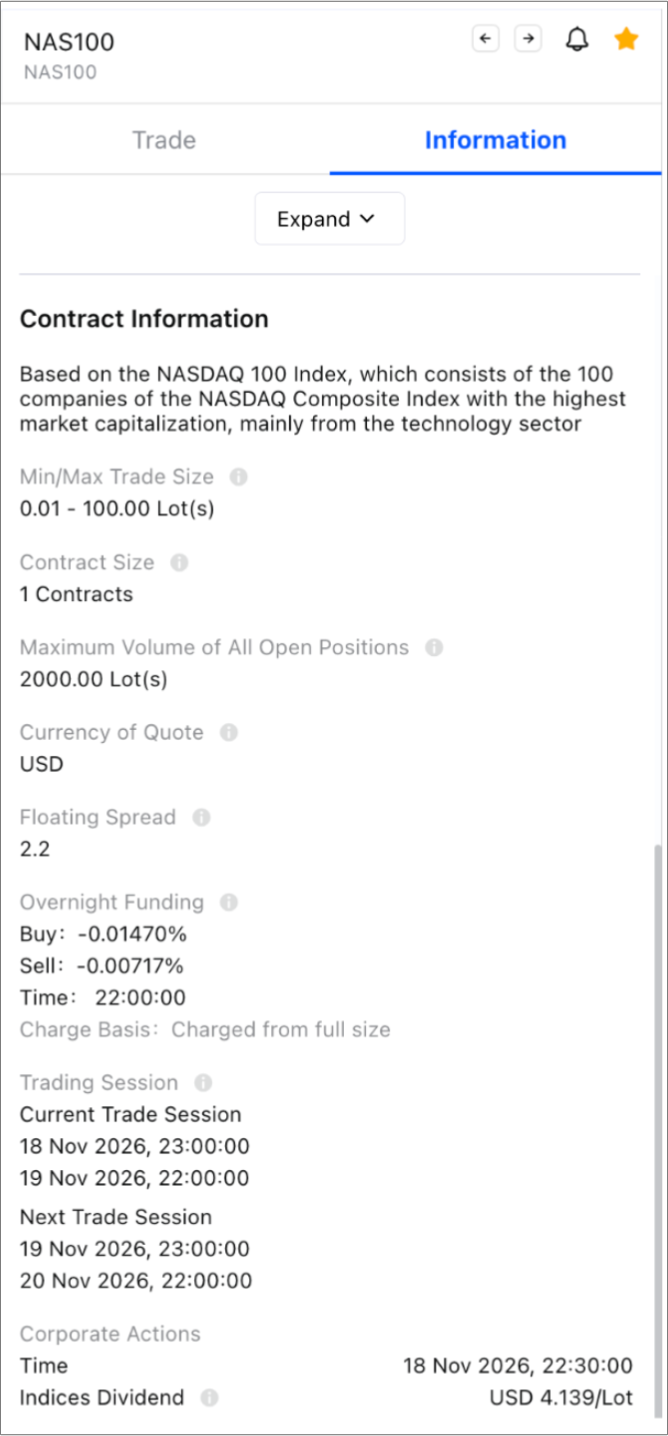
Image: Mitrade (NAS100 Contract Information)
The platform shows the current and next session in your device's local time. The screenshot above was taken on a device set to UK time, so the 23:00 and 22:00 shown there are 10am and 9am in Sydney.
If your device is set to Sydney time, the hours appear in Australian time automatically. The same panel lists the spread, the overnight funding rates and any upcoming index dividend adjustment.
The Three Sessions That Move Indices From Australia
An index CFD may trade almost all day, but three moments drive most of the action. Each one is the opening of a major share market.
The Asia open. The Tokyo Stock Exchange opens at 9am Japan time, which is 11am in Sydney during daylight saving. The ASX opens an hour earlier at 10am.
The Europe open. London and Frankfurt open at 7pm Sydney time from November to mid March. That is when GER40, UK100 and EU50 wake up.
The US open. New York opens at 1:30am Sydney time from November to mid March. That is usually the busiest hour of the day for NAS100, US30 and US500.
The chart below shows NAS100 on a 30 minute chart in Sydney time across 18 and 19 November.
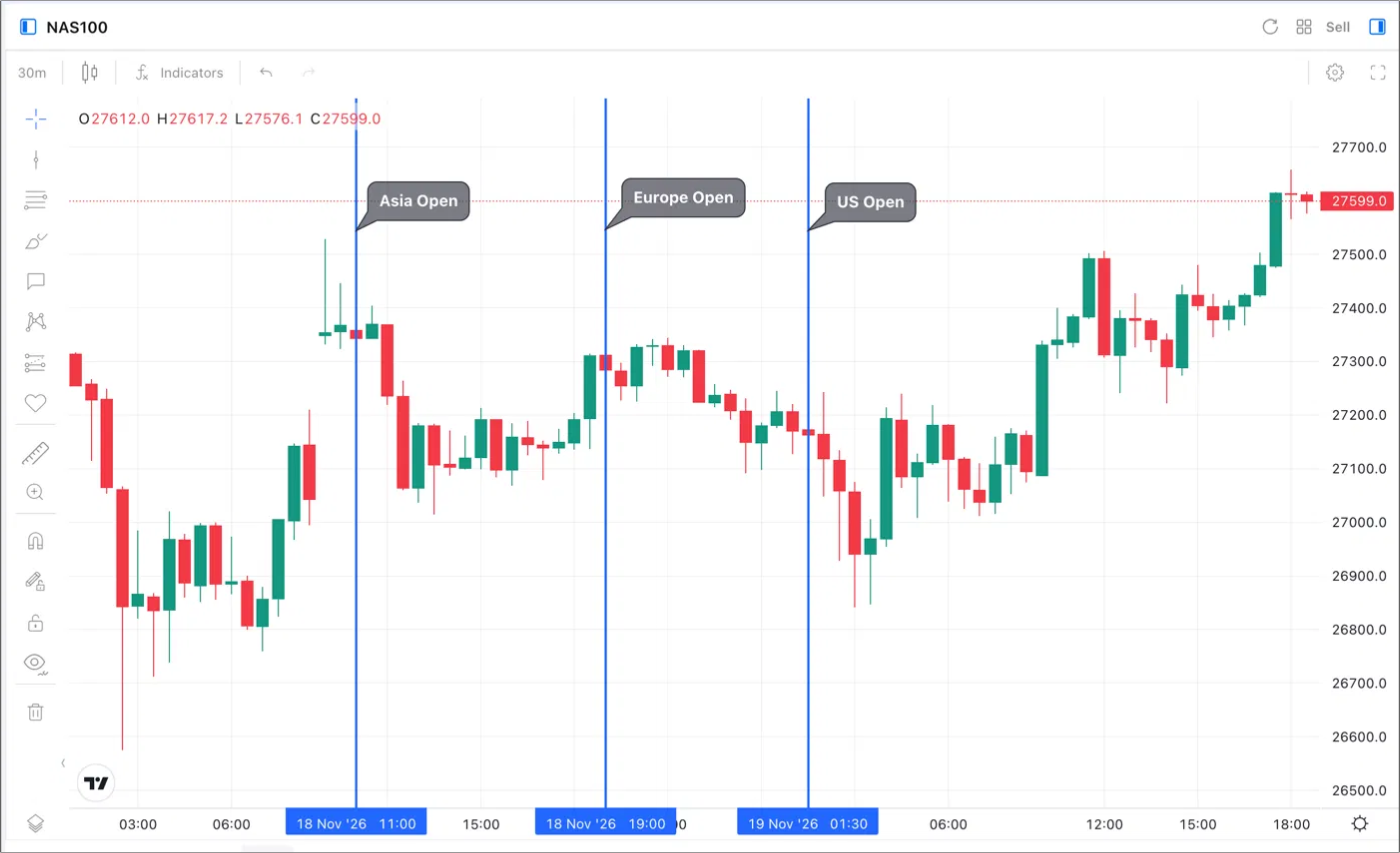
Image: Mitrade (NAS100 30 Minute Chart, Sydney Time)
After the Asia open at 11am, NAS100 slid from about 27,370 to about 27,010 within two hours. The Europe open at 7pm brought a quieter drift lower.
The US open at 1:30am produced the sharpest swing. The index dropped from about 27,170 to about 26,840, then rebounded above 27,200 within roughly two hours.
That pattern is common. The home market's open brings fresh orders, news and economic data, so prices move faster.
“Trade Nas100 CFDs with an ASIC-regulated broker. Fast AUD funding via PayID. ”
US Index Trading Hours in Australian Time
The three US indices share the same hours on the platform. They trade from 10am to 9am the next day Sydney time, with a one hour break from 9am.
NAS100
The NAS100 tracks the 100 largest non financial companies on the Nasdaq, led by big technology names. A separate Nasdaq guide explains the index itself.
Its main session follows US stock market hours. On the New York Stock Exchange, the core session runs from 9:30am to 4pm Eastern Time. In Sydney, that is 1:30am to 8am from November to mid March.
The busiest window is usually the first hour after 1:30am. US economic data released before the open can also move it at 12:30am Sydney time.
US30
The US30 tracks the Dow Jones Industrial Average, made up of 30 large US companies. The Dow guide covers how the index works.
It follows the same New York session as NAS100. It tends to move a little less in percentage terms, because it holds fewer high growth technology shares.
US500
The US500 tracks the S&P 500, the broadest of the three. It trades the same hours and reacts to the same US data and earnings.
For Australians, the US indices suit night owls and early risers. The final two hours of the US session fall between 6am and 8am Sydney time, before most people start work.
Asian Index Trading Hours in Australian Time
Asian indices are the easiest to trade during the Australian working day. Their home markets open while Sydney is at its desk.
JPN225
The JPN225 tracks the Nikkei 225, an index of 225 large Japanese companies. On the platform, it trades from 10am to 9am the next day Sydney time.
The Tokyo cash market runs from 9am to 3:30pm Japan time, with a lunch break in between. In Sydney, that is 11am to 5:30pm during daylight saving.
That makes the JPN225 the main index that moves during Australian business hours. It also reacts strongly to the Japanese yen and Bank of Japan decisions.
AUS200
The AUS200 tracks the S&P/ASX 200, Australia's benchmark index. On the platform, it trades from 10am to 8am the next day Sydney time.
The ASX itself runs normal trading from 10am to 4pm. Outside those hours, the AUS200 still moves overnight in response to Wall Street.
That overnight session is useful. If US shares fall sharply, Australian traders can react before the ASX opens the next morning.
European Index Trading Hours in Australian Time
European indices trade in the Australian evening. They suit traders who have finished work and want to trade before bed.
GER40
The GER40 tracks the DAX, an index of 40 major German companies. On the platform, it trades from 10am to 9am the next day Sydney time.
The Frankfurt exchange runs continuous trading from 9am to 5:30pm Central European Time. In Sydney, that is 7pm to 3:30am from November to mid March.
The first hour after 7pm is usually the busiest. European economic data and central bank news often land in this window.
UK100
The UK100 tracks the FTSE 100, an index of 100 large companies listed in London. It shares the same platform hours as GER40.
The London Stock Exchange main market runs from 8am to 4:30pm UK time. In Sydney, that is also 7pm to 3:30am from November to mid March.
EU50
The EU50 tracks the Euro Stoxx 50, made up of 50 leading Eurozone companies. It trades the same platform hours as GER40 and UK100, and tends to move with them.
How Daylight Saving Shifts Index Trading Hours
Daylight saving is the biggest source of confusion for Australians trading global indices. Australia, the US and Europe all change their clocks on different dates.
New South Wales, Victoria, the ACT, Tasmania and South Australia move their clocks forward in October and back in April. Queensland, Western Australia and the Northern Territory do not.
The US and Europe move their clocks forward in March and back in late October or early November. That means the gap between Sydney and New York changes during the year.
From November to mid March, the US open is at 1:30am Sydney time. In October and from mid March to early April, it is 12:30am, because Sydney and New York are both on daylight saving time.
In the Australian winter, when Sydney is on standard time and New York is on daylight time, the US open moves to 11:30pm. The European open moves from 7pm to 5pm, and for most of October and late March, it is 6pm.
Japan does not use daylight saving. So the Tokyo open moves from 11am in summer to 10am in winter, purely because Sydney's clocks change.
Check the platform after every clock change
Index CFD sessions on the platform can also shift when the US and Europe change their clocks. The safest habit is to check the Trading Session panel after every clock change.
Pay extra attention in March, early April, October and early November. Australia, the US and Europe change their clocks on different weekends, so for a few weeks each time the usual times can be an hour off.
Overnight Costs and Index Dividends
Holding an index CFD past the daily cut off adds an overnight funding charge. On every index in this guide, funding is applied at 9am Sydney time.
The rates vary by index and direction. On the platform at the time of writing, NAS100 buy positions paid 0.01470% per night, while sell positions paid 0.00717%.
On indices, funding is charged on the full position size. That differs from ETF CFDs such as QQQ, where the platform charges funding only on borrowed funds.
Index dividend adjustments
When companies in an index pay dividends, the platform applies an index dividend adjustment to open positions. These appear under Corporate Actions in the Information tab.
For example, the platform listed an adjustment of $4.139 per lot on NAS100 and $5.825 per lot on US30 in mid November. Check this panel before holding a position over an adjustment date.
“Trade Nas100 CFDs with an ASIC-regulated broker. Fast AUD funding via PayID. ”
Leverage on Index CFDs in Australia
ASIC caps retail leverage on major stock indices at 20:1. That means you put up at least 5% of the position value as margin.
Leverage matters more around market opens. A fast swing at 1:30am can hit a stop before you wake, so size every trade from the stop, not from the margin available.
Which Index Suits Your Schedule?
The best index to trade is often the one that moves while you are awake and focused. Here is a simple guide.
Daytime traders: JPN225 and AUS200 move during Australian business hours.
Evening traders: GER40, UK100 and EU50 open at 7pm Sydney time from November to mid March.
Night owls and early risers: NAS100, US30 and US500 move most between 1:30am and 8am.
Traders who cannot watch overnight: use pending orders with a stop loss and take profit already attached.
Many Australians trade one Asian or European index in the evening and leave US trades to pending orders. That keeps the busiest US hours covered without losing sleep.
Common Mistakes With Index Trading Hours
Forgetting the daily break. The market is closed between 9am and 10am Sydney time, or from 8am to 10am on AUS200, so trades cannot be opened or closed.
Ignoring daylight saving. The US open can shift by two hours across the year.
Trading quiet hours by habit. Spreads and moves often differ outside the home market's session.
Holding through the funding cut off unknowingly. Funding applies at 9am Sydney time every trading day.
Missing Friday's early close. European indices can stop an hour earlier on Fridays, so check the session first.
Index Trading Hours: FAQs
What time does the NAS100 open in Australia?
On the platform, the NAS100 trading day starts at 10am Sydney time and runs until 9am the next day. Its busiest period usually begins at the US open, 1:30am Sydney time from November to mid March.
Can I trade the Dow Jones during the Australian day?
Yes. The US30 trades through the Australian day on the platform, although moves are usually smaller until New York opens.
Which index trades during Australian business hours?
The JPN225 and AUS200 are the most active during the Australian working day. Tokyo opens at 11am Sydney time during daylight saving.
What time does the DAX open in Australian time?
The Frankfurt exchange opens at 7pm Sydney time from November to mid March. The GER40 CFD trades for much longer, from 10am to 9am the next day.
Do index trading hours change with daylight saving?
Yes. Australia, the US and Europe change clocks on different dates, so the Sydney times for each open can move by one or two hours.
Where can I check index trading hours on Mitrade?
Open any index on the Mitrade platform, select the Information tab and scroll to Trading Session. It shows the current and next session in your device's local time.

 Enjoy simple and fast trading Flexible leverage options available Follow real-time trading strategies Demo account with $50,000 virtual funds


You might be interested in…
Disclaimer: The content presented above, whether from a third party or not, is considered as general advice only. Trading OTC derivatives involves significant risk and may not be suitable for all investors. CFDs are leveraged products, and you may lose all the funds in your trading account. You do not own or have rights to the underlying assets. This content is general information and does not take into account your objectives, financial situation or needs. Consider the PDS, FSG, TMD and other relevant disclosure documents before deciding whether to trade, and seek independent advice where appropriate. Past performance and demo results are not reliable indicators of future performance.


