




Fed Rate Decision This Week: Will the US Dollar Strengthen and Gold Prices Fall? (26 October 2026)


Global financial markets are entering a crucial week as five major central banks prepare to announce their latest interest rate decisions. With the US Federal Reserve, European Central Bank (ECB), Bank of Japan (BoJ), Bank of Canada (BoC) and Reserve Bank of New Zealand (RBNZ) all in focus, investors are preparing for potential volatility across currencies, commodities and global stock markets.
The central question is whether the US dollar can regain momentum while gold prices remain under pressure.
On Monday, 26 October, the US Dollar Index (DXY) traded around 101.64 as falling Treasury yields weighed on the greenback. Meanwhile, spot gold rebounded above US$4,000 per ounce after suffering a sharp decline in the previous week.
For Australian investors, the outlook is particularly important. With AUD/USD trading around US$0.7030 and Australian inflation figures due this week, the interaction between Federal Reserve policy and Reserve Bank of Australia (RBA) expectations could create significant trading opportunities and risks.
Key Market Highlights: 26 October 2026
US Dollar Index (DXY): Around 101.64, reflecting a softer US dollar ahead of the Federal Reserve decision.
Gold price (XAU/USD): Around US$4,010 per ounce in early Monday trading, recovering modestly after a 4% weekly decline.
AUD/USD: Trading near 0.7030, with Australian inflation data and US monetary policy in focus.
US 10-year Treasury yield: Approximately 4.97%, hovering near a one-month low.
Brent crude oil: Around US$114–115 per barrel, easing from recent highs but remaining elevated.
Federal Reserve outlook: Markets largely expect rates to remain unchanged in October, while attention turns to the possibility of further tightening later this year.
Key upcoming events: Australian CPI, the Fed decision, US GDP, PCE inflation and several other major central bank announcements.
These developments suggest that inflation expectations, interest rate differentials and geopolitical uncertainty will remain the primary drivers of financial markets.
Super Central Bank Week: Why the Fed Decision Matters
The Federal Reserve is scheduled to announce its October interest rate decision on Wednesday, 28 October, US time, corresponding to early Thursday morning in Sydney.
While markets widely anticipate that the Fed will leave interest rates unchanged, investors will pay particular attention to the accompanying policy statement and Federal Reserve Chair's comments.
The key issue is not simply whether the Fed raises rates this week, but whether policymakers signal that further tightening may be necessary.
Could persistent inflation force the Fed to remain hawkish?
The Federal Reserve continues to face a difficult policy environment.
Elevated energy prices are contributing to inflation concerns, while volatility in technology stocks and signs of slowing economic activity raise questions about the resilience of the US economy.
Higher oil prices can increase transportation, manufacturing and consumer costs, potentially making inflation more persistent.
At the same time, weaker financial markets may tighten financial conditions and reduce the need for aggressive monetary policy intervention.
This creates two competing forces:
Scenario 1: The Fed maintains a hawkish stance
If policymakers emphasise persistent inflation risks and suggest additional rate increases remain possible, US Treasury yields could rebound.
A rise in yields may support the US dollar while placing renewed pressure on non-yielding assets such as gold.
Scenario 2: The Fed adopts a more cautious tone
If the Fed highlights slowing growth, financial market instability or concerns about employment, investors may reduce expectations for further tightening.
This could weaken the US dollar and provide support for gold prices.
Consequently, the tone of the Fed's communication may matter more than the immediate interest rate decision.
US Dollar Forecast: Can DXY Resume Its Uptrend?
The US dollar entered the final week of October under pressure as Treasury yields declined and investors reassessed the outlook for US monetary policy.
On 26 October, the Dollar Index traded near 101.64, while the benchmark US 10-year Treasury yield hovered around 4.97%.
Falling yields have narrowed the interest rate advantage previously supporting the greenback.
However, several factors could still help the dollar recover.
1. US inflation remains a significant risk
Persistent inflation could encourage the Federal Reserve to maintain restrictive monetary policy for longer.
If upcoming PCE inflation data exceed market expectations, Treasury yields may rise, potentially strengthening the dollar.
2. Geopolitical uncertainty may increase safe-haven demand
The Middle East remains a major source of uncertainty.
Although diplomatic efforts involving Qatar have raised hopes of easing tensions between the United States and Iran, continued attacks and threats to energy infrastructure suggest that supply risks have not disappeared.
Escalating geopolitical tensions can increase demand for the US dollar, particularly during periods of market stress.
Nevertheless, the dollar's reaction is not guaranteed. If geopolitical developments lead to weaker US growth expectations and falling Treasury yields, the greenback may struggle to strengthen.
3. Central bank policy divergence could influence currency markets
This week's monetary policy decisions may reshape interest rate expectations across major economies.
If the Fed remains hawkish while other central banks signal a more accommodative outlook, the dollar could benefit from widening interest rate differentials.
Conversely, relatively hawkish guidance from overseas central banks could limit dollar gains.
US Dollar Index Technical Analysis: Key DXY Levels
The US Dollar Index is consolidating around 101.6 after retreating from recent highs.
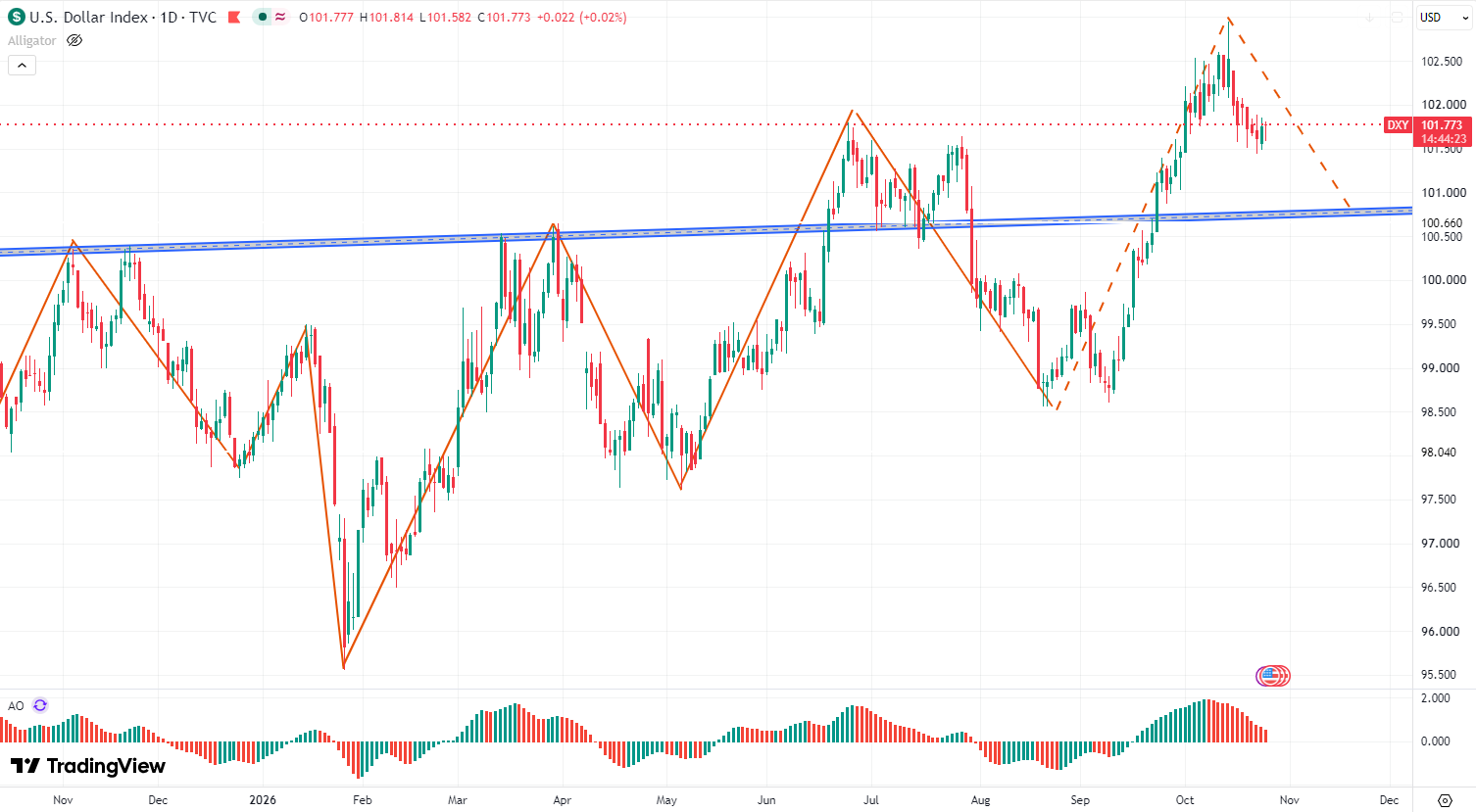
Source: Tradingview
The following levels provide a framework for monitoring potential price movements:
Bullish scenario: A sustained move above 102.00 could indicate improving upward momentum and potentially open the way towards 103.00.
Bearish scenario: A failure to regain 102.00, followed by a decline below 101.00, could expose the 100.60 region.
A sustained break below 100.60 would weaken the case for an immediate dollar recovery.
“Trade US Dollar Index with an ASIC-regulated broker. Fast AUD funding via PayID. ”
Gold Price Forecast: Will XAU/USD Fall Below US$4,000 Again?
Gold prices experienced substantial selling pressure last week, with bullion declining approximately 4%, its largest weekly fall since June.
The precious metal briefly fell to its lowest level since mid-July before recovering towards US$4,010 on Monday.
The rebound followed a decline in oil prices, which temporarily reduced concerns about inflation and aggressive Federal Reserve tightening.
However, gold's near-term outlook remains uncertain.
Why has gold been under pressure?
Three major factors are influencing the precious metal.
Higher-for-longer interest rate expectations
Gold does not generate interest income. When investors expect US interest rates to remain elevated, interest-bearing assets can become relatively more attractive.
US dollar movements
Gold is internationally priced in US dollars. A stronger dollar can make gold more expensive for investors using other currencies, potentially weighing on demand.
Geopolitical developments
Gold often benefits from safe-haven demand during periods of geopolitical uncertainty.
However, this relationship can be complicated when geopolitical tensions push oil prices higher and increase inflation expectations.
In such circumstances, expectations of tighter monetary policy may offset some of gold's traditional safe-haven appeal.
Gold Technical Outlook: Key XAU/USD Levels
With gold trading near US$4,010 on 26 October, the US$4,000 level remains an important psychological reference.
Bullish gold scenario
If gold holds above US$4,000 and US Treasury yields continue declining, buyers may attempt to push prices towards US$4,050 and potentially US$4,100.
A more dovish-than-expected Fed statement could support this scenario.
Bearish gold scenario
If US inflation remains elevated and the Fed signals that further interest rate increases are possible, gold may face renewed selling pressure.
A sustained decline below US$4,000 could bring US$3,950 and US$3,900 into focus.
Importantly, a temporary recovery does not necessarily confirm the end of the broader correction.
Traders should monitor price action around these levels and remain alert to volatility surrounding major economic announcements.
“Trade gold CFDs with an ASIC-regulated broker. Fast AUD funding via PayID. ”
AUD/USD Forecast: What Does the Fed Decision Mean for Australian Traders?
For Australian investors, the Fed decision is especially relevant because of its potential impact on the Australian dollar.
AUD/USD traded around 0.7030 on Monday, 26 October, as investors awaited important inflation data from both Australia and the United States.
The Australian dollar is influenced by several factors, including:
Interest rate expectations for the RBA and Federal Reserve.
Global risk sentiment and demand for commodity-linked currencies.
Australia's economic outlook and inflation trends.
US dollar movements and global bond yields.
Australian CPI could influence the RBA outlook
The Australian Bureau of Statistics is scheduled to release September CPI data on Wednesday, 28 October, at 11:30 am AEDT.
A stronger-than-expected inflation reading could increase expectations that the RBA will maintain restrictive monetary policy.
This may support the Australian dollar, particularly if the Fed adopts a more cautious stance.
Alternatively, weaker Australian inflation combined with a hawkish Fed could place downward pressure on AUD/USD.
AUD/USD: Key levels to watch
With AUD/USD near 0.7030, the 0.7000 psychological level is an important reference for short-term traders.
Bullish scenario: If AUD/USD holds above 0.7000 and the US dollar weakens, the pair could attempt to recover towards 0.7050 and 0.7100.
Bearish scenario: A sustained move below 0.7000 could shift attention towards 0.6950 and potentially 0.6900.
Australian traders should consider both the Fed decision and domestic inflation data before interpreting currency movements.
How to Follow Gold, Forex and Global Markets with Mitrade
Australian traders should consider both the Fed decision and domestic inflation data before interpreting currency movements.
Periods of significant economic uncertainty can create price movements across forex, precious metals, commodities and stock indices.
Mitrade provides access to CFD trading markets, allowing eligible traders to speculate on price movements without owning the underlying assets.
Depending on product availability and account eligibility, traders can explore markets such as gold, major forex pairs and global indices.
A CFD allows traders to take positions on rising or falling prices, but leverage can magnify both profits and losses.
Before trading around major announcements, consider the following:
Monitor live prices and economic announcements.
Review trading spreads and potential overnight funding costs.
Consider stop-loss orders, recognising that execution at the requested price is not guaranteed.
Use appropriate position sizing and avoid excessive leverage.
Understand the risks associated with market gaps and sudden volatility.
*CFDs are complex leveraged products and carry a high risk of losing money rapidly. Leverage magnifies both gains and losses, and trading is not suitable for every investor. Check the applicable product disclosure statement, fees and regulatory information before opening an account.


Disclaimer: The content presented above, whether from a third party or not, is considered as general advice only. CFD trading involves significant risk of loss. Past performance does not guarantee future results. This article serves informational purposes only and does not constitute financial advice. Consider your risk tolerance before trading.


